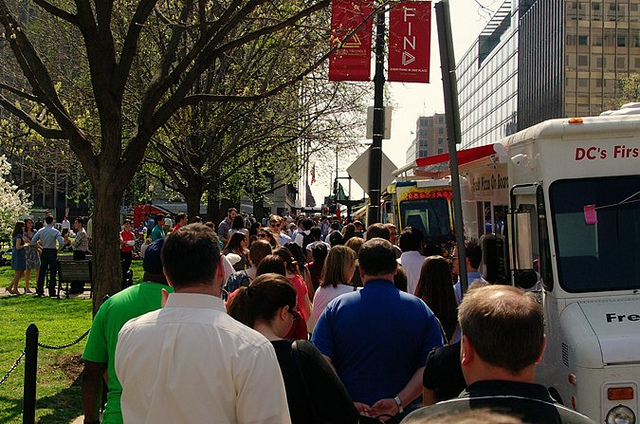
 Photo by philliefan99
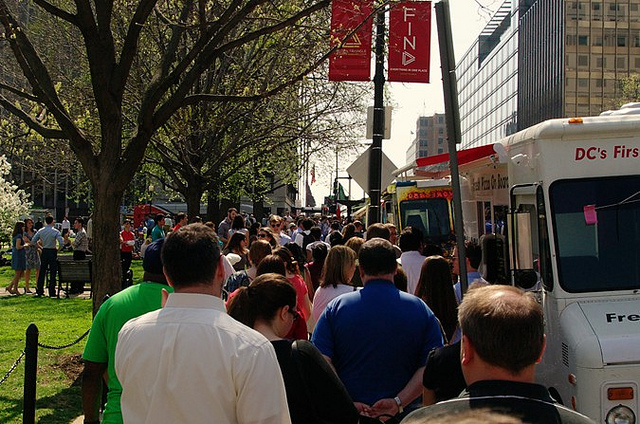
As expected, the D.C. Council’s Committee on Business, Regulatory, and Consumer Affairs gave its unanimous disapproval to the District government’s proposed regulations over food trucks. The vote, which itself is non-binding, sets the regulations up to be rejected next month by the full council, ensuring that a process that Councilmember Jim Graham (D-Ward 1) called “longest-running movie on the council” will tack on yet another act.
The District has been attempting to impose specific regulations, now on their fourth revision, on the city’s expanding food truck market since mid-2010. And while the most recent draft seemed to hold some promise, food truck operators pushed back over several stipulations.
Food truck operators are wary of language in the current draft that would designate up to two dozen “mobile vending zones” around the city’s busiest landmarks such as Farragut Square and Union Station and offering parking spaces in those locations through a monthly lottery. While city officials say there are more proposed parking spaces than food trucks in existence, the group representing food trucks has said it is not keen on having the government parcel out where they can set up shop. Additionally, the proposed regulations stipulate that trucks that don’t win a lottery spot keep at least 500 feet from the designated zones.
Mobile vendors also want to see the end of a rule requiring they position themselves next to sidewalks that are at least 10 feet wide.
The Council officially has until June 22 to approve, reject, or take no action at all on the regulations, and while the full Council’s vote is likely to reflect the committee tally taken today, Vincent Orange (D-At Large), who chairs the committee, wants to take a slightly different course. Orange said he plans to introduce emergency legislation that would empower the Council to tweak the regulations directly, which could help avoid returning them to the drawing board for a fifth draft.
That seems possible considering the Food Truck Association of Metropolitan Washington largely agrees with the regulations, at least when it comes to topics like health standards, food safety, and labor practices. But the group’s opposition to the parts of the regulations it did not like was fierce. It mounted extensive social media and outdoor advertising campaigns, and even attracted the support of some brick-and-mortar restaurateurs.
“We want to keep having this good, positive dialogue,” Orange said.
The vote came as a relief to the Food Truck Association. “We’re ready to work with the District and community to make the needed revisions to the current proposal,” Doug Povich, the group’s chairman and the owner of the Red Hook Lobster Pound truck, said in a news release. “We hope the Council will be able to consider an improved version of these regulations as soon as possible.”