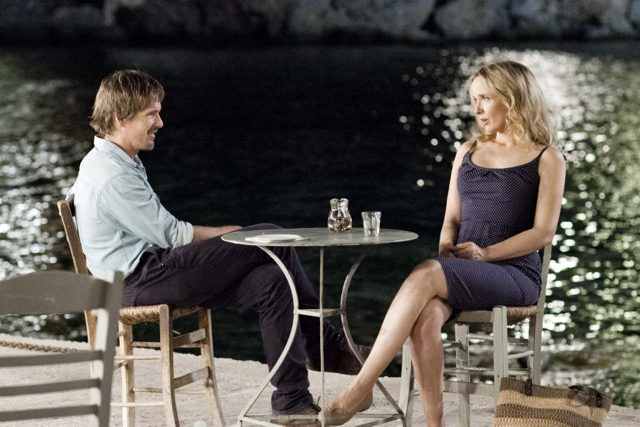
 Ethan Hawke and Julie Delpy (Castle Rock Entertainment)
When Ben Affleck received the Best Director Picture Oscar for Argo, his acceptance speech drew a lot of criticism because of controversial statements about his marriage with Jennifer Garner. The particular part that had people in a tizzy went a little something like this:
“I want to thank you for working on our marriage for 10 Christmases. It’s good, it is work, but it’s the best kind of work, and there’s no one I’d rather work with.”
The focal point of the criticism was that Affleck, rather than thanking Garner for her support, love, and other cutesy sentiments, thanked her in a more frank and somewhat abrupt fashion. By describing marriage as “work,” he burst the illusion of a Fairy Tale Marriage and instead lays out a grim truth about marriage: It’s a daily struggle to make love work.
In Richard Linklater’s Before Midnight, the third film in the Before trilogy that began with 1995’s Before Sunrise and continued with 2004’s Before Sunset, the amorphous auteur spectacularly and masterfully captures that very idea. The idea that making love and marriage work is a constant struggle. A struggle that, in a single moment, can go from cutesy and flirtatious to downright nasty, with cruel insults lobbed back and forth like a heated tennis match.
The film, which takes place nine years after the swoon-worthy, perfectly ambiguous ending of Before Sunset, reunites us with American writer and pseudo-intellectual Jesse (Ethan Hawke) and his brazen Parisian soulmate Celine (Julie Delpy). In the years since the events of Before Sunset, we learn that, on that fateful reunion in Paris nine years prior, Jesse (Spoiler Alert!) indeed missed his flight back to the United States. He and Celine have been together ever since.
As the film opens, Jesse, now living out his “Fairy Tale Romance” with Celine in Europe, is teary-eyed and distressed as he sends his son from his first marriage back stateside, where he lives nine months out of the year with his mother. Naturally, being so absent from his son’s life weighs heavily on Jesse’s heart and this distress ultimately serves as the narrative MacGuffin that causes Jesse and Celine to put their relationship under the microscope.
In that one brief but enormously important opening scene, Linklater effortlessly answers the lingering ‘did-they-or-didn’t-they’ question and tosses us right back into Jesse and Celine’s life without needing to linger on a nine-year backstory. The couple has just spent a wonderful summer on the Greek seaside, staying with a few other families in the gorgeous oceanfront villa of a famous writer friend of Jesse’s.
From one endless tracking shot to the next, Linklater (along with co-screenwriters Hawke and Delpy) fills the 90-minute runtime with non-stop heady dialogue and self-serious conversations on life, love, politics, and philosophy that’s come to define the series. With a number of scenes that can fit in the palm of your hand, Linklater manages to breezily capture the highs and lows of Jesse and Celine’s life together. As the couple’s conversations casually shifts locales—from the car ride back from the airport, to the dinner table with their Greek friends and hosts, to an evening stroll on the beach, to, finally, a posh hotel room that serves as a trapping for the film’s explosive finale—it abruptly shifts in tone. What starts as trademark witty, vaguely philosophical banter smoothly transitions to an examination of their life together: The sacrifices they’ve made for each other; what they want but can’t have; what they have but don’t want. Simply put, for those expecting a charming, romantic tale like the first two need brace themselves for the film’s brutal third act.
Before Midnight isn’t just a great film, it’s (maybe) the capstone of a terrific trilogy and possibly one of the greatest cinematic love stories to ever be filmed. I know, that’s quite the hyperbole to throw out, but please, let me defend.
With the Before films, Linklater brilliantly captures the evolution of love in various stages; painting portraits of how one’s character, ideas, priorities, and notions of romance shift throughout various points in one’s life. Before Sunrise showcased the reckless abandonment of love as a 20-something. Before Sunset restructured its priorities as it captured the return to maturation as a 30-something. And with Before Midnight, a vivid portrait of what it takes to make love stay (Spoiler Alert: A lot). It’s a sort of cinematic social experiment to try and film love at various stages, but what makes Linklater’s films (and, to their credit, Hawke and Delpy, who co-wrote Sunset and Midnight with Linklater) so successful is the commitment to filming everything as authentically as possible.
Shooting the first film in (roughly) real time so it feels as though we spend every breathless, intimate minute with Jesse and Celine in a 24-hour period was a bold and brave artistic choice, but shooting each sequel nearly a decade apart makes it as though we’ve grown with the characters just as Hawke and Delpy have literally grown with them. Whether or not that was Linklater’s conceit in 1995 (it probably wasn’t) is irrelevant, that level of commitment to a pair of characters and their story is astounding.