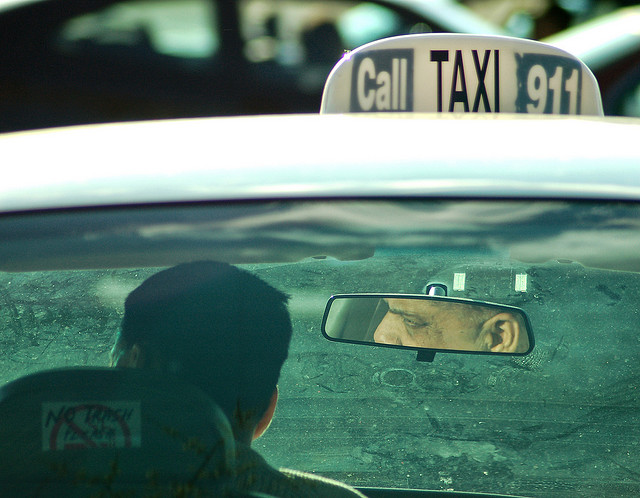
 Photo by andertho
A D.C. Council hearing scheduled to discuss how passengers of the city’s taxicabs often feel unsafe turned out to be just as much about drivers’ safety in the wake of Tuesday morning’s slaying of a cabbie in Adams Morgan.
The hearing of the Committee on Environment, Public Works, and Transportation opened with a moment of silence for Solomon James Okoroh, a driver who was fatally shot in his taxi about 3:15 a.m. Tuesday morning. The hearing also came just after a report from the D.C. Taxicab Commission about the number of complaints it receives about the local taxi fleet.
Earlier this year, the commission said it receives about 150 complaints per month, 80 percent of which come from women. However, in his testimony today, D.C. Taxicab Commission Chairman Ron Linton said that in all of fiscal 2012, the agency received 744 consumers complaints, and of those, 215 were for refusals to give rides, 175 were for improper charges (one instance being a $90 fare for a seven-block trip), and 33 were for driver misconduct, which includes harassment. The rest of the complaints were not actionable, Linton said.
Those divergent statistics were thrown into relief by the testimony of Jen Corey, a board member of Collective Action for Safe Spaces, an anti-harassment group. Corey, who is a former winner of the Miss D.C. beauty pageant title, recounted instances of drivers refusing to drive her to destinations on upper Wisconsin Avenue NW, or failing to pick her up in more populated locations such as Dupont Circle.
Corey also said she demurs from taking cabs because D.C.’s taxis are only now beginning to accept credit cards, as mandated by new regulations which take effect Sept. 1. She also recalled being mugged while withdrawing cash for cab fare from an automated teller machine late at night.
As a result, Corey said she uses the taxi- and sedan-dispatching smartphone app Uber for her livery needs. “I cannot risk my safety in hopes that I get a good [driver],” she told the committee.
In his testimony, Linton said that cabs will be outfitted with panic buttons for passengers and drivers by 2014. The hearing also touched several times on the suggestion that cabs have protective dividers between passengers and drivers, similar to how taxis are configured in New York, but drivers at the hearing rejected that, saying that assailants such as the two suspects that allegedly killed Okoroh on Tuesday morning could just as easily attack them through the front windows.
Massoud Medghalchi, a representative of a taxi driver’s association, also said such a configuration would make cab rides more impersonal between driver and passenger.
Councilmembers Mary Cheh (D-Ward 3) and David Grosso (I-At Large) found the statistics provided by Linton rather dubious. Linton said that the “vast majority” of the city’s more than 10,000 licensed cabbies have no complaints against them. He also said that new dome lights that will be added to taxis this year will help customers more easily identify cabs that are for hire. But a representative from a driver’s group said that the new lamps, which will feature four-digit designation number, will be tantamount to a “backdoor medallion system,” raising the already expensive cost of operating a taxi.
Still, Cheh, Grosso, and Jim Graham (D-Ward 1), who represents Adams Morgan, were keen on adding more physical measures to protect riders and drivers alike.
“We’re dealing with mad men in this case, absolutely mad,” Graham said of instances such as Okoroh’s death.