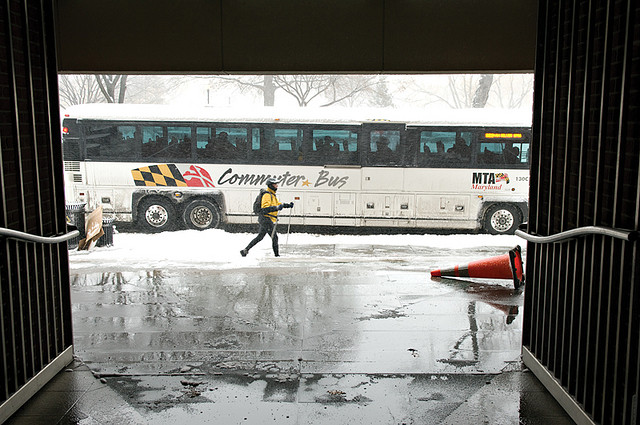
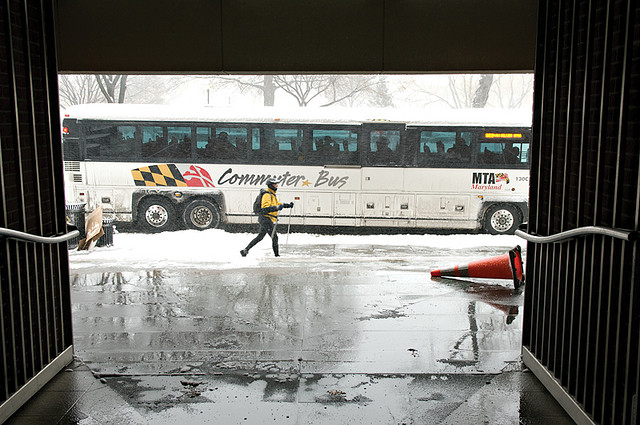
 Photo by Joshua Yospyn.
A proposed $5 fee on non-WMATA commuter buses that enter D.C. caused 10 members of Congress and the governors of Maryland and Virginia to send concerned letters to Mayor Vince Gray and the D.C. Council, The Washington Post reported yesterday. Long story short, the fee isn’t going to happen right now. But don’t you want to know the long story?
The fee was proposed by Councilmember Mary Cheh (D-Ward 3), who chairs the Council’s Committee on Transportation and the Environment, and was later approved by that committee and the whole Council.
The current budget proposal calls for “an increase of commuter bus permit fees by $5 per day” to “fund a portion of the new Bus Efficiency and Enhancement Project.” The total raised would come to $273,000.
As the Post reported, this did not sit well with politicians in Virginia and Maryland.
Maryland Gov. Martin O’Malley sent a letter to Gray and Council Chairman Phil Mendelson opposing what he called a “new tax.”
“Maryland provides commuter bus service for 7,000 riders in and out of the District of Columbia each weekday,” O’Malley wrote in his June 3. He placed the added cost per rider at more than $30 per year.
“The commuter bus system is a vital job access tool that Marylanders rely on to get to federal and private sector employers in the District,” he wrote. “These Marylanders contribute millions of dollars in sales and other taxes to the District while generating employment in the restaurant and other service sectors. Raising the cost of transportation for these workers who voluntarily commute in an environmentally friendly manner will harm both the economic recovery underway in Maryland and the District employers who rely upon these workers.”
Virginia Gov. Bob McDonnell made similar points in the letter he sent Monday. “Should this proposed fee become law, Virginia’s transit providers will be faced with the choice to either increase passenger fares or curtail services to meet the additional costs,” McDonnell wrote. “In either scenario, more commuters will likely turn to single-occupant vehicle travel, thereby increasing congestion on and maintenance costs for both Virginia’s and the District’s roadway networks.”
The D.C. Council also got flak from several members of Congress who represent districts bordering the city, including Reps. Frank R. Wolf (R-Va.) and Donna Edwards (D-Md.). The Loudoun County Board of Supervisors also chimed in after a meeting that, according to Leesburg Today, included “a number of impassioned speeches about the tyranny of the plan.”
Gray and Del. Eleanor Holmes Norton (D-D.C.) also opposed the fee, according to the Post.
In a call with DCist, Mendelson said it seemed best to “let [the fee] go for now.”
“The amount of money involved is very small,” he said, and the proposal “had not been discussed with the regional partners.” Mendelson said there’s “a lot of misunderstanding about the fee,” which he said already exists.
Indeed, misunderstandings abound.
District Department of Transportation spokesperson Monica Hernandez said that anyone who operates a bus in D.C. must have a $55 permit. An annual $250 rental fee for a public space—each spot where commuters are picked up and dropped off—applies only to commuter buses not run by a government agency. She said that fee is being collected.
However, Cheh’s spokeswoman Kiara Pesante told DCist commuter buses do not pay fees to enter the city. The proposed fee on non-WMATA commuter buses would have gone to fixing issues that occur because of these vehicles, like blocked traffic. The Bus Efficiency and Enhancement Project would pay for things like moving bus signs and making timing changes on signals at some intersections where there are issues.
The fixes still need to be made, Pesante said, and other avenues will be explored.