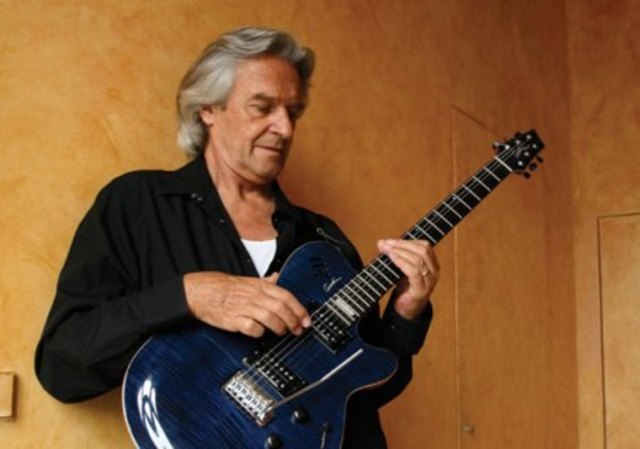
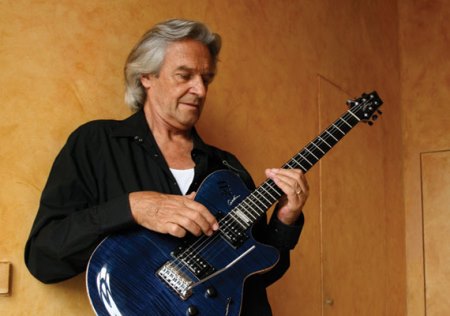
 John McLaughlin (Photo by Ina McLaughlin)
 One of the most fertile periods in jazz history began taking shape in the late 1960s and early 1970s. Prior to this time, jazz and rock n’ roll were on divergent paths, one taking the route to “high art” while the other became an integral part of the popular landscape. Then, groups of talented, young musicians, who were schooled in jazz but still in touch with the tastes of their peers, brought the two together. “Fusion” is how this hybrid form came to be known, and there is no greater exemplar of this music than legendary guitarist John McLaughlin.
“The only ‘thing’ we can communicate is our life story,” McLaughlin says in an interview. “Since my life has been dedicated to music and the guitar, my work consists in translating my life experiences into music.”
Few musicians have had such rich life experiences to draw from in their work. The 71-year old guitarist cut his teeth in the rich British blues scene of the early 1960s, doing session work to augment his income. In 1969, former Miles Davis drummer Tony Williams was forming a new band, Lifetime, and recruited the young Englishman. Shortly thereafter, the iconic trumpeter brought McLaughlin into the studio to record In A Silent Way, an album that many mark as the fusion movement’s true beginning. McLaughlin then went on to form his own band, The Mahavishnu Orchestra, which took the genre to new heights. His immersion in Indian spirituality and music also led to the formation of Shakti, a watershed blending of Eastern and Western musicians. To this day, relentless exploration is the preeminent characteristic of McLaughlin’s career. He has explored orchestral music, flamenco, electronic music, and any number of genres in between.
“What I can say is that what inspires me most of all is the human being,” McLaughlin says. “Regarding the compositions, they arrive when they arrive. I’m unable to sit down and write music. I have to wait for it to arrive in my imagination.”
McLaughlin will be at The Howard Theatre on Sunday to close out the DC Jazz Festival with his latest project, The 4th Dimension. As if to encapsulate his entire musical history in one ensemble, the group starts with spirituality of John Coltrane, one of McLaughlin’s earliest influences, builds through prog rock intensity and throws in a dash of Indian modality. For Sunday’s show, the setlist will draw from the band’s two albums, To the One (2010) and Now Here This (2012), as well as classic fusion compositions from days past.
“The music we play is essentially jazz music, even though some will call it ‘fusion,’ ‘jazz rock,’ et cetera,” McLaughlin says. “In jazz there is the all important element of improvisation. Improvisation is the art of being yourself spontaneously.”
The quartet’s current lineup features bassist Etienne M’Bappe, keyboardist Gary Husband and drummer Ranjit Barot. McLaughlin has always surrounded himself with the best in the world, musicians who are capable of hanging with one of the most proficient guitarists of all time. Like their bandleader, each musician here is not only a master technician, but is also capable of transcending mere craft and forging a more visceral connection with the audience.
“In playing together, we have the possibility not only for individual experience of liberty and freedom, but a collective experience of liberty also,” McLaughlin explains. “These experiences communicate to the audience immediately when they happen, and the audience always knows when true inspiration is present.”
John McLaughlin’s 4th Dimension will perform at The Howard Theatre on Sunday. 6 p.m. doors/8 p.m. show. Tickets $45 in advance, $50 day of show.