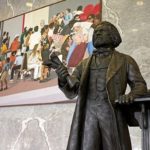
The District finally got some representation in the U.S. Capitol. Well, at least in the building’s collection of statues, when the sculpture of the early civil rights leader Frederick Douglass was unveiled, finishing a journey that began more than seven years ago.
The seven-foot-tall bronze figure was acquired by the D.C. government back in 2006. But since its installation at a District building at 441 First Street NW, Del. Eleanor Holmes Norton (D-D.C.) pushed to see the statue included among the sculptures lining the Capitol that represent the states. Each state is afforded two statues, but for years, Republicans opposed permitting D.C. to place sculptures of its historical figures in the Capitol on the grounds that the District did not deserve equal footing. The District’s standing, vis-à-vis sculpture—remains unbalanced, as the Douglass statue’s companion, a casting of Pierre L’Enfant, still remains lodged at One Judiciary Square.
But today’s unveiling, in the Capitol Visitor Center’s Emancipation Hall, is a start. “Douglass’s life as an active D.C. resident and his deep commitment to our equal rights are the reasons that his statue is here to be unveiled today as a gift from the almost 650,000 American citizens of the District of Columbia,” Norton said to an audience that included Douglass’ descendants.
Douglass, who escaped slavery, spent much of his adult life living in D.C., where he was instrumental in winning passage of the D.C. Emancipation Act of 1862. He was also an early advocate for District voting rights, writing often about the city’s disenfranchised residents.
That legacy was touched upon by Vice President Joe Biden. “There is arguably no one who fought harder for citizenship and full equality than Frederick Douglass,” he said. “Over a century ago, Douglass asked a good question.’What have the people of the District done that they should be excluded from the privileges of the ballot box?'”
Senate Majority Leader Harry Reid (D-Nev.) also used the occasion to voice a bit of support for D.C.’s quest for statehood. “Washington, D.C. residents pay taxes, just like residents of Nevada, California or any other state,” he said. “The District deserves statehood. And Congress should act to grant it.”
But this was hardly the first time that Reid has spoken up, if just in a public setting, against the District’s relegated status. While he has long given his personal support as a voting member of the Senate to bills that promote D.C. congressional representation or statehood, as The Fix notes, the issue has not been a major agenda item during his six-year tenure as majority leader. Reid also said he would attach his name the New Columbia Admissions Act, a pro-statehood bill that gets introduced, but rarely advanced, every few years. It was most recently brought up in January by a group of four Democratic senators.
Still, the statehood mentions, if just piecemeal, were welcomed by Norton and other advocates for D.C. voting rights. “We hope the Majority Leader uses his position to prompt action and bring this bill to the floor of the Senate,” Kimberly Perry, the executive director of DC Vote, said in a statement.
Whether Reid turns his vocal support into legislative action will wait to be seen. For now, though, at least the District counts as half a state in terms of statues.