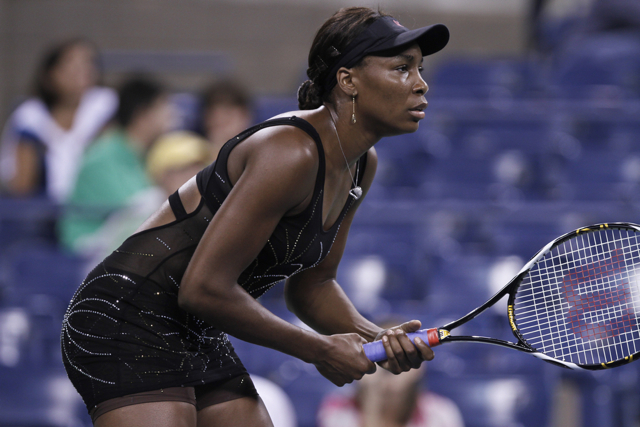
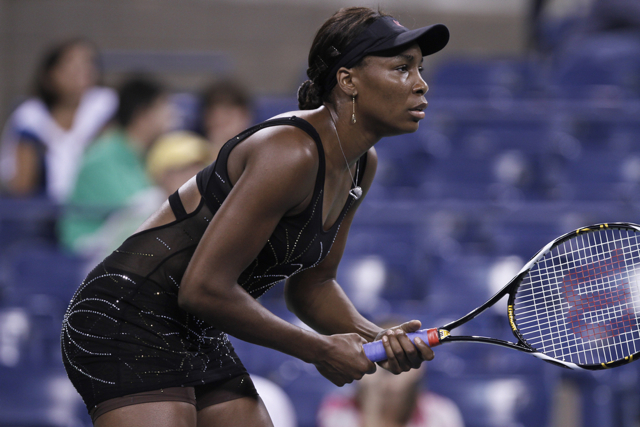
 Venus Williams at the 2012 U.S. Open. (Photo by Lev Radin/Shutterstock)
For the first time in 17 years, the women’s draw at Wimbledon is absent of the player who has dominated tennis’ premier event for the past two decades. Venus Williams made headlines last month when she pulled out of the tournament, which she has won five times, citing a back injury. But even though she is only a spectator this year at the All England Club, Williams’ legacy there is permanent, and not for anything she did on the grass.
It wasn’t until 2007 that Wimbledon paid out equal prizes to its male and female victors, a change that only happened after Williams, who had won three times by then, raised a stink. Four decades into the Open Era, and the sport’s top event was still governed by gender inequality. But after she published an essay in The Times of London and got the backing of the Women’s Tennis Association and Prime Minister Tony Blair, the All England Club realized it was behind the times and finally equalized the prize money.
Williams’ campaign is the subject of Venus Vs., a documentary premiering tonight on ESPN as part of the network’s “Nine for IX” series, which marks the 40th anniversary of the landmark federal legislation requiring equal opportunity in scholastic programs for male and female students, especially in athletics. The film’s director, Ava DuVernay, says she was drawn to the project because it tells an empowering story of a black woman who, upon going pro in 1994, turned the tennis world on its head and propelled a revolution in the game. We spoke by phone Monday.
Why did you choose to tell this story about Venus Williams?
It’s a compelling story that’s been little-told. Most people who are tennis fans aren’t even aware of it. It was most widely covered in the U.K. It’s a bold and empowering story from a champion that we think we know.
It seems like Venus has always been a kind of polarizing figure since she went pro. Did you find anything like that?
I don’t know if I’d use the word polarizing. She was galvanizing for some. For me, she was far from polarizing. She looked a certain way, played a certain way, from a certain place. It’s been a complex tenure for sure.
But the women’s game is a lot different now than it was before Venus and Serena got started. I’m just wondering if we can credit them with changing the game.
You look at old-school basketball, it looks completely different. I’m not enough of a tennis historian. They had a unique way of play and they were dominant. I’m sure they adjusted to other players and their strength. They were definitely part of a new era.
I knew some about Venus’ fight for equal prize money at Wimbledon, but I was surprised to learn not every player had fought for it. You start all the way back with Billie Jean King.
We start with Billie Jean King fighting for equalizing prize money. We go through there being a big gap in the activist spirit of the leaders of the tour between Billie Jean and Venus.
Right. But I was amazed to see players like Chris Evert, Steffi Graf, Martina Navratilova. They didn’t fight for this. Why did it take until Venus came around?
This is something Venus found passion for and laid the torch down for. She emerged as the right person at the right time for this. It’s about this tapestry of a woman who was originally an outsider—the ultimate outsider—who was penalized for beads dropping out of her hair, where she came from, how she learned the game. I found it incredibly compelling.
Venus is 33, she’s not playing at Wimbledon this year. It’s probably safe to say her on-court career is winding down. What’s her legacy?
I’m just telling a story. It was victory on the court as well off the court. I’m empowered all the time by telling stories about black women. I found her emergence as a champion in her sport after being an outsider to be poignant and beautiful.
What did that victory mean for her?
In the documentary she talks about the effect of fighting for equality across all corners of society, be it sports or school. In every arena, equality in terms of race, in terms of gender, in terms of sexuality. Where there’s uneven ground, a cause like this helps. I thought that was really well put by her.