Martin Austermuhle
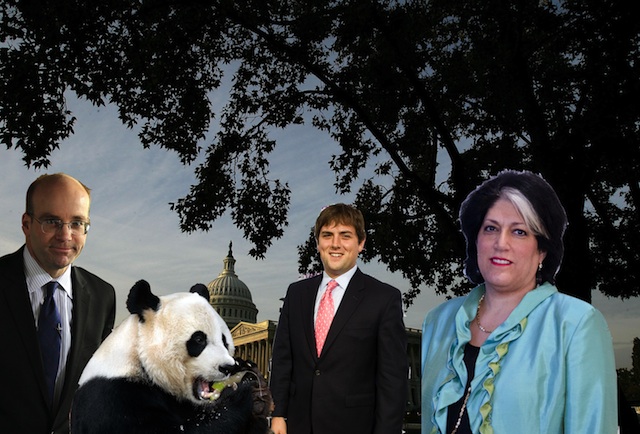 Mike Allen, a panda, Luke Russert, Tammy Haddad. (Original photos by Getty Images/Design by Benjamin R. Freed)
Washington’s got a whistleblower making news, but it’s not Edward Snowden.
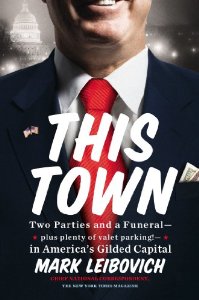
Today is the long-awaited publication date of This Town: Two Parties and a Funeral—Plus Plenty of Valet Parking!—in America’s Gilded Capital (Blue Rider Press, $28), Mark Leibovich’s searing rebuke of the inbred little fraternity that Americans like to refer to as their nation’s capital.
Leibovich, the chief national correspondent for The New York Times Magazine, has created an early buzz, mostly because he’s a member of the brotherhood who has witnessed more than what most people in official Washington want to acknowledge occurs. In This Town, Leibovich has produced an entertaining and enlightening expose of Washington’s self-perpetuating and inward-looking political class.
From the shameless ass-kissing between journalists and the politicos they cover to the shameful revolving door that seems to exist between public office and profit-laden lobbying firms, Leibovich expertly explains how Washington has become a town that’s so easy to hate—for everyone except the people in it:
While so much of the nation has despised Washington, a gold rush has enthralled the place. It has, in recent years, become a crucible of easy wealth, fame, forgiveness, and next acts. Punditry has replaced reporting as journalism’s highest calling, accompanied by a mad dash of “self-branding,” to borrow a term that had now fully infested the city: everyone now hell-bent on branding themselves in the marketplace, like Cheetos… They gather, all the brands, at these self-reverential festivals, like the April White House Correspondents’ Association dinner, whose buffet of “pre-parties” and “after-parties” now numbers more than two dozen—because a single banquet, it is clear, cannot properly celebrate the full achievements of the People Who Run Your Country.
Leibovich draws on his own experience reporting on Washington to highlight the congressional staffers who take themselves far too seriously, the public officials who fight for one cause only to switch sides when more money is offered in the private sector, the journalists-cum-celebrities who “drive” the capital’s conversation on a daily basis, and other professional starfuckers who seem to love little more than being close to those in power.
 As page-turning a read as the book is, it does suffer from a significant existential flaw: Leibovich himself is part of the cabal that he so gleefully throttles, and I often caught myself thinking what some of his colleagues might say about him were they the ones writing the book. “I’ve been in This Town for sixteen years,” he admits. “I have chosen to live, work, and raise my family in the murk.”
So how does someone who is himself murky get to write 368 pages about how everyone else is so much murkier? Well, the going wisdom is that he’s merely doing what good reporters are supposed to do, even if this does mean that he’ll never be able to have lunch in “This Town” again. (Although if he can, there are plenty of fine options.)
I think there’s something else to it, though. Leibovich says that despite the cynicism that Washington can breed, it’s still a place that engender optimism and wonder. He admits that his kindergarten-aged daughter and their friends still stare in awe every time a motorcade passes by; even after 12 years, I have to admit that I similarly think that the sheer enormity of the president’s motorized cavalcade makes me stop and marvel. Leibovich almost wants to think that this is a place that can be the best of what the American democratic experiment is.
That’s why it’s sad to think that for all his grousing about “This Town,” his shorthand for the incredibly small world of power-brokers he covers, Leibovich spends almost no time at all writing about this city. In fact, this is just about the only mention that D.C., our shorthand for non-federal Washington, gets in his entire book:
To be sure, the “real” city of Washington has an actual elected mayor: black guy, deals with our city problems. But that’s just the D.C. where people live, some of them (18.7 percent) even below the poverty line, who drag down the per capita income to a mere $71,011—still higher than any American state… Yes, Washington is a “real city,” but This Town is a state of belonging, a status and a commodity.
I get that Leibovich isn’t a local reporter, and writing about how awful Washington is can be easier than trying to dispel the myth that we’re all boomtowners feeding off of the federal trough. Still, it’s always going to bother me when otherwise intelligent scribes so blithely paint all of D.C. with the worst of what Washington has to offer; would Los Angelinos want to be consistently linked with Hollywood, or New Yorkers with Wall Street? Certainly not. (In what’s likely an unintended coincidence, it was on this day in 1790 that D.C. was established as the nation’s capital.)
That being said, maybe it’s for the best that Leibovich didn’t say much about the non-federal side of the city. After all, I’d rather keep Andrea Mitchell, Tammy Haddad, Mike Allen, and many of the other characters Leibovich lambasts in their own little slice of that town—and away from D.C.
Martin Austermuhle was editor-in-chief of DCist from 2011 to 2013.