 Photo via Capital City Care
It took a popular ballot referendum, 12 years of congressional meddling, and three more of bureaucratic slow-walking, but at long last, D.C. residents who suffer from some of the worst diseases can finally get prescriptions for medical marijuana.
Capital City Care, the city’s first licensed clinic, finally opened its doors on North Capitol Street yesterday afternoon and sold its first half-ounce of medical-grade pot to a man suffering from HIV. “As a person living with HIV, the ability to use medical marijuana will go far in helping to alleviate the challenges I have both with the disease and side effects from my medication,” the patient, Alonzo, who elected only to give his middle name, said in a press release from the clinic.
Patients with HIV or AIDS, cancer, glaucoma, or severe muscle spasms are eligible to get medical marijuana prescriptions from their doctors. The District’s medical marijuana regulations permit up to 10 cultivation centers. So far, two other dispensaries and six cultivation centers are licensed.
Scott Morgan, one of Capital City’s owners, says his clinic serviced one other patient yesterday in addition to Alonzo, and is scheduling appointments for five others who are approved to buy weed there. But business is expected to be slow at first. In order to be able to purchase medical marijuana, a patient must suffer from one of the four listed chronic illnesses and get a written recommendation from their physician, who must be licensed to practice in the District. In April, D.C. Department of Health officials estimated that only 110 of the more than 9,500 licensed doctors in the city have expressed interest in prescribing marijuana.
“A number of patients have had a hard time getting their doctor to issue the recommendation,” Morgan says. “It’s our hope that opening our doors will create a positive tone for the program.”
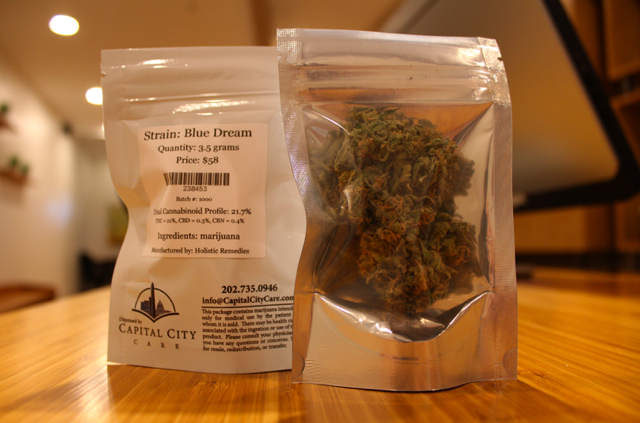
Alonzo, the debut patient, bought three strains yesterday— Blue Dream, Jack Herer, and Master Kush. Blue Dream, which tastes subtly of blueberries, is designed to control pain and stress without zapping the user of energy, according to Sticky Guide, a website that reviews medical marijuana. Jack Herer is described as offering “immense euphoria” with each toke. Alonzo also bought a marijuana accessory, Morgan says.
District residents approved palliative use of marijuana on a 1998 ballot measure that passed with 69 percent support. And though it took nearly a decade-and-a-half to realize, D.C. now joins 18 states in offering the treatment.