 (Benjamin R. Freed)
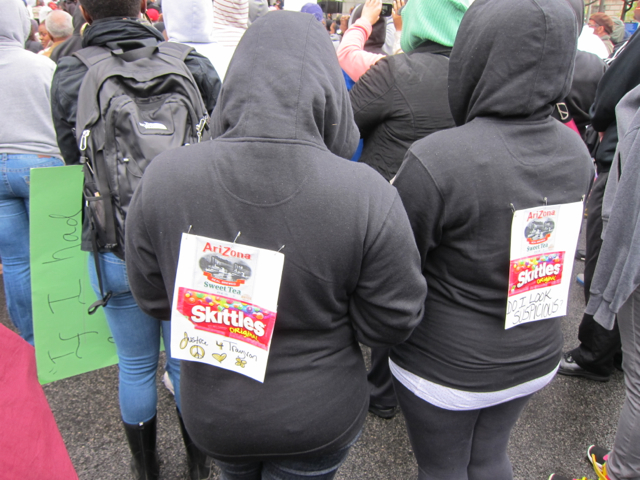
The Smithsonian says it is not “currently” trying to acquire Trayvon Martin’s hooded sweatshirt for a collection, despite the interest one museum director showed in an interview with The Washington Post.
Lonnie Bunch, the director of the National Museum of African American History and Culture, spoke with the Post for a piece about the future of the clothing item Martin was wearing on the night he died. From the article:
Martin’s hoodie, Bunch said, represents a unique opportunity to further the discussion about race in America. (And, by the way, he’d love to have it for his collection once the legal case plays out. He also has his eye on the hoodie that Marian Wright Edelman, founder of the Children’s Defense Fund, wore in solidarity with protesters.)
“It became the symbolic way to talk the Trayvon Martin case. It’s rare that you get one artifact that really becomes the symbol,” Bunch said. “Because it’s such a symbol, it would allow you to talk about race in the age of Obama.”
While Bunch did not say he was actively trying to obtain the hoodie for the Smithsonian, the possibility was enough for several large media outlets, including CBS’s This Morning, to pick up the story. The National Museum of African American History and Culture’s Twitter feed was then inundated with opinions, mostly negative, about the possibility of having the sweatshirt at the museum. A blanket response was sent out to anyone who tweeted about the rumored acquisition: “Thank you for sharing your thoughts on this issue. We know there are many opinions and will take them into consideration.”
But in two tweets this morning, the Smithsonian attempted to put an end to the reports and said it was not trying to “currently” acquire the sweatshirt.
Despite reports, we are not currently seeking to add Trayvon Martin’s hoodie to our collections. @NMAAHC
— Smithsonian (@smithsonian) August 2, 2013
Although items related to the Zimmerman trial may one day have historical value, acquiring any object involves a lengthy process.
— Smithsonian (@smithsonian) August 2, 2013
The museum expanded on the tweets in a statement from spokeswoman Fleur Paysour.
“We recognize that certain items related to the Trayvon Martin trial could one day have historical value and provide a way to study and discuss race in America,” Paysour says. “Acquiring any object for our museum involves rigorous consultation with a team of museum historians and curators. Any items connected to the Trayvon Martin case—should they even become available—would have to go through that lengthy process.”