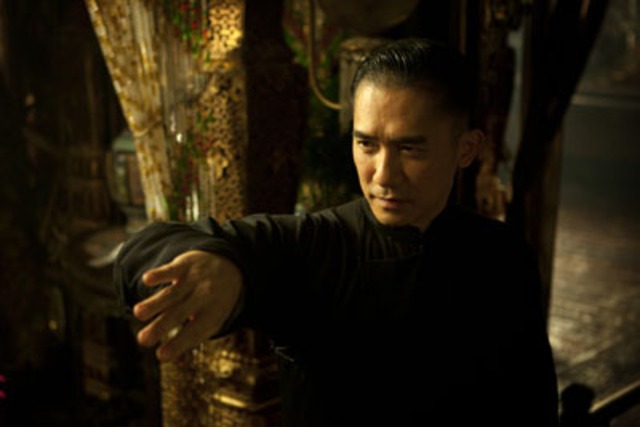
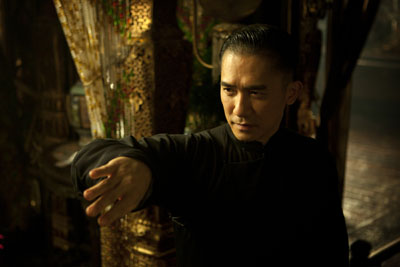
 Tony Leung (The Weinstein Company)
Director Wong Kar Wai specializes in stylish films that are quirky, fatalistic, and romantic — core values of art house cinema. What has set his films apart is their style and divided nature. His 1994 breakthrough Chungking Express is the most lighthearted example of this, a film that changes courses midstream to tell diverging but related stories. When Wong can integrate these pieces, his movies are inventive and evocative: Chungking Express, Happy Together, and In the Mood for Love, all of which were shot by his quintessential collaborator, cinematographer Christopher Doyle, and all of which also happen to star actor Tony Leung.
But Wong doesn’t always hit his marks: take the muddled futuristic vision of 2046, the muddled historical martial arts epic Ashes of Time, and his low point, 2007’s My Blueberry Nights. The latter film, his first English-language foray, had many of the same elements that gave Chungking Express its charm and energy, but something was lost in translation. Wong treads a fine line between charming and precious. He keeps his elements in perfect balance in Chungking Express, but My Blueberry Nights fell apart in whimsy.
Wong’s latest film is better than that, but it’s not quite a return to form. In his first martial arts picture since Ashes of Time, the director is reunited with Tony Leung, but standing in for Doyle is cinematographer Philippe Le Sourd, who makes The Grandmaster look like the stylish jewel box you expect from Wong Kar Wai.
But it doesn’t quite work.
The Grandmaster follows the life of Ip Man (Leung), who founded the Wing Chun school of Kung fu and taught Bruce Lee everything he knew. The movie begins on a rainy night with a gorgeously shot fight between the young Ip Man and would-be rivals. Wong spent years researching the various schools of martial arts and brought in legendary choreographer Yuen Wo Ping, who moved from Hong Kong films to work on The Matrix and Kill Bill. The martial arts scenes are expertly done as Ip Man uses his own fighting style against a series of different approaches. It’s kind of a metaphor for artistic style, but unfortunately, Wong doesn’t take a chapter out of his own protagonist’s approach of elegant simplicity. Slow-motion sequences that have always been a part of Wong’s films with Christopher Doyle, but in the best of these, such tricks were used sparingly. Le Sourd regularly turns to this device, and the result is pretty but slick.
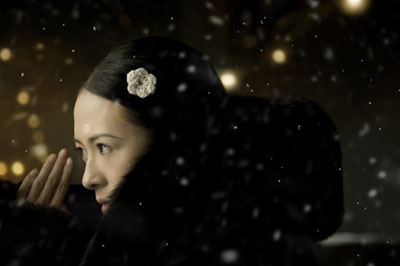 Ziyi Zhang (The Weinstein Company)
The movie shifts emphasis to Ip Man’s relationship with Gong Er (Ziyi Zhang), daughter of the elder martial arts master Gong Baosen. Her scenes are food for the director’s romantic side, with plenty of snow and steam powered trains and revenge. The elements of personal vision and thwarted love are come to play in Wong Kar Wai’s best films, but the material here doesn’t fully lend itself to his own personal vision.
The original version of The Grandmaster, known as “The Chinese Cut,” ran 130 minutes, but producer Harvey Weinstein cut 22 minutes for the U.S. release. The edits were made with Wong’s approval. I don’t feel like I’m missing out on a masterpiece, as some have assessed the original cut. The U.S. version adds title cards to put the film in some historical context, and some of the titles provide information American audiences just would not have. But titles explaining who characters are can be distracting, and unnecessary given the script. And in one instance, a title announces that we are in Hong Kong 1950 right after a character has just announced that fact.
Fans of Wong Kar Wai have waited six years since his last film, and will need to see The Grandmaster in whatever form is available. But epic subjects are not the director’s strength. Wong’s finest work finds grand emotions in intimate subjects, and we never get close enough to the characters here to approach those heights.
—
Written and directed by Wong Kar Wai
With Tony Leung Chiu Wai, Ziyi Zhang, Jin Zhang
Rated PG-13 for violence, some smoking, brief drug use and language
Opens today at AMC Loews Georgetown, Landmark E Street Cinema, Angelika Mosaic, and selected multiplexes.