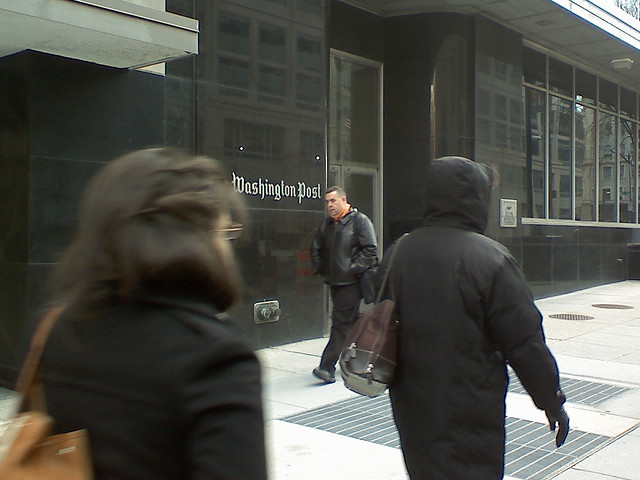
 Photo by Dan Macy
This afternoon, Jeff Bezos— the founder and CEO of Amazon who will buy the Washington Post for $250 million— gathered the paper’s staff to talk about his plans for his future purchase. Earlier this morning, Bezos met with a few Post reporters and editors to give them a taste of what he has in store for the future.
Among his ideas and plans for how the paper will run on a day-to-day basis, Bezos said that he “wants to create a ‘daily ritual bundle’ that would appeal to a variety of readers,” according to the Post. He also said that his plans to help the Post grow their readership and become more profitable won’t involve cutting back staff or resources, and “rejected the idea that news organizations could cut their way to profitability or stability, or attract advertisers without adding readers.”
So that’s good news for those in fear of a scaled-back Washington Post! However, that also probably means Post columnist Richard Cohen (no relation to this writer, by the way) isn’t going anywhere soon.
Apart from that, Bezos’ vision for The Post seems pretty optimistic. He wants to invest in the paper to help it grow, according to the paper.
Asked how he would define success, he replied growth. Continuing to contract by cutting the staff would lead to extinction, he said, “or, at best, irrelevancy.” He told a group of reporters and editors Wednesday morning that “making money isn’t enough. It also has to be growing.”
“What has been happening over the last few years can’t continue to happen,” Bezos said
.
And as for how reporters and editors can help make a change in their day-to-day operations? His number one advice was “don’t be boring,” and called out two pieces in the paper this week that grabbed his attention: Adam Bernstein’s obituary of 9:30 Club’s “That Guy” Josh Burdette, and Max Fisher’s primer on the situation in Syria.
He also discussed the two biggest business problems the paper currently faced: Rewriting and debundling:
In the former, the newspaper could spend weeks or months on a project that a Web site like the Huffington Post could rewrite “in 17 minutes.”
In the latter, whereas people once bought a paper and read and passed sections of it around, the Web has debundled the paper so that people can read one story and move on to a different site.
If you don’t work for the Washington Post, chances are you weren’t at the staff meeting Bezos held this afternoon. But thanks to Poynter media blogger Andrew Beaujon, you can see what Post staffers tweeted during it.