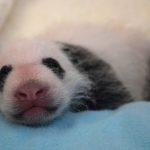
The National Zoo has ended the speculation: Its new panda cub is a girl, and Tian Tian, you are the father!
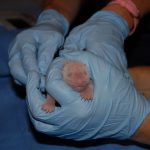
Jesus Maldonado, a research scientist for the Zoo, made the announcement in a very non-Maury way Thursday morning to a crowd of reporters. He said the stillborn cub was also a girl fathered by Tian Tian, the National Zoo’s male panda. The cubs, born August 23, were fraternal twins.
Brandie Smith, senior curator of mammals and giant pandas, said both Mei Xiang and the cub are doing well. Smith said for the first ten days Mei was extremely focused on Butterstick, but she’s now coming out of her baby fog. She ate for the first time yesterday.
Smith said the cub is “absolutely beautiful,” adding later that she’s beginning to get her panda color.
It will probably be several months until the cub, who won’t be named for 100 days, is on display to the public, Smith said. In the meantime, Mei Xiang and cub can be observed via the National Zoo’s panda cam.
When asked if she’s surprised by all the attention given to the cub’s paternity, Smith said “We’re fascinated by it, and we’re glad others are too.”
The San Diego Zoo’s Gao Gao, who could have been the cub’s father, could not be reached for comment. But one imagines he reacted like this.

Here’s more information on the paternity test, via the National Zoo.
Zoo scientists used two tests to confirm the sex of both cubs. The first test was developed by scientists in China and analyzes a fragment of the zinc finger protein gene. The second test, also using a shorter fragment of the same zinc finger protein gene, was developed by SCBI scientists and veterinarians. They used the second test to verify the results of the initial test.
For the paternity tests they compared genotype profiles of DNA samples from the cubs to profiles from Mei Xiang, Tian Tian and the San Diego Zoo’s giant panda Gao Gao. As a result of previous conservation research, SCBI’s Center for Conservation and Evolutionary Genetics had blood samples from Mei Xiang, Tian Tian and Gao Gao on hand. They compared a small sample of muscle tissue from the stillborn cub and a tiny sample of cheek cells from the cub born Aug. 23 to the adult pandas’ DNA samples for the tests. Veterinarians obtained the cheek cell sample with a swab during a preliminary health check Aug. 25.