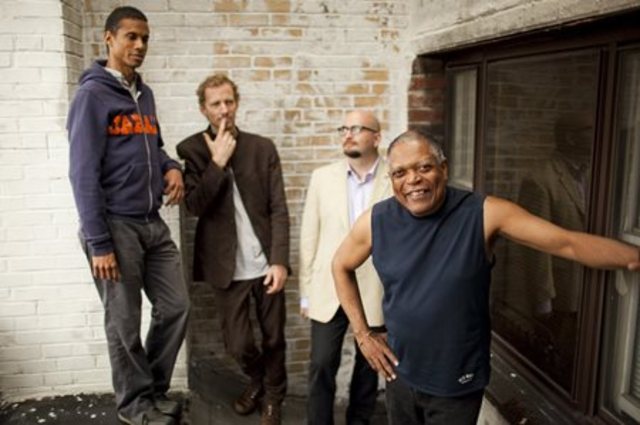
 Legendary drummer and D.C. native Billy Hart (far right) will lead his quartet on Wednesday to launch the ’13-’14 jazz series at the Atlas Performing Arts Center.
Tomorrow marks the start of the 2013-2014 jazz season at the Atlas Performing Arts Center. Once again, series curator and area saxophonist Brad Linde has proved Jazz at the Atlas worthy of being named one of the best jazz venues in the D.C. area. The programming offers the steam punk influenced sounds of Darcy James Argue’s Secret Society, avant-garde explorations from saxophonist Tim Berne, drummer Allison Miller as part of the Washington Women in Jazz Festival, as well as performances from locals such as saxophonist Brian Settles and guitarist Anthony Pirog. There is music to suit all tastes, however the season’s opening concert is also one of its most anticipated: drummer Billy Hart leading his world class quartet.
Hart is a District native and this concert will be the first time the 72-year old musician will be leading an ensemble in his hometown. After getting his start in D.C. playing with the likes of Shirley Horn and Buck Hill, Hart made his way to New York and has spent the past 50-plus years touring with an astonishing list of jazz notables. He toured with organist Jimmy Smith and guitarist Wes Montgomery before joining Herbie Hancock‘s sextet in 1969 and spending four year’s with the master. During the ’70s, Hart was featured on Miles Davis‘s seminal 1972 album, On the Corner, and also spent time with pianist McCoy Tyner and saxophonist Stan Getz. Much of the ’80s was spent with the band, Quest. In addition to continuing an active touring schedule, Hart has also become an accomplished educator, teaching at the Oberlin Conservatory of Music, the New England Conservatory of Music and Western Michigan University.
In 2003, Hart formed a quartet with pianist Ethan Iverson, best known for his work with The Bad Plus, saxophonist Mark Turner and bassist Ben Street. In 2012, the band released All Our Reasons, its first recording for the renowned European jazz label, ECM Records. These in-demand musicians tour the world in other ensembles, so it’s indeed a treat that they will assemble here in D.C. Despite the relative infrequency of their performing in this particular lineup, the Billy Hart Quartet has earned a reputation among the finest in jazz.
Hart recently took a break during his teaching schedule to speak with DCist about working with this band and his early days in D.C.
DCist: Let’s start with your current band. Why did you choose these particular musicians and what does each of them bring to the table?
Hart: Well, these guys are obviously much younger than myself. So they offer a very contemporary viewpoint, which for whatever reason I’m interested in. Not to compare myself to Miles Davis, but he was like that, and Art Blakey was too. There are a lot of guys my age who are not interested in a contemporary viewpoint. They say that each generation transforms art into its own image. But my feeling is that it’s not the art that changes, just the image. So I guess I’m interested in how art evolves. As far as I’m concerned, these are three of the brightest talents for their age.
DCist: You talked about a “contemporary viewpoint.” Is there any particular aspect of the contemporary viewpoint that you find exciting and would like to explore?
Hart: I think the world at this point has gotten a lot smaller. So this music — for whatever strange reason we’re still calling it jazz — when in fact it’s North America’s classical music, as opposed to calling Europe’s music “our” music. You know, when most people say “classical music,” they’re referring to Europe as if there are no other cultures on the planet. So what classical musics do, if they’re legitimate, they include more of the cultures, especially in this country since it’s a multi-cultural country. We get the higher-mindedness of all the cultures. If you were a pre-World War II musician, you might not have been interested so much in Balinese music or Korean music, but now we are.
DCist: I want to follow up one point you made. You described jazz as “North American classical music” and then eloquently described how it’s continually evolving. But by calling jazz a classical music, aren’t you concerned with labeling it a museum piece that doesn’t necessarily evolve?
Hart: In every culture on the planet, there’s a folk music or a dance music. In this country we call it “pop music” because of the capitalistic implications. All the folk musics evolve into classical music. And what you’re saying is correct, but I look at it cyclically. It’s a cycle that keeps going and the folk musics just keep evolving into the classical musics. The classical musics just get older. If you look at say, European classical music, that started maybe seven hundred years ago. If you look at Indian classical music, it might have started two thousand years ago. We’re barely at a hundred years, so we’re still evolving.
DCist: Let’s turn back to the upcoming performance. In terms of material, what can the audience expect?
Hart: Well, we’ve made three CDs at this point, so we’re basically performing the vocabulary of the three CDs. Now, one of the CDs hasn’t come out yet, so consequently we’re playing a lot of the music from a CD that people haven’t even heard. But, you know, John Coltrane used to do that.
DCist: In cases like that where people might not be familiar with the music, what do you hope they walk away with after hearing the new material?
Hart: That’s an interesting question. I’m just thinking of what Wayne Shorter might’ve said to a question like that. So-called “jazz music” has a rhythm aspect to it that causes euphoria and optimism at the same time. That’s a natural feeling that’s sort of like a partnership between the performer and the audience. I don’t think of ourselves as being the sole proprietor of that.
You know, Wayne Shorter once said something, when one of his musicians asked him, “What are we going to play, maestro?” He said, “You can’t rehearse the unknown or the future.” But there’s something exciting about being a part of it.
DCist: Now let’s shift gears a bit and talk about how you got your start in D.C. At what point did you start playing out and playing gigs in and around D.C.?
Hart: Around 1958.
DCist: What was the city like back then?
Hart: It was fruitful. It could’ve been that way in a lot of cities. You didn’t make a whole lot of money, but there were many places to perform. You didn’t travel a lot to Baltimore or Arlington, you stayed in certain neighborhoods. But the work was consistent. I worked in one club for nine months, six nights a week. And you had as many clubs then as you have in New York today.
DCist: So what kind of music was being played in D.C. back then?
Hart: It was relatively advanced because you’d have people on the cutting edge of music that would come into town from New York or whatever. During my time, Miles Davis, John Coltrane, Cannonball Adderley and Horace Silver would all come and we got used to seeing them.
Back then we also had The Howard Theatre. Before it got to be a basic pop music venue, at least once a month there would be a so-called jazz show and you could see the Duke Ellington big band with Nancy Wilson as a vocalist, with three small bands, say Thelonious Monk, James Moody and Miles Davis on the same show. That would be a hang because they’d be there all week. One of my first jobs, in 1958 when I was still in high school was right at 7th and T. I remember Oscar Peterson coming to see the band that I was in. Occasionally people would come and sit in.
DCist: Who were some of the people who sat in with you?
Hart: Almost anybody. I remember Sonny Stitt, Gene Ammons, it could’ve been anybody.
DCist: Who stood out to you among the D.C. musicians as people who could take their careers to the next level?
Hart: I went to high school just as they were being integrated, that’s how old I am. I went to one school called McKinley Tech. There were three guys that were upper classmen. One guy’s name was Quentin Warren. The day after he graduated he joined up with Jimmy Smith, the great organist. Butch Warren, the bass player, the day after he graduated he left and went to New York to join Kenny Dorham. And then there was a pianist here for years named Reuben Brown. He left to join Lou Donaldson. Butch came back and then left again and recorded a bunch of classic albums for Blue Note Records. Quentin played a lot with Jimmy Smith and eventually got me the job with Jimmy Smith.
DCist: People like Buck Hill decided to stay in D.C. Did you play with him at all?
Hart: Buck Hill is my mentor, my teacher. He was my major inspiration. He’s the one that played me my first records. I discovered Charlie Parker through Buck Hill.
DCist: If there’s one aspect of your playing or philosophy on music that D.C. had an influence on, what would that be? Or is there one?
Hart: I guess being in between the North and the South, I was around to see pop music from an Afro-American standpoint like The Temptations, Smokey Robinson & The Miracles, Otis Redding and James Brown. I was able to see them or interact with them because Washington was in the middle between those kind of people and New York. I got both ends of Afro-American music. I think that worked to my benefit because I was able to learn from both genres.
Did you see that movie The Butler? His son is me. To be from Washington, D.C. and be around all of that. I also went to Howard University, and I went to Howard with Stokely Carmichael. So to be around Malcolm X and Martin Luther King, at the same time I was around John Coltrane and Miles Davis, and having peers interested in all of that. To have that happen constantly at the same time I was around Buck Hill and Andrew White, it was a very fruitful exchange of ideas. It was very contemporary times when the music was changing.
DCist: D.C. being a political town, and this being a time of great political change, how did that affect you personally and how did that translate into your music?
Hart: It gave you a broader outlook. You might have heard of Emmett Till but it didn’t mean so much. You weren’t as terrified. I had friends who would join Martin Luther King to be a part of that. As I began to play, I would see them in the South. I became a part of that scene. You had friends that were in the Vietnam War. I was very close to being drafted. That was a reality. All of that made your world bigger. It was closer than just television.
DCist: So for my last question, even to this day, musicians in D.C. get to a certain point and they have to make a decision. Do I stay, or do I go to New York, or L.A. or whatever? What were the factors that made you decide to leave D.C.?
Hart: There was one other thing that happened in Washington, D.C. that was pertinent. A guy named Charlie Byrd and he had a bass player named Keter Betts. They went to Brazil and they get credit for discovering the bossa nova. A lot of those Brazilian guys would come to Washington and play at Charlie Byrd’s club, and I got to play with some of those guys. So my world was bigger. Before I left Washington, D.C. I had already done tours of Europe and Japan. I began to have as many friends in New York as I had originally in Washington, D.C. I had broadened my horizons.
The Billy Hart Quartet will perform at the Atlas Performing Arts Center on Wednesday, September 25, 2013 at 8 p.m. Tickets $20 to $32.