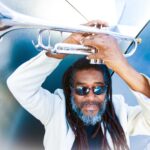
Wadada Leo Smith and his ensemble will perform the Pulitzer Prize-nominated “Ten Freedom Summers” in its entirety on Friday and Saturday at the Atlas.
 As everyone in this city knows, 2013 marks the 50th anniversary of the famous March on Washington. However important that event and Dr. King’s memorable speech was, that day was a high point in a continuum that was the Civil Rights movement. In order to grasp its true meaning, the March must be put into context within a decades-long struggle.
So among the numerous commemorations that are occurring around the District this year, one in particular stands out because it is an ambitious attempt to establish this context through musical interpretation. Trumpeter Wadada Leo Smith spent over 30 years intermittently composing Ten Freedom Summers and premiered it in 2011. A recording was released last year on Cuneiform Records, located in Silver Spring, Md. The five-and-a-half hour long song cycle is spread over four CDs and was among the most praised releases of 2012, earning Smith a nomination for the Pulitzer Prize. This weekend, Smith will bring his ensemble to the Atlas Performing Arts Center to perform Ten Freedom Summers in its entirety over the course of three concerts.
“I wanted to make a creative contribution,” Smith in a recent interview with DCist said. “That started the idea of contemplation about what I can do for the civil rights movement that didn’t involve me standing on the streets and protesting, but involved me creatively.”
Smith is quick to note that each piece in Ten Freedom Summers is designed to stand on its own, as are the three concerts that will take place this weekend. However, the 19 pieces on the album are divided into three sections: “Defining Moments in America”, “What Is Democracy?” and “Freedom Summers.” The subject matter ranges from key individuals in the Civil Rights movement to the broad philosophies that underscored it. Smith described his approach as “psychological,” in that he wanted each song to frame a specific moment that illustrated an idea or individual. He cited the first piece he wrote, “Medgar Evers: A Love-Voice of a Thousand Years’ Journey for Liberty and Justice,” as an example.
“Medgar Evers was assassinated when he stepped out of his car. The moment that I was trying to describe in this piece was when he drove into his driveway, his family was standing in the doorway, and the assassin was somewhere near the house. How do I get to that psychological moment?” Smith said.
A large ensemble will accompany Smith this weekend. His colleagues include Smith’s Golden Quartet featuring Anthony Davis on piano, John Lindberg on bass and Anthony Brown on drums. Pacifica Red Coral will also be featured, with violinists Shalini Vijayan and Mona Tian, violist Andrew Macintosh, cellist Ashley Walters, harpist Alison Bjorkedal, and percussionist Lynn Vartan. Projections from video artist Jesse Gilbert will augment the music, which includes a new composition written in tribute to the victims of the 1963 16th Street Baptist Church Bombing in Birmingham, Alabama.
Ten Freedom Summers marks a high point in a rich, half-century long career. The 71-year old Smith was an early member of the Association for the Advancement of Creative Musicians, a pioneering collective that brought together musics from all over the world with the intent of removing all boundaries to artistic expression. In addition to releasing dozens of albums as a leader since the early ’70s and being a respected ethnomusicologist, Smith has developed an entire musical system that departs from the standard notation of Western music. He calls this approach Ankhrasmation, which is a technique that communicates information from the composer to the performer while giving the performer a great deal of leeway for interpretation. While many of Smith’s compositions have been developed using Ankhrasmation, Ten Freedom Summers was written in a more traditional manner.
“This gives me a chance to express a large notion about what the creative composer can do that’s different than what the classical or contemporary composer would be doing,” Smith explained. “I wanted to show that the creative composer who comes out of the so-called jazz tradition can have other ideas about how to make a work of art.”
Wadada Leo Smith & Co. will perform Ten Freedom Summers over three performances at the Atlas Performing Arts Center on Friday (8 p.m.) and Saturday (3 p.m. and 8 p.m.). Tickets for each individual concert are $20 (student) to $33.50, or tickets are available for the entire cycle for $88.50. CapitalBop will also host a free listening session with Smith at 7 p.m. on Saturday.