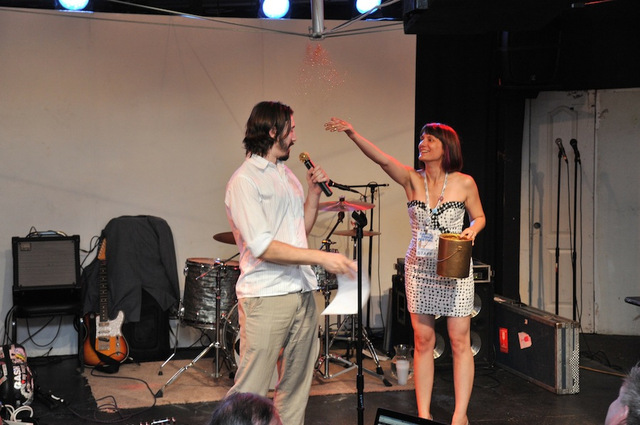
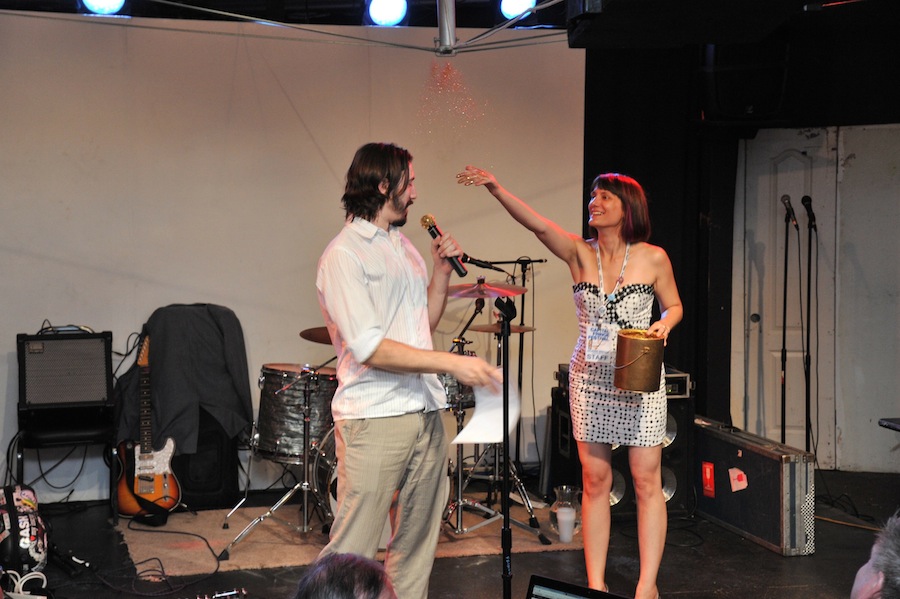
 Julianne Brienza, at right, sprinkles gold dust on the winner of Capital Fringe’s Director’s Award, which went to “Disco Jesus and the Apostles of Funk.” The summer hit will also be at this year’s fallFRINGE. Photo Copyright 2013 by Paul Gillis Photography.
If you made it to any of the Fringe shows this past July, there’s a 90 percent chance you bumped into director Julianne Brienza, the ever-present force behind the festival she founded and has helmed since 2006.
What you probably couldn’t have known is how painfully ill she was the entire time. “I had salmonella poisoning during it,” she said during a recent interview. “I was really out of it. I would literally work for four hours and then sleep in a hammock that we have. … Every time I’d come out, I’d be like, ‘Oh my god, it’s Tuesday, why are there are so many people here?’”
Recalling one time she sat through a performance in the admittedly 100-degree oven of “The Tent,” Brienza felt like her “eyeballs were going to pop out of my head.”
“I thought I was getting old. ‘I just can’t do this anymore,’” she said. “It’s just festival time.”
The reason it took Brienza four days to even think something was wrong enough with her system to go to a doctor and get antibiotics is pretty simple: Summer Fringe carries with it a high octane amount of stress even under normal circumstances, so Brienza rarely sleeps or eats all that well during the 18-day period anyway.
That kind of gritty determination to just power through it when your entire body has been poisoned is probably one way to explain Capital Fringe’s growth into an influential hub of the otherwise slow summer theater season in D.C.
According to the organization’s website, Capital Fringe has “generated over $1.4 million in revenue for participating artists” and “premiered over 400 new works of contemporary performance.” No concrete data on how much beer has been consumed under the Baldacchino Tent until the wee hours of the morning, but… let’s just say it’s a lot.
Kicking off at 6:30 p.m. tonight, fallFRINGE is a more laid back affair, which can confuse some folks. What, if not simply a scaled back redux of July, is this little theatrical collection every November?
“The first year we did fallFRINGE, it was surprising because people came and they thought it was the summer festival. Like, ‘I’ve heard about this Fringe but I’m always away in the summer. Is this it?’ And I was like, ‘Well not really. But kinda?’” Brienza says.
FallFRINGE came about five years ago, when she was short $9,000 on Fringe’s budget goal for the year. “I was on the phone with an artist being like ‘what am I gonna do?’ and he was like, ‘Oh I’ll donate a show to you.’”
The first year, there were just three shows, all donated by artists. Since then, as you’d predict, it has expanded and evolved—now less an auxiliary money-maker as another, distinct-in-its-own-rite, way to grow the Fringe name, and to bring more experimental theater to DC.
“It’s really chill,” Brienza said. The fallFRINGE is “actually really nice because you can have different conversations with the artists. And those audiences that do come, it’s just a much more intimate environment. I really want to keep it that way.”
Brienza says that last year she finally begun to refer to fallFRINGE as a “festival,” since 2012 is when they began to use more than one venue for shows (there were 14 performance groups in 2012; 13 this year).
Last year, about 10,000 people attended. It’s still less of a slam dunk than summer, which Brienza says has to have something pretty major go wrong in order to not be at least a moderate success.
But hey, they’re adding another bar, too, so patrons don’t have to worry about open container laws and transport between venues—so that’s a leg up. “The big show, Disco Jesus, is in the Redrum. And that’s a drinking crowd. So why not?””
One of the most interesting, and also complicated, factors of any festival is programming – deciding what will draw audiences in and who gets a spot. Although several of the shows this year, like Tell-Tale and Guide to Dancing Naked, earned awards and had packed houses over the summer, it’s not a popularity contest.
“I often wonder if people think that these are, like, my favorite shows,” Brienza says. The reality is actually quite complicated and has nothing to do with what she likes or doesn’t like (she admits she’s “not into Shakespeare” and yet there’s a decidedly Shakespearean show on there this year in 43 and ½: The Greatest Deaths of Shakespeare’s Tragedies).
“It’s really about having an ongoing dialogue with a group—most of the people that are in the fall festival started talking to me about it in June. ‘I’d really be interested in that.’ And then we just kept talking. If they’ve been a successful producer, chances are they’ll probably do Fall Fringe.”
Whereas in past years every show in fallFRINGE was a repeat of something from the summer, Brienza said she had to rethink that process, because it was actually making it more difficult for creative teams to get publicity.
“Nobody wants to review shows that were already reviewed in July. And press is how you get some tickets,” she said. “I sort of changed it to that anyone can do the fallFRINGE as long as they participated in the summer festival in some capacity. Which could mean that you were the actor in the show. And we want to have a mix of new shows and returning shows. This year I think we finally kind of got to that.”
Another deciding factor is what kind of a producer is behind a show and whether he or she feels up to promoting a play, even against the considerably heightened competition of fall entertainment (for instance football, or Homeland).
There are other wildcard criteria. I asked why something like this summer’s wildly funny The Continuing Adventures of John Blade, Super Spy didn’t make it back. It was reviewed and sold well, but Brienza says that was such a huge ensemble that it would have been difficult to reassemble in November.
“Probably three years from now fallFRINGE will be different. Because a lot of it is the artists, coming to get savvy about getting into it. No one’s going to ask you.”
The one show Brienza says she did directly invite to this year’s fallFRINGE is Joseph Price’s Operating System. He had been slated to do it this summer but ran into a scheduling conflict with his job.
“He has a big following with the Speakeasy crowd. So I feel like he’s not going to totally fail,” she says.
Another new show on the ballot is He Smokes With Mirrors, which is done by Not A Robot Theatre Co. The group was behind this summer’s infamous The Clocks, which from chatter and write-ups over the summer seemed to fascinate and befuddle audiences.
“I just know they’ve been building a lot of puppets for it,” she says. “So I’m excited to see what that is.”
For those coming at Fringe for the very first time, who maybe have no idea what to expect and aren’t sure what to make of it, Brienza says she considers the most important and exciting element to be the dedication and inventiveness of everyone participating.
“These guys are committing a lot to work on these shows for five to six performances in an 11 day period. Which is kind of interesting for where we live because it’s sort of a big budget town where you don’t really get that sort of independent scene,” she says. “I think that’s interesting, because we don’t really have a lot of that. And some of them may be good, some of them may be bad.”