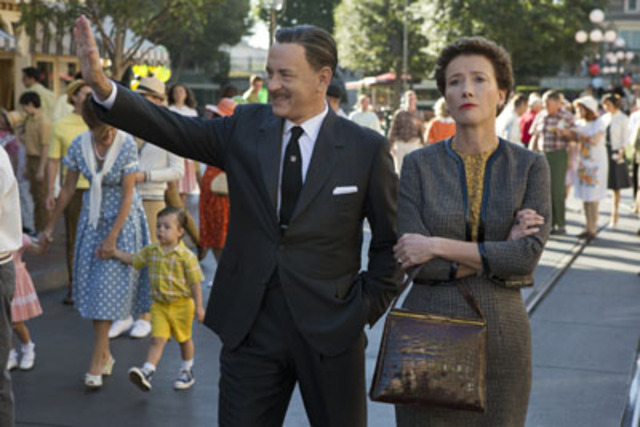
 Tom Hanks and Emma Thompson in HAND ME AN OSCAR, CHARLIE! (Walt Disney Pictures)
It looks and sounds exactly like the kind of Hollywood schmaltz that throws boiling vats of syrup and sentiment against the impenetrable walls of my jaded critic fortress, only to meet an unyielding, cynical foe. Its very concept is that of an extended advertisement, a two-hour pat on the back for the Disney Empire. It celebrates a classic children’s movie that I saw with my family at a long-shuttered Washington movie palace, my primary memory of which is terror. Those were the days when people could still smoke in movie theaters, thus any childlike wonder I may have had at the magic of cinema was overcome by childhood neuroses at the danger of clouds of cigarette smoke in a dark, crowded movie theater that would almost certainly burn down. Those lucky enough to escape death by asphyxiation succumbing instead to fatal trampling at the feet of a Florsheim-heeled mob.
And yet, improbably, I enjoyed Saving Mr. Banks, director John Lee Hooker Hancock ‘s awards-season bio-drama of the creative battle between Mary Poppins author P. L. Travers (Emma Thompson) and entertainment mogul Walt Disney (Tom Hanks). (Told you it was awards season.) I laughed, I cried, and I did not even mind that Hanks doesn’t sound much like Uncle Walt.
The movie begins not in the Magic Kingdom but in a magic kingdom: memory. The young author, nicknamed Ginty (Annie Rose Buckley) daydreams on the lawn of her home in Australia, doted on by her loving father (Colin Farrell). Past and present alternate throughout the whole film as Travers’ childhood memories come up against the pressing concerns of adulthood. Namely, that Walt Disney, who has been trying to get into Mary Poppins’ big-screen pants for twenty years, flies the reluctant author from London to Los Angeles in a last desperate attempt to acquire the rights to Travers’ well-loved book. Before she signs off on anything, the stiff and serious Travers attempts to work with the movie’s script and songwriters (Bradley Whitford, B.J. Novak and Jason Schwartzman). Cultural and personality conflicts ensue.
If you are aware that there is a movie called Mary Poppins, you may know how Saving Mr. Banks ends. But getting there is more eventful and more emotionally fraught than you might think. Travers’ father was a flawed man, her childhood not a magical idyll, and the present-day movie’s title makes it clear where the movie is going: somebody is going to be saved, or die waiting. The movie suggests too that the prim and proper P.L. Travers is saved as well, learning to get down with her inner child in a lesson plan orchestrated by a mouse, or rather a mouse’s creative team.
The skeptical viewer may be forgiven for assuming that various liberties were taken with the subject and the historical record. Many such liberties were taken with last year’s Hitchcock biopic, about the making of a very different movie. But poetic license did not make that terrible film any more interesting. For all its spoonfuls of sugar, Saving Mr. Banks reveals the creative and personal bitterness that lies behind even the most commercial confections. It may not be good art, but in a season that commodifies childhood wonder, let us also, like Mrs. Travers, summon up childhood trauma.
—
Saving Mr. BanksDirected by John Lee Hancock
Written by Kelly Marcel and Sue Smith
With Emma Thompson, Tom Hanks, Colin Farrell
Rated PG-13 for thematic elements including some unsettling images
Opens today at Landmark Bethesda Row