 Last night was the fourth mayoral debate and, if it was any indication, this race will be anything but boring. Hosted by The Current Newspaper, the debate was held at The Dumbarton House in Georgetown and featured six of the seven “serious” contenders in the April 2014 primary. Noticeably absent was Mayor Vince Gray, who attending a public safety walkthrough of Shepherd Park in Ward 4.
In lieu of having the chance to square off against the current mayor, the six candidates who were there—Councilmembers Muriel Bowser, Tommy Wells, Jack Evans, and Vincent Orange, as well as non-Council candidates Reta Jo Lewis and Andy Shallal—got an unexpected visit from a different candidate: 31-year-old businessman Christian Carter, who, despite not being invited to participate in the debate, rolled in 15 minutes late and pulled up a chair next to Bowser.
Things got a bit tense when Current publisher Davis Kennedy—who was moderating the debate—refused to acknowledge Carter’s presence until people from the crowd yelled out to “let him speak.” But things got even more awkward after Kennedy finally gave in to Carter’s presence, saying “I forgot to say that the candidates who were invited to participate were all those who have been elected at least to the city Council. We invited two other candidates to participate who we thought were reasonable longshots.”
Both Lewis and Shallal were, obviously, not happy about this. Shallal and Lewis supporters were also pretty offended by Kennedy’s remarks, as one person from the crowd shouted out that she’ll “never” support the Dumbarton House again.
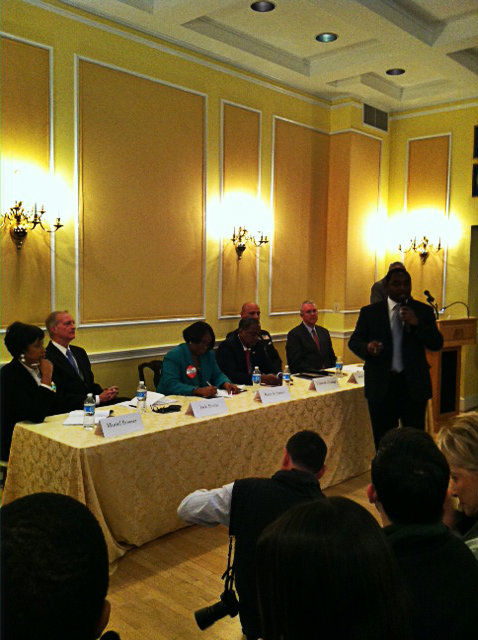 Photo by Matt Cohen.
Once all of the hullabaloo from Carter’s abrupt entrance settled down, the candidates made their pitch to the crowd by answering a variety of questions about various hot-button issues facing the city. As the debate took place in Georgetown, a lot of the questions were pretty Ward 2-centric (which obviously gave Evans a home field advantage), such as: What should be done with the Whitehurst Freeway? (Most agreed it should be torn down, but only if a Metro or light rail is installed to connect the city); should Georgetown get a Metro station? (Most also agreed that there should be one, but Wells thinks a streetcar track or light rail is far easier to install than a Metro station); should non-Citizen’s Association members be taxed to support neighborhood private security? (All: No!); and—perhaps the most Georgetown-y question of all—should the city expand sales tax to include gyms and similar businesses (Also: no).
Kennedy pressed the candidates about more city-wide issues, including what should be done about the city’s parking issue. All the candidates except Wells agreed that the Office of Planning got it wrong by reducing the amount of required parking spaces in neighborhoods. The candidates seemed to be most divided when Kennedy prompted a question about campaign finance reform laws. “We should ban corporate contributions and also ban Councilmembers from being on corporate payrolls,” Orange said, taking an extreme position, while Lewis, Bowser, and Shallal all agreed that it should be about the disclosure of where the corporate contributions are coming. Evans said that “campaign finance laws are where they should be,” referring to the latest campaign finance reform bill that was recently passed by the Council. Wells, of course, has been more than vocal about his “clean money” campaign.
But the tensest moments of the evening came when Kennedy introduced what was to be a series of “ultra-tough” questions, which were written specifically for individual candidates. “Are these questions going to be rude or tough? Because they were rude earlier,” Shallal said half-jokingly, referring to Kennedy’s “reasonable longshots” comment. Wells defended himself against Kennedy’s question that, in his seven years on the Council, he “hasn’t done much,” (citing, among other things, his upcoming marijuana decriminalization bill, which has the support of the mayor and most of the Council). Lewis held her own defending claims that, while her resume is impressive on the national level, she doesn’t have much local experience.
But the toughest question by far was directed at Orange, in regards to his attempt to stop health inspectors from shutting down a food wholesaler, which landed him in some trouble with the ethics board. “I would, in fact, do it again,” he said, explaining that his actions were to prevent a business from shutting down right around the holidays.
Throughout the evening, Carter answered as many of the questions as he could, but mostly came off like a deer in the headlights after his dramatic entrance. In response to an education question, Carter said that he would want to get more “white people” into D.C. public schools so that they could get more government investment. That, coupled with a statement about “yellow people,” prompted a lot of tense looks between his fellow candidates sitting at the table.