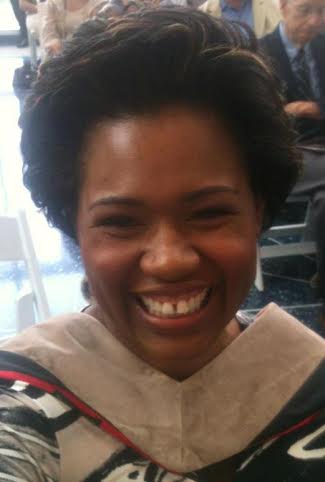
 Sherelle Hessell-Gordon. Courtesy D.C. Rape Crisis Center.
Founded 42 years ago, the D.C. Rape Crisis Center offers free counseling to survivors of sexual assault, as well as their friends and relatives. They also provide community education at schools, churches and hospitals, among other places, and support a coalition that seeks to affect change through legislation. Now, DCRCC has its sixth leader: Sherelle Hessell-Gordon.
Hessell-Gordon has been involved in the violence against women movement for a number of years. She started working at a shelter in Montgomery, Ala. before serving with the California Coalition Against Sexual Assault, the Florida Council Against Sexual Violence, and the Colorado Coalition Against Sexual Assault. Before coming to DCRCC in December, she was the CEO of a consulting firm called RootWorks.
While she took over as executive director in early December, Hessell-Gordon and her family just moved to D.C. in the past week. But she already has a clear vision for the city, which saw a 37 percent increase in the number of rapes reported in 2012.
“I think what the city does well is commitment to supporting holistic and comprehensive services for survivors of sexual assault,” Hessell-Gordon said during a phone interview. “I believe that when you look at system-based advocates and community-based advocates, you definitely have a level of commitment around that there is a need. … I think there’s a dedicated effort, group of people, who are willing to contribute to a world free of sexual violence.”
Hessell-Gordon said she hopes to bring organizing and coalition building to D.C. She explained that, “because there’s many different ways in which people can respond and contribute” to ending sexual violence, “we are just wedded to our own way of how that works.”
“What a coalition does is it provides common language, it provides a level of expertise and training, and it provides a level of technical assistance,” she said. “While that’s here — there are a number of different councils and groups that are doing it — I think the lack of a leader in that regard is missing. I think because of my background, I hope to fill that gap and that role.”
One of the first rape crisis centers established in the country, Hessell-Gordon called DCRCC’s legacy “phenomenal.”
“I think that the organization is prime, the season is prime to do some really intentional, thoughtful work around leading and responding to the issue,” she said. “I love the reputation and the dedicated staff that are connected to this organization, and the reputation that it has within the community around community-based advocacy.”
“When you couple the legacy and the staff, and the commitment from the community and support, that’s a wonderful platform to build on,” she continued.
DCRCC serves as the State Sexual Violence Coalition for D.C., which recently helped introduce to the Council the Sexual Assault Victims’ Rights Amendment Act of 2013 — which aims to address how D.C. police handle sexual assault cases and treat survivors.
Hessell-Gordon said anytime there’s “a common language around a standard of service of care,” it’s helpful for any city. It also allows organizations like her’s to weigh in on “ways to be better.”
“I know that through my conversations since I’ve been here with the [Metropolitan Police Department,] that they’re already and have been making efforts to change the way that they do victims’ advocacy,” she said. “What this language does is continue to illuminate and provide that standard. The police department welcomes it and is having to partner with advocacy-based organizations in figuring out the best way to provide services for sexual assault survivors.”
As for DCRCC itself, Hessell-Gordon said she wants to build “a stronger infrastructure.”
“So that the organization is sustainable beyond personalities,” she added. “I think a lot of times when doing this work from a grassroots perspective, we build organizations from the heart. I think what I bring is a level of business sense that helps the organization build sustainable business practices. We are an organization and we want to be around for a long time.”
For the community at large to be involved in ending sexual violence, Hessell-Gordon said there needs to be conversations across different generations “about how race and class and gender affect this issue and how we respond.”
“It’s about changing a mindset,” she said. “It’s about having a conversation where, we as a society, are starting to build skill sets around what really is consent, and not looking at this issue as a spiral, but understanding that it perpetrates in different communities at a higher level. There’s connections there that illuminate the issue even more.”
“It all starts with a perspective, a conversation, a culture change. And then no tolerance of [sexual violence] within our communities,” she continued. “Any type of social change happens from the ground up. There needs to be a revolutionary mindset around changing our thought process in every way in which consent and assault permeates our world.”
You can hear Hessell-Gordon speak more about this subject at the February 7 TedXFoggyBottom event.