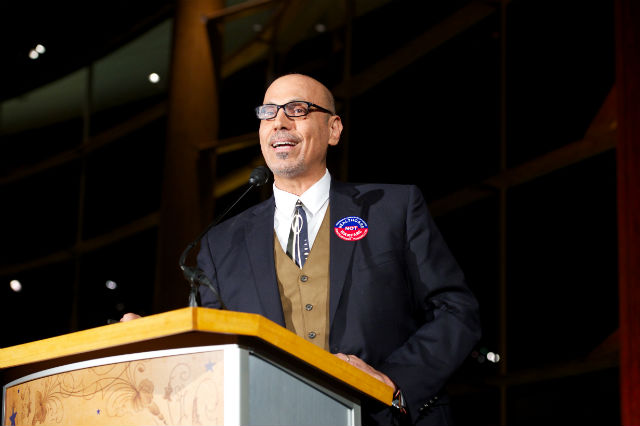
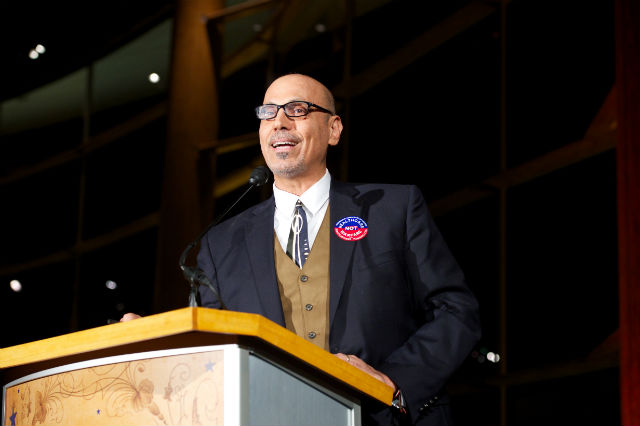
 Andy Shallal. Getty Images.
If you don’t know Andy Shallal, you likely know one of his restaurants.
The 58-year-old artist and activist who “happens to be in business” owns Busboys and Poets — which has four locations and more coming — and Eatonville Restaurant. His eateries are known for hosting poetry readings, book talks and lectures on progressive politics. But until now “democracy’s restaurateur,” as Ralph Nader calls him, has never attempted to become a politician himself.
DCist recently sat down with Shallal at the 14th Street NW location of Busboys and Poets. Note: This interview took place before the Washington Post poll found Shallal with five percent support among voters. See his reaction to the poll here.
This interview has been edited for clarity and condensed for space.
DCist: Let’s start with schools. In your first 100 days as mayor, what would you do to improve the system?
Shallal: I would slow down what we’re doing right now and really try to assess where we’re going, and the value of things that we’ve tried that have worked and things we have tried that have not worked. I think too often we are in a state of always trying to move quickly to get results that are short-term, and often times they also may not be the best fit for all students, teachers, and schools. I think education is a very complicated issue. That has to be understood, because no one said that they can solve our education “issues.”
At the very least, there’s no magic bullet to fix it. I think we’ve done some things that have worked, which I’d like to continue. But we’ve also done things that haven’t worked. What hasn’t worked is closing schools. The first thing that I would do in my administration is make sure we stop closing schools. I think it affects communities, that it separates people, and disbands the most important element of a child’s education, [which] is their community. I want to make sure that we stop doing that. We haven’t really saved money doing it, and so it doesn’t make sense to me. The D.C. Fiscal Policy Institute has done
multiple reports on that issue. It’s sold to us as if we’ve saved money, but we haven’t.
I think it’s really important also to have a clear vision. A clear vision in the sense that, I want to change the way we talk about schools. There’s no such thing as a failing school. I don’t believe in that kind of language. Just as there’s no such thing as a failing child. If we decide we want to make something work, we gotta make it work. If we decide we don’t, we just call it failing and close the door. That’s not acceptable. It’s not acceptable for us to keep closing down schools because we call it failing. If it’s really failing, it’s because we failed. We have to turn that around.
I want to be able to have charter schools not cherry-pick. I don’t want this lottery issue. If I’m living across the street from a school, I should be able to go to it. I shouldn’t have to go shopping around for my kid every single year looking for a school. That’s just not fair. The idea of putting parents in a really awkward position where they have to do a lottery, sit there and pray that they’re going to get into the school across the street, that seems ridiculous, frankly. If they’re gonna have charter schools, which we do — about half of the schools are — I think we really should make sure that each charter school is … able to accommodate the kids that are living in the neighborhood, at least. And then if there’s extra spaces, you open up the lottery for people who want to come from other parts of town. But I want to make sure we hold them to the same standards as public schools.
We’ve been sold a bill of goods that having choice is about shopping for schools every year. I don’t think that gives parents choice. It gives some parents choice, but even those parents would prefer to have a great school across the street, than to have to go looking all over town. … Parents that have nannies that can drive their kids, parents that have the ability to do that — stay-at-home moms or dads — can do that. It’s not such a big deal for them. But most people don’t have that luxury. Most people work jobs where they have to be there certain hours.
There’s this perception that this is how it’s supposed to be. I just don’t think that’s the answer. I want to give public schools more flexibility. I know charter schools have lots of flexibility; I want to give public schools the same type of flexibility. I want to work with the teachers’ union, so it’s not that antagonistic us against them kind of attitude. Teachers are an important part of education, and we need to work with teachers’ unions to make sure that the way we do things with the schools, everyone agrees on.
DCist: What are some specifics things you’d do to encourage healthy development, like more grocery stores, east of the Anacostia River?
Shallal: We have to understand that economic development is not a one-size-fits-all. We’ve been doing economic development as if it’s a business, like a chain of restaurants. If it works in one place, we’re going to open a whole bunch of the same thing all over the place. That’s not how a city should feel or look like. We have this idea that economic development means the most amount of dollar for the most amount of square footage in a certain location. I’ve heard people say, ‘We want to turn Anacostia into Georgetown or Old Town Alexandria.’ And for me, that’s not necessarily what Anacostia wants to be.
I’d love to have neighborhoods. I don’t want to go everywhere and see Georgetown; that’s not to me a vibrant, exciting city. I want to see neighborhoods that have their own unique character architecturally, types of business they have, the type of restaurants they have. … Too often we think of development as something we impose on a community, as opposed to something we help to ignite for them. So I’d like to see more involvement, a way to encourage local entrepreneurs, local businesses, local startups. … Too often we don’t do that. Too often we have a one-size-fits-all as an answer. We run a city sometimes like a business. A city is not a business. The development that happens in this city is supposed to benefit the people that live there. Too often they become invisible. Too often they become the D.C. that we don’t see.
DCist: Would something like a government-supported BID, as Councilmember and candidate Jack Evans has suggested, make sense to you?
Shallal: Absolutely. I think we can create immediate jobs for a lot of people: Cleaning up the alleys, to beautify the city and beautify areas, paints murals and do all kinds of things that help create an identity for a community that often times gets neglected and ignored once big economic development comes in.
We tend to think of these kinds of developments as a quick fix … — we bring in new development to the area then other things will start sprouting. That’s not how it’s supposed to look like. Every little shop, every little store should have its own unique character, as opposed to … putting up a development like Homeland Security at St. Elizabeths campus, which has done nothing for the community from an economic development perspective. There are 14,000 jobs there, but only 300 of them or so don’t require a college education. … It may bring more money to the city, but these people aren’t seeing the benefit of that money.
DCist: Per a Twitter follower, what would you do about marijuana arrests that disproportionately affect black men?
Shallal: I think at the very least we have to identify that race plays a role. When I hear some politicians say that we’re racially blind, I get concerned in a city that is so racially charged. I think being racially blind doesn’t mean that you don’t pay attention to race. On the contrary, you’re ignoring that race plays a role. And race does play a role in this country, in this city, in this day.
I think, at the very least, be conscious of race, train the police department to understand race and understand the culture, understand the nuance of how you deal with race and how race plays an important role. … I think it’s a crisis. One out of three [black] men [under the age of] 25 has had a brush with the law. It seems rather startling. … We have one of the highest interned citizens numbers in the country. Ten percent of our population in the city, 60,000 people, are returning citizens, people who are often times dropped off at the side of the road with their things and a bus token. It’s a lot of reality how race plays out in the city. We have to address it. We have to train the police department, staffing at all levels to understand that race is very, very significant, and then monitor how we’re doing.
DCist: So is the decriminalization and legalization of marijuana a separate issue?
Shallal: No, I think it is. They’re certainly interrelated with one another. Part of what that [ACLU] report said was that the usage is about the same between whites and blacks, yet blacks have 85 to 90 percent of the arrests. Clearly, marijuana decriminalization has to be addressed at this point. Just like we regulate alcohol, we need to regulate small amounts of marijuana, as well, for personal use.
DCist: You’ve already voiced your support for the elected attorney general referendum, which the Council overturned.
Shallal: I think we have to understand that we live in a democracy. I think when we keep shutting down the public, it makes people less and less engaged. And when they’re less engaged, we have a much more difficult task to run a city. … You start by engaging them politically and electorally. When people feel like they can make a difference, they become much more engaged citizens.
DCist: You haven’t served in political office, which can certainly be seen as a positive. But what would you say to people who find this to be a weakness against Councilmembers who have been involved in D.C. politics for years and know the inner workings of the Wilson Building?
Shallal: This is about leadership. Leadership can transcend different jobs and different positions. I’ve been a leader all my life. I’ve had my own businesses for decades, and I know how to lead and I know how to succeed. I think the idea that city Councilmembers are very knowledgeable in how the city operates, I would beg to differ. I think they’re often times knowledgeable in areas of their own personal expertise and their own committees that they deal with. But I’ve talked to many of them and, honestly, they’re knowledge base is not as deep as you may think it is.
I think there’s a desire in having someone who is an outsider to operate the city. I understand budgets. I know how to read budgets really well. I’m really good with money. … I’ve been looking at the city budget for quite some time now and, frankly, there’s a lot of opaqueness to it. I’d like see more transparency in how money is spent.
What I’ve noticed from a cursory look is that I believe there’s a lot of waste in the city that nobody pays attention to. And for us to think that city Councilmembers have had the interest of the voters for all these years, you only have to look at the tax debacle recently where people who owed $200 had their homes pulled out from underneath them. To me, that doesn’t show a city Council that’s engaged or cares about the people.
I am not a pay-to-play person. I have not been involved, and so it makes me less tainted in having to be beholden to a certain constituency. I think that’s what the people want, they want someone who has not been bought, is not beholden to a certain interest group. I feel like I bring a fresh perspective, I bring a vision this city has been lacking. This city is rich in resources, but poor in vision. And I think that’s been one of the problems, having a vision where all this economic development that we look around that politicians love to talk about — where they’re counting cranes and high rises — it’s supposed to benefit the people. And many of them are being crushed by that, as I mentioned earlier. I think that if you have a vision that says, the people are supposed to be the beneficiaries of that, then we stop running the city like a business, and run it like a city that’s supposed to be working for everybody, not just for people who give the highest donations, for people who have access to city hall. I think we’ve done that. I think the city does not feel like it belongs to many individuals that I’ve been talking to.
Twenty percent of this population lives below poverty. We are a city that’s one of the wealthiest in the entire country, yet we have the highest rate of childhood poverty. We are the city that has the most educated population in the entire country. At the same time we have 62 percent dropout rate in our schools. Our school system is rated below Mississippi, at the very lowest of every matrix. Illiteracy rate is 50 percent east of the river. These are third world country statistics. So, somebody tells me that city Council knows how to do this, I will say just look at the numbers and look at who they are ignoring: the very vulnerable. Isn’t that what government’s supposed to take care of? The very vulnerable, our children, our elderly, our working poor.
Homelessness is the highest that it’s been in a very long time; our shelters are overflowing. There’s a lot of money being wasted. Do you know how much it costs for a family to stay at D.C. General? $54,000. I want you to visit D.C. General and see where $54,000 is going. I think it’s time for a fresh start.
DCist: I think that’s on everyone’s mind: How to help the vulnerable population. What are specific things you’d do in the first year to help them?
Shallal: We need to make sure that affordable housing is truly affordable … so that the people who’ve lived here all their lives, for decades, enduring the worst of times, don’t get pushed out when things get better. I think it makes people really upset when that happens. I want to make sure we really do have a living wage in this city, and make sure that the jobs that we attract to this city are jobs that have benefits and a living wage. So that the people who work all day long don’t have to worry about putting food on the table or a roof over their head. I want to make sure the city becomes much friendlier to small, local startups. A lot of people have opportunities that they want to be able to put out on the street. They’re working out of their homes or basements. If there’s a way, the city [should] help push them forward and become self-sufficient and make a business and hire other people.
I think there’s a lot of ways we can help alleviate poverty. I’d like to see the possibility of free public transportation. People should not have to be bound by the geographic area where they live. We live in a very mobile society. … If I can go look for a job further away from my home because I can get there and afford it, it gives me better opportunities. I don’t have to be stuck in a menial job within walking distance. Maybe I can expand my horizons and go further out and find a job that pays me better.
We’ve institutionalized poverty. … I don’t want to just hand out turkeys on Thanksgiving. I want to make sure people can buy their own turkey on Thanksgiving.
DCist: What would you do differently than what the city’s doing now to create affordable housing? Put more money in the Housing Production Trust Fund? Diversify where the housing is?
Shallal: Well, the Housing Production Trust Fund is fully funded this year. I want to make sure it gets fully funded every year, so it’s not like whenever the budget decide it’s not time for it that … we take steps backwards. We have to continue that inventory and continue to grow it. I think at the very least we would start with that.
I want to revisit the idea of public housing. I think public housing has a lot of merit. But I think the way we’ve done public housing is not very good, so we’ve set it up for failure. We don’t have good lighting, we don’t have good landscaping, we don’t have nice-looking buildings. We don’t have things that encourage a sense of pride in one’s neighborhood. We need to make sure that when we have public housing, it’s well maintained, it’s safe, that the landscaping looks attractive, that the buildings look attractive, and not make it look like a prison. … If you look at places like Alexandria, they do public housing very nicely. You can’t even tell when you’re driving by a public housing project. (I want to stop calling it project, by the way. Project makes it seem like they’re doomed for failure.) That’s one thing that we’ve done very badly, and I’d like to address it again.
The whole idea of inclusionary zoning is really useful on some level, but I find it really — I’m a little confused by it. There’s this idea if you put a poor person next to a rich person, they’ll suddenly feel like, ‘Oh, I can be rich too and I need to get off my ass now and do something.’ It really doesn’t make a lot of sense.
DCist: You mentioned “waste” earlier. What are some specific examples of that? Is there something D.C.’s spending too much money on?
Shallal: I’m not saying we’re spending too much on anything. I just think that we have to look at the budget as a moral document, not just as numbers. Every number has an impact.
I was standing in line one time at the social services office over in Anacostia, and I asked a woman who was standing in line there — Tiffany whose hours had just been cut significantly at a florist shop. She said, ‘They’re cutting back a lot of the benefits, like rent assistance and food stamp assistance and other assistance.’ I said, ‘Do you know why?’ And she said, ‘Well, there’s no money in the budget.’ I said, ‘Well, how much do you know about the budget?’ She knew very little. But we’ve been conditioned in that, ‘Oh, that’s just the way it is. The budget says it’s so.’ The budget doesn’t have anything to say. We decide what the budget looks like, and it’s based on certain social contracts that we’ve had for centuries. … I think there’s a lack of understanding of that, and I think we need to get back to the idea that every single line item on that budget has meaning.
When I’m mayor, I want to be able to look at that budget and really drill down at every number and find out where that waste is and make sure that it gets reduced or eliminated. There is a lot of waste. I know that just by looking at what happens at D.C. General. If you look at the school system, it has a huge budget. I’ve seen numbers between $10,000 per child to $24,000 per child, depending on how you do the math. I want to be able to understand that a little more and come up with real solutions that [make sure] that money that we’re putting up for the schools are really trickling down to the kids. Kids are the real beneficiaries of that, not budget overhead and contractors that are benefitting from that.
I think a fresh eye is really useful.
DCist: You’ve talked about how you want to devote the senior year of high school to civics. A Twitter user asked the question, how would you engage with D.C. college students?
Shallal: There are more universities in this city than there are high schools, which is remarkable. They don’t pay taxes, which is also remarkable. They want to help. I’ve talked to professors, I’ve talked to universities. One of my alma maters, George Mason University Institute For Conflict Analysis And Resolution, I’ve talked to professors there who say they’d love to get involved in creating the civics curriculum and other things, as well.
I see that young people often times don’t go out and vote. They don’t feel like it’s really significant. … But I feel like high school’s a missed opportunity. You have this captive group, and you want to engage them as much as possible. So if you can get them to be a powerful voting bloc the last year of high school, that would give them so much empowerment in a sense of civic engagement they would otherwise not have. Rather than spending the entire year waiting to get out, make that year the most important, exciting year. Have them spend it at the Wilson Building. Have them spend it all over the city. Have them follow city Councilmembers and ask them difficult questions and be the ones dogging them about issues. Have the city Councilmembers and anyone running for office be sitting at their feet because they want that voting bloc. 7,000 of them are in this city. I think it’s a missed opportunity.
The other is engaging universities in — cause I see a lot of kids that come out of DCPS often times or charter schools that don’t have real life skills. They know a little bit of math, they know a little bit of English, but they don’t have life skills. I’d like to engage them in a life skills academy after fifth grade, let’s say, when kids are going to middle school. Often times, that’s when the wheels fall off and kids get into all kinds of issues. Try to create a life skills academy after the fifth grade where every child in public schools has to go through that process. … Have it be a six week program that’s mandatory. They learn how to be a better citizen, how to deal with diversity, how to avoid bullying, how to field a conflict, anger management. All this stuff that often times some kids don’t get at home. This is our opportunity to make sure that kids are on a level playing field, so they don’t have any impediments to succeed. I think if we can create that kind of common values curriculum, I think it can go a long way in making kids able to have a conversation with one another differently, have teachers understand their language, having certain standards of behavior. So it’s not just every school for itself and every child for himself, depending on what family or background you come from, if you want to succeed you can succeed. I want to make sure that every child succeeds.
And then maybe repeat it again after eighth grade, maybe with a different, higher level-type of engagement. But I do believe that rituals are important, that certain rite of passages are really important. They realign people in a different way.
DCist: The Washington football team: For the team to come back to D.C., should they be required to change their name?
Shallal: This seems like such a simple thing to do, frankly. I don’t know what’s the big deal. The fact that we’ve gone through this over and over again seems so unevolved. Yeah, it’s time for this. If enough people find it offensive, I think we should change it, just like we changed the name of the Bullets. … I don’t like the new name too much, but hey, they changed it and it happened. And people are perfectly OK with that. It’s much ado about nothing, and we need to change the name.
DCist: The RFK-United stadium deal: What is your opinion on swapping city land for new stadiums? Would you support something like that as mayor?
Shallal: I wouldn’t support something like that that really takes away taxpayers’ money. As much as we’d like to think that the Nationals stadium — I know some politicians feel that that was a big, big, huge thing — I think it may have been OK. It’s useful for economic development. But I think we would have had that stadium no matter what. I have businesses in this city. I’m still paying a hefty sum of money every year for the stadium tax, and that’s gonna go one for another at least 15 years. For me, it’s not been a great deal. I don’t believe in giving up taxpayers’ money for a for-profit venture.
I don’t want to give up public spaces. Land is our most precious resource. It’s limited. And for the city to be constantly acting like pawnshop, it’s not a good idea. I think lots of developers when they buy a lot of land, they’re gonna maximize it’s potential from a financial perspective. That’s not necessarily always the best thing for the community or the best thing for the city. For me, getting ride of the Reeves Center, for instance, and just building more condos and retail on the first floor is not what this community necessarily needs more of. We have 70 restaurants between Thomas Circle and Florida Avenue. I love all the restaurants, no doubt. I’m one of them. I’m not sure that’s what the city needs more of.
I think what we need is more community gathering places, more arts center, more incubators, more creative spaces for people to come together in. And public spaces, so there’s no barriers for people to get in. I’d like to see the Reeves Center turned into a Torpedo Factory [Art Center in Alexandria]-style [place] on the first floor, have incubators throughout it of different IT companies, entrepreneurial startups, things like that. Lots of great creative ways to turn this building into something really exciting and buzzy all day long. I think there’s lots of opportunities to do things a little differently, instead of feeling like it’s a cookie cutter, one-size-fits-all. That’s not what people want, I don’t think. I think people want diversity. They want to see this city be more vibrant, more exiting, rather than having more of the same. People don’t want a city of the rich, for the rich, by the rich. They want a city made up of people, real people.