 Via TPB.
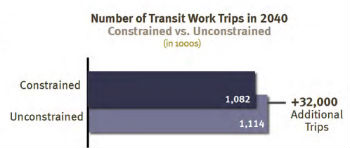
A recently released report from the National Capital Region Transportation Planning Board found that, if funding commitments for Metro from the federal and regional governments don’t happen, an estimated 32,000 trips a day would be pushed to the roads in 2040.
In a summary of the TPB’s report, the Metropolitan Washington Council of Governments said:
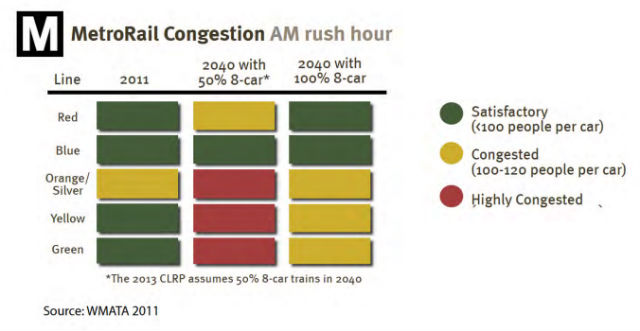
In its analysis, the TPB assumed that Metro railcars and station platforms would become so overcrowded, primarily in the system’s core — downtown Washington and parts of Arlington — that Metro wouldn’t be able to accommodate a portion of anticipated growth in ridership resulting from future population and job growth.
The TPB also assumed that a lack of funding commitments from Congress, the District of Columbia, Maryland, and Virginia for ongoing maintenance of the system beyond 2020 would result in diminished system safety and reliability. That would further limit the number of people who could or would use Metro to travel to and from work each day.
In all, the TPB estimates that about 32,000 trips a day, around 12% of the ridership growth that would otherwise be expected — and a conservative estimate, according to TPB planners — would be pushed into non-transit modes, mainly driving.
This “capacity constraint” placed in 2020 would also lead to high levels of congestion for the people who do ride. As the PlanItMetro blog explains, 2020 is “the year beyond which current levels of maintenance funding levels expires.”
In other words, because regional leaders have not committed to funding transit, those that forecast travel demand have decided to stop forecasting increases in transit usage. Were it not for this artificial “cap”, travel demand forecasts would show much higher numbers of future transit use.
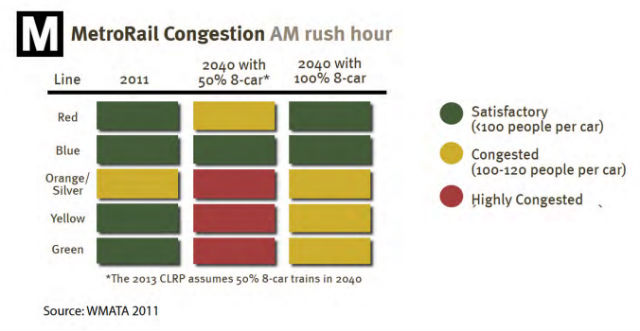 Via TPB report.
Metro officials, including General Manager Richard Sarles, and members of the MWCOG Board of Directors will discuss the need for this funding at a meeting tomorrow.
The Board is requested to adopt Resolution R23-2014, approving a letter from the Board of Directors to Congress supporting the Momentum Strategic Plan and requesting federal funding for Metro 2025.
Metro 2025, the capital improvements part of the Momentum plan, is expected to cost $6 billion.