 In yesterday’s Go Home Already, I linked to a story which talked about the results of a report conducted by Wider Opportunities for Women. The report discussed the amount of money that people under certain conditions in different areas around the Washington metro area need to make in order to feel financially “secure.” Of course, there’s serious wiggle room in that phrase, and plenty of commenters argued the validity of the numbers cited — for instance, a single person without children to support in the District was deemed to need a yearly income of $32,000 per year to be “stable.”
I finally got a chance to peruse the report, titled “The Basic Economic Security Tables for the Washington, DC Metro Area,” this morning, and thought that I’d share some of the information inside of its pages for you to squabble over. Specifically, the data on single people and what they need to get by.
One failure of the study is that it never comes out and explicitly states what its definition of “economic security” is. Based on the literature out there, the term appears to mean having enough money coming in every month to build a stable future. (I know, we’re defining relative terms with yet more relative terms. Best I could do, though. If there are any economists in the audience, please feel free to define the concept to me in concrete terms.)
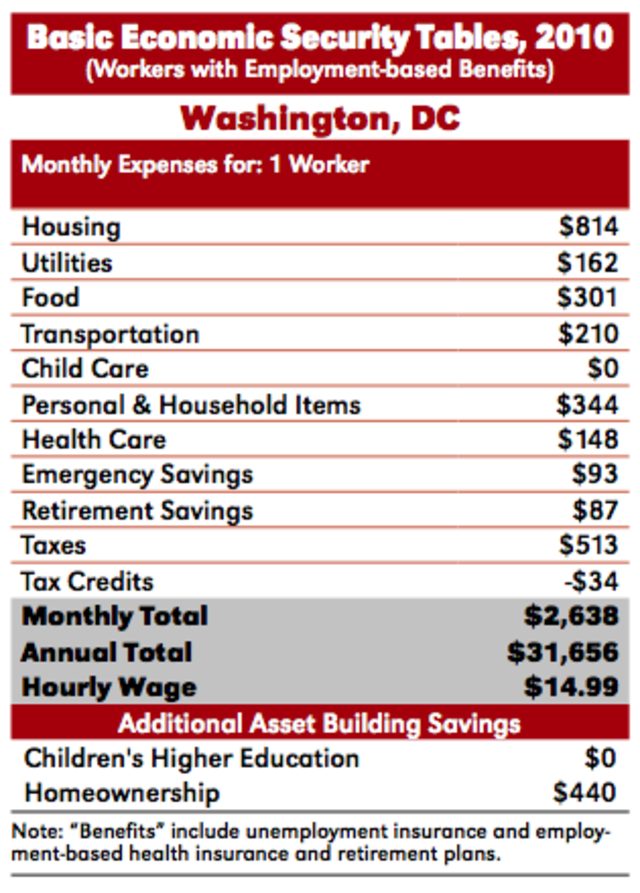
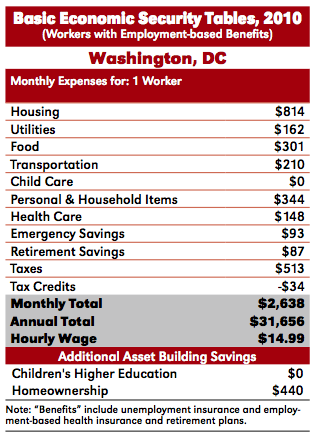
That said, what does the study consider basic budget items for workers? “The core BEST Index contains basic budget items essential to all workers’ health and safety: housing, utilities, food and essential personal and house-hold items such as clothing, household products and a landline telephone,” says the report, which also notes that the Index also assumes that all work occurs outside of the home (incurring transportation costs) and that everyone pays their taxes. Aside from the fact that most single people I know carry a cell instead of a landline, that seems somewhat fair. The Index includes a provision for their progeny’s higher education (obviously null for those without children) and homeownership saving. The chart to the above right represents the amount that those with “employment-based benefits” (read: health insurance) need to make call themselves financially secure.