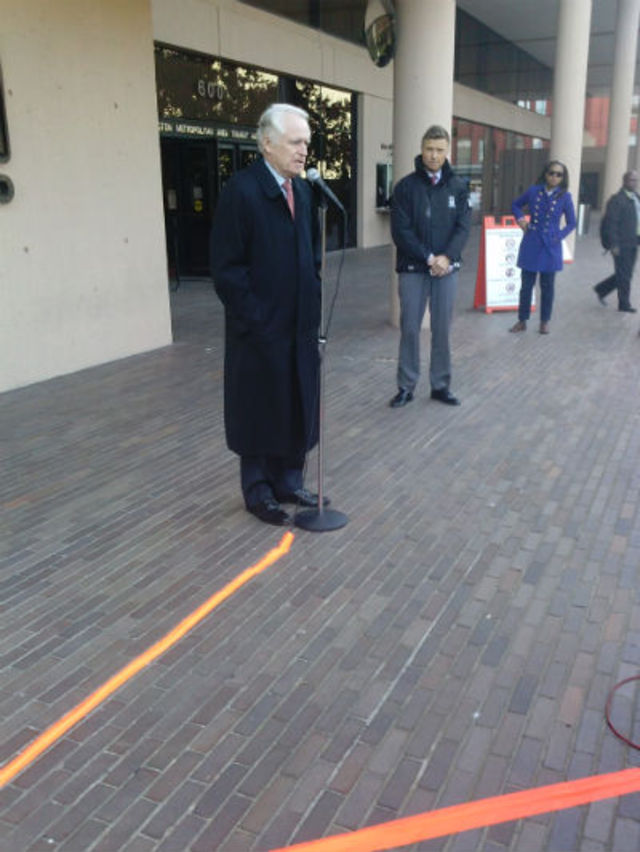
 Sarles outside Metro headquarters. Photo by Sarah Anne Hughes.
Metro’s general manager testified today on the need for increased funding from the federal and regional governments in order to continue improving the system.
Richard Sarles told the Metropolitan Washington Council of Governments board of directors that, by 2010, Metro had “slipped pretty far downhill,” and less than $400 million a year was being spent on reconstruction. “We would have continued to slide without having an aggressive reinvestment program,” he told the board. “Thanks to the jurisdictions and the funding they’ve provided, we’ve reversed that trend and been digging ourselves out of the hole.”
Based on the rate of progress that’s taken place, Sarles said, he estimates Metro will be out of the hole in three years. “We’ve begun to relieve some of that impact on our customers,” Sarles said, adding that Metro no longer does scheduled maintenance during the weekdays.
“There will always be a need for reconstruction, but it will not be as intense as now,” he said.
The COG board unanimously passed a resolution in support of a letter that asks Congress to re-authorize the Moving Ahead for Progress in the 21st Century (MAP-21) Surface Transportation bill and replenish the Highway Trust Fund. MAP-21 provides funds for Metro’s safety improvements.
“If the region is to maintain its current transportation system and make the needed capacity investments for the future to meet population and economic growth, significant additional transportation funding is needed,” said the letter signed by D.C. Council and COG board Chair Phil Mendelson.
The State of Maryland and the Commonwealth of Virginia both passed major
transportation revenue acts in 2013, and the District of Columbia is dedicating increasing funding from its general fund for transportation improvements. These increases in transportation funding at the state level will make more investment possible for the Washington metropolitan region. However, the increased state revenues do not make up for the decline in spending power of the federal contribution, leading to a decrease in overall transportation funding. As the seat of the federal government, we, the region, are asking the federal government to do more to ensure regional mobility and prosperity.The COG Board of Directors urges you to consider the critical role that safe, efficient, and sustainable transportation investment plays in the economy of the region and the workings of the federal government and workforce. The extension of MAP-21 and replenishment of the Highway Trust Fund, including much-needed increases in federal funding, should be at the forefront of your legislative responsibilities.
When asked if Metro needs more funding from Virginia, Maryland and D.C., Sarles replied, “It’s needed.”
“Our board has been working very hard at lining up the support for that type of funding,” he continued.
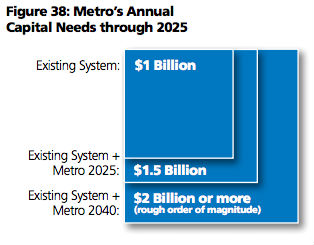 Metro 2025 — a $6 billion part of the Momentum plan to increase the amount of eight-car trains in service and provide additional improvements — requires an extra $500 million a year from local governments, as well as funding from the federal government. Sarles said there are discussions underway with local jurisdictions to provide this funding and he’s “cautiously optimistic” they’ll get it. Metro’s fiscal year 2015 budget looks for $50 million from D.C., Maryland and Virginia.
But if they don’t secure the funding, he warned, an option to order 220 additional 7000-series cars expires in August 2015. If that happens, they’ll be set back five years.
The COG board will present another resolution on funding for Momentum at a future meeting, Mendelson said.