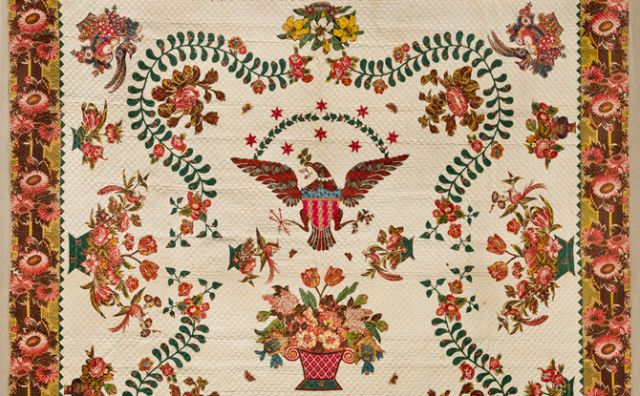
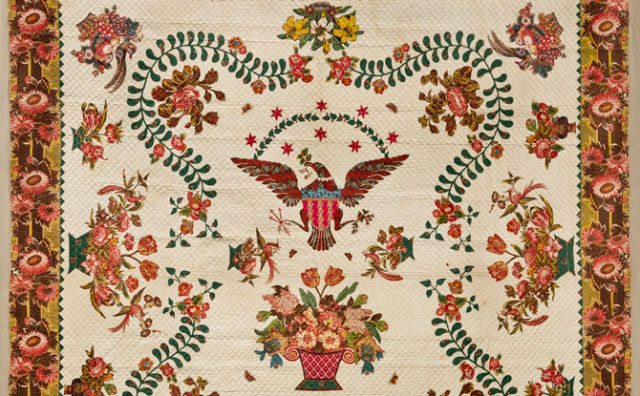
 Elizabeth Welsh of Virginia, Medallion Quilt, ca. 1830; Brooklyn Museum, Gift of the Roebling Society; Photo Gavin Ashworth 2012, courtesy of the Brooklyn Museum.
By DCist contributor Carolyn Lang
To mark Women’s History Month, the National Museum of Women in the Arts will use the 31 days of heightened public awareness to provide programming that showcases the creative contributions of women across geographical and generational borders. The celebration will include film screenings, a staged reading marathon, gallery talks, artist conversations, and a Wikipedia edit-a-thon.
The NMWA, currently the only museum in the world dedicated solely to art made by women, does so in part to attempt to redress the vast underrepresentation of art by women featured in museums. Ideally, a female-only space wouldn’t be necessary, and art museums would be at least roughly emblematic of the diversity of the field they showcase. However, that is not the case.
“Take a look at museums in the U.S. and abroad and you will find that less than 5 percent of the art on the walls is by women artists, and that includes many major contemporary art institutions,” museum director Susan Fisher Sterling said. “The same can be said for women’s representation in solo exhibitions and acquisitions of modern and contemporary art by museums, not to mention collectors and the art market.”
While 51 percent of visual artists working today are women, only 2 percent of work on the walls of the National Gallery is by women.
The limited visibility of female accomplishments in museums will ultimately lead to the reduction of female contributions noted in cultural history, a reality that the NMWA actively works to rectify.
March at NMWA will include exhibitions, programs and events aimed to appeal to all patrons, which the museum offers all year.
“By offering the same types of programs that we offer year round, visitors who might discover NMWA during Women’s History Month can continue to participate in the kinds of programs they most enjoyed,” Director of Education Deborah Gaston said. “Currently, we are featuring Workt by Hand: Hidden Labor and Historical Quilts, so have sought to present programs that take inspiration from that show.”
Quilting programs will include lunchtime gallery talks by staff, discussions with quilt scholars and curators, and artist-led workshops and demonstrations by area quilt guilds to encourage local participation. “It is particularly wonderful that this spring’s exhibition centers on an art form so closely associated with women historically, so the exhibition lends itself to Women’s History Month in form and content,” Gaston added.
The NMWA is making a concerted effort to include a generation who may find quilting to be archaic by hosting specialty events with a DIY lens. In February, the museum hosted an evening event called NMWA Nights: Wine, Twine, and Valentine, a happy hour that allowed guests to try their hand at quilting while listening to live music.
March will also be a month-long celebration of prolific artist and feminist Judy Chicago’s 75th birthday, and will include a conversation and book-signing on March 2. Chicago’s most lauded work, The Dinner Party, is a massive ceremonial banquet art installation with 39 place settings, each representative of an influential woman in history. There are 999 more names of women inscribed on the white tile floor, creating a physical manifestation of Chicago’s desire that women be more represented both in history and in the present.
In tune with Chicago’s vision, NMWA will hold the second annual Wikipedia edit-a-Thon all day on March 30, to improve Wikipedia articles about female artists and figures.
The museum will also host its fourth annual Staged Reading Marathon, part of SWAN (Support Women Artists Now) Day events on March 29, featuring a selection of plays by American women playwrights directed by female D.C. stage directors.
The celebration of work by women is not limited to American artists. Israeli-American cellist Inbal Segev will perform on March 5, and the museum will hold two film screenings in partnership with D.C.’s Environmental Film Festival on March 24 and 25. The Barefoot Artist is the story of Lily Yeh, Chinese artist and founder of Barefoot Artists Inc., a non-profit organization aimed at training and empowering residents in impoverished communities in Rwanda, Kenya, Ecuador and China. The Barefoot Artists have been lauded for their methodology of using the arts as a tool to build community and empower personal transformation.
The second film, Sokola Rimba (The Jungle School), documents Indonesian woman Butet Manurung’s journey to bring literacy to indigenous tribes living in the forests of Indonesia to help them to situate the encroachment of the modern world.
According to Sterling, NMWA is currently producing a Census of Women Artists in Museums, a new web-based initiative to encourage people to go to museums in their states, regions or countries and count the women on the walls. They will be using mapping technology to post the results and issue an online study.
The empowerment of women through art has significance in the larger realm of feminism, and the emerging fourth-wave of feminists.
“While I’m not a big adherent to ‘wave theory’’ [of feminism], because I believe that change is always in play, I have no doubt that there is a fourth wave because young women out there believe there is one,” Sterling continued. “Media, especially social media, is key, but there are also major grassroots actions and events around issues, e.g. rape on college campuses, to genital mutilation to … feminist punk rockers Pussy Riot, who have achieved cult status.”
Sterling trusts that young women everywhere will continue to advocate on behalf of the advancement of women across all media and carry the spirit of Women’s History month, equity, into the future.
“There are adherents to fourth wave feminism all over the globe because the movement is global. These younger women are tech savvy gender sophisticates who are socially conscious on multiple channels.”