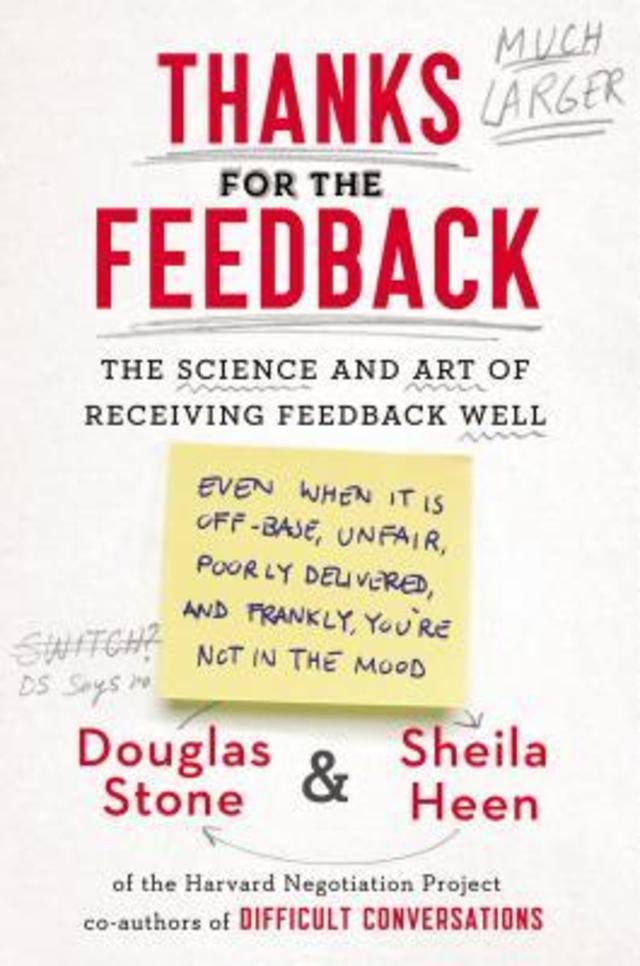
 Don’t take this the wrong way, but you might want to go to this book talk on Wednesday. Douglas Stone and Sheila Heen will be at Politics and Prose on March 5 at 7 p.m. to discuss their new book, Thanks for the Feedback: The Science and Art of Receiving Feedback Well (Viking, March 2014).
Stone and Heen, Harvard Law School negotiation specialists, say being critiqued is tough for a lot of people. “We do want to learn and grow,” they write, “and we also want to be accepted just as we are right now.” Thanks for the Feedback understands this emotional tension, but explains that “your growth depends on your ability to pull value from criticism in spite of your natural responses” to “off-hand comments, annual evaluations, [or] unsolicited advice.”
Bosses, significant others, and loving parents, you’re off the hook this time — the authors say we should invest more in teaching how to receive feedback than how to give it. That’s because no matter how feedback is given, it’s useless if the receiver can’t absorb it: “It is the receiver who controls whether feedback is let in or kept out, who has to make sense of what he or she is hearing, and who decides whether or not to change.”
So logically we know feedback is good, but how do we improve our response to it? Thanks for the Feedback outlines the three main types of feedback, how each is useful in its own way, and what “triggers” might prevent the feedback from being taken well. These triggers, Stone and Heen write, can shift conversations to be more about the trigger than the feedback. They give advice on how to deal with this.
There is room for cooperation between the feedback giver and receiver, as receivers can “coach” givers on how to give them helpful feedback. The book also explains how its lessons can be applied to organizational cultures, to foster a more feedback-friendly work environment. Plenty of anecdotal examples are given, which keep the book from being too abstract or lecture-like.
In addition to their positions at Harvard, Stone and Heen are co-authors of the New York Times bestseller Difficult Conversations: How to Discuss What Matters Most. While writing it, they realized that giving and hearing feedback was way up there in “difficult conversations.”
Wednesday’s talk is free and open to the public.