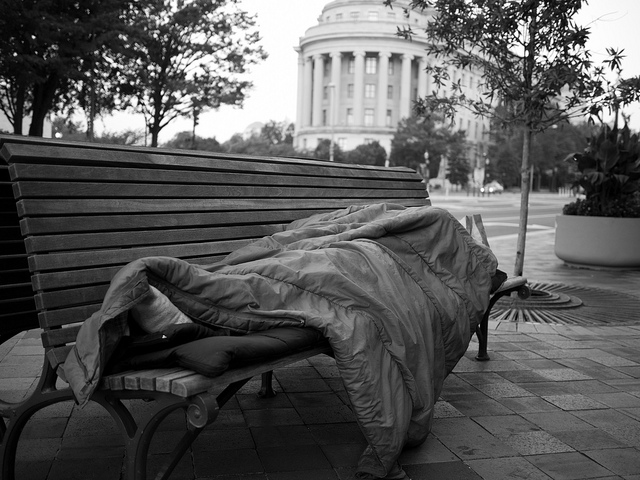
 Photo by Devin Smith.
Actors will give voice to a largely voiceless population tonight as they read stories from homeless writers at Theater J.
Author Susan Orlins began facilitating a weekly writing group at Miriam’s Kitchen four years ago focused on storytelling.
“I said, ‘Tell me a story about heartbreak,'” she said during a recent phone interview. “People really opened up and they were open to this idea.” Now a collection of these stories from both writers at Miriam’s Kitchen and the newspaper Street Sense, where Orlins is also a volunteer, has been developed into “Homeless Lives: Unforgettable Stories” and will be performed at 8 p.m. tonight. Admission is free.
One of the stories will come from Gerald Anderson, who wrote the series “My Katrina” for Street Sense. Orlins said she met Anderson on her first day at the paper, where she learned that his Street Sense customers had raised money to send him back to New Orleans for the first time after the devastating hurricane.
“This is the kind of bond that vendors have with their customers,” she said. After realizing he had a story to tell, Orlins suggested he write a series for the paper. “He has a gift for storytelling,” she said. “He did not go past seventh grade, he dropped out of school. But he has a gift for storytelling, a gift for the way he expresses himself.”
Anderson’s story will be told Friday, as will stories about being in prison, love, bullying, homophobia and even Santa Claus. They were told to Orlins orally and then edited without taking away the language and essence of the storyteller.
“These are really riveting stories,” Orlins said, adding that they will be read by professional actors. “Nobody’s getting paid. Everyone just wants to be a part of this.”
Beyond the immediate benefit of having trained actors deliver these stories, this also protects the identities of the writers from Miriam’s Kitchen.
When asked if these stories reflect the writers’ views on how the city treats the homeless, Orlins said writers at Street Sense use the paper to voice their opinions on advocacy. But for some who come to the writing group at Miriam’s Kitchen, it offers a break, a chance to get away from the realities faced on the street.
“It shows our common humanity,” Orlins said of “Homeless Lives.” “We learn about ourselves in the process. One man told me, ‘Because of the writing group at Miriam’s Kitchen,’ and now these stories that are going to be told, ‘This has opened up avenues for me that I never thought possible.'”