 Via Shutterstock.
Among the issues — and there are many — D.C. Public Schools are facing and attempting to fix is an end to the “school-to-prison pipeline;” a term that describes a pattern in which schools push students out of the education system and into the criminal justice system. There’s a popular belief that our nation’s education system is often neglectful when it comes to addressing the needs of troubled and underprivileged students, more intent on disciplining them through suspension and expulsion instead of working with them to solve the root of the problem. The effect, experts say, sets youth up for a life behind bars.
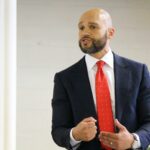
While the school-to-prison pipeline is an issue facing schools across the nation, in D.C., some school officials are exploring new methods to help fight that culture. The root of the problem, they think, lies in how D.C.’s public, private, and charter schools punish students. “We’ve got to stop incarcerating what is essentially adolescent behavior,” says Dr. Ian Roberts, principal of The Academies at Anacostia.
At a panel organized by Councilmember David Grosso (I-At Large) addressing the school-to-prison pipeline problem last night, Roberts — along with Thena Robinson Mock, the project director of Ending the Schoolhouse to Jailhouse Track of The Advancement Project, and Eduardo Ferrer, the legal and policy director of D.C. Lawyers for Youth — discussed what can be done at the local and national level to help address this issue.
A big part of the problem is the myth that suspension and expulsion helps set a student straight, according to the panelists. According to statistics from DCPS, 13 percent of students enrolled in D.C. public schools during the 2011-2012 school year were suspended at least once, while some middle schools had suspended over 50 percent of their student body. “The bulk of suspensions and expulsions are discretionary,” Ferrer says, “and they mostly have adverse effects.”
At The Academies at Anacostia, Dr. Roberts says he’s been employing his own unique efforts to help combat the school-to-prison pipeline, and they’ve shown to be an improvement. At the beginning of each school year, before students arrive, Roberts makes his staff go out into the community and introduce themselves to every parent. “It builds a positive relationship with the parents and with the community,” Roberts says. Especially for his staff who, he says, are mostly “white college grads” from a middle class or upper middle class upbringing, and have never spent time in the predominantly black, lower-class neighborhoods near the school.
Roberts has also introduced several other quirky policies that has helped students stay in school and out of juvenile detention centers. “We believe in giving students second chances,” he says. “The solution is not for [the Metropolitan Police Department] to arrest students for school violence, and it’s not to suspend or expel students.” Roberts firmly believes in finding different ways to help troubled students that often act out with violence. Among them is keeping the school open later, so that teachers or guidance counselors can work with students to help them work out their problems. Roberts has even implemented week-long suspension moratoriums, instead forcing students who get into trouble to work out their issues in school, rather than sending them away as a punishment.
On a national level, advocacy groups like Dream Defenders and the ACLU are trying to solve the school-to-prison pipeline problem by working to diminish ineffective procedures like zero-tolerance policies, high-stakes testing, excessive police presence in schools, and a racial bias towards students of color. By implementing restorative justice programs as a counter—much like what Roberts is doing at The Academies at Anacostia—it can greatly reduce the amount of students in the school-to-prison pipeline.
But while Roberts’ methods at The Academies at Anacostia are having a positive impact, that’s just one school. The big question is what can be done to reduce the school-to-prison pipeline at a city-wide level. For one, the role of MPD officers in schools can be reevaluated. “The role of cops in schools is not to be a disciplinarian,” Mock says. “That is for teachers, guidance counselors, or administrators. Not police.” In terms of what city officials can do, Grosso says that introducing legislation that increases transparency in school data, as well as introducing more wrap-around services for school—especially in mental health—can help schools.