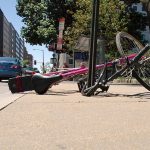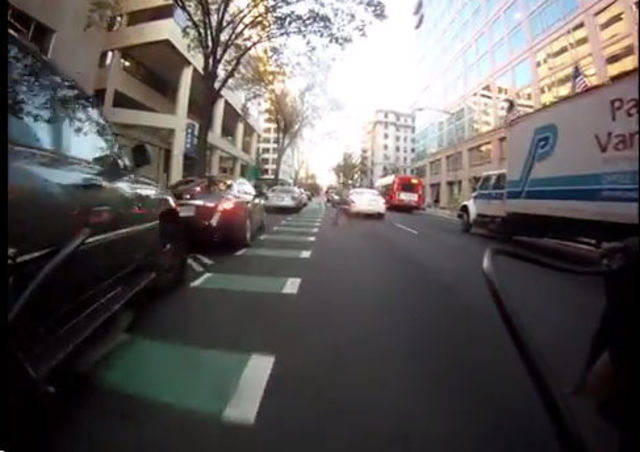
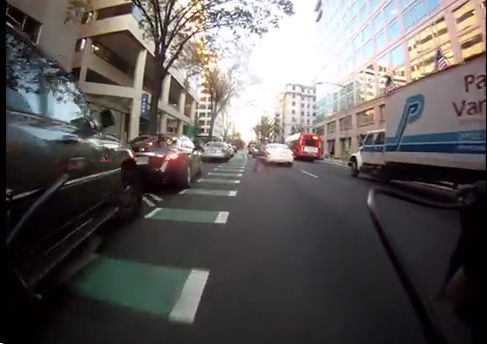
 A view of illegal activity in the L St NW cycletrack from Evan Wilder’s handlebar-mounted video camera.
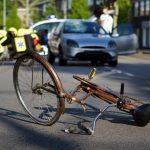
In 2011, Evan Wilder was hit by the driver of a truck after he was told to “move his genius ass to the fucking right” while riding in the center lane on Rhode Island Avenue NE. We know this because Wilder was filming his ride.
The photojournalist found himself in a similar situation last week. A driver of a truck tried to force him off a section of R Street painted with a sharrow, he wrote, and he collided with the back of the vehicle, causing the driver to become aggressive and throw his bike in the truck. Wilder was ticketed by an MPD officer for following too closely while in the hospital.
Again, Wilder had a camera rolling and turned the footage over to MPD, which is reviewing the video. A decision is expected soon.
Wilder can’t remember when he started biking to work — maybe 2009, he told DCist — but he remembers why he started doing so with a camera. After years of biking around town without issue, Wilder moved near the National Cathedral and ran into his first “scary incident” on Connecticut Avenue near the Woodley Park Metro station. A driver in a red sports car changed lanes, nearly hitting Wilder. He tried to get his license plate number, but Wilder said the driver kept “brake checking” him and got away.
“A guy in a red car, that’s all I knew,” he said. “I knew I couldn’t go to the police with that story.” Feeling unprotected, with other stories of driver-said, biker-said incidents in his mind, Wilder got a camera and has biked with it since. “Gloves, helmet, camera,” he said of his routine. “We’re ready to go.”
He’s become known in the cycling community for posting videos, both to YouTube and Vimeo, of bad driver behavior toward bikers. The kind of videos that make fellow cyclists lose their breath with fear and familiarity. Instead of just deleting the footage, Wilder uses it to show where the dangerous intersections are, to show where drivers regularly use the bike lanes. He also talks about these incidents on his blog.
While Friday’s Bike to Work Day was a wash out, with thousands of registered participants staying off the road because of rain, more people than ever are biking to work in D.C. Those who do know that dangers are present and real. Like Wilder, a small number of these commuters already bike with cameras. Here’s why.
Robert Fitzgerald moved to D.C. in July 2012 after living in southern Sweden, “where you bike everywhere.” He points to two negative interactions as the impetus for purchasing a camera.
Fitzgerald said he was attacked by three people hiding behind a car one night while riding his bike home. “I didn’t have any evidence,” he said. “I didn’t have any way to help the police find them. Nothing ever happened there.” Later, he was doored on his way to work. That time there were witnesses, and the taxi driver at fault was ticketed. But still, Fitzgerald said he wondered what would have happened if there weren’t witnesses — or if the witnesses had a bias against cyclists.
Now when he rides, he rides with a helmet camera. “It falls on the weaker road user to prove that it wasn’t their fault,” he explains of his reasoning. He even used it when he moved recently, placing his helmet on the dash of the moving truck.
Fitzgerald posts some of the footage to YouTube. “I thought it would be really funny putting the spotlight on these people who will never get caught in any other way. I’m not trying to screw anyone over,” he said. “It’s kind of a name and shame, as much as I can. If I see illegal behavior and I don’t see it being enforced, I want to go out and do something.”
His most popular video, by far, shows a man named Fred Smith and his wife defending a man whose truck is parked in the L Street NW cycletrack. Smith believed that the bike lane was the narrow area where the bollards are, not the actual part of the road dedicated for bikes.
In another, a woman who nearly hits Fitzgerald while making a turn threatens to shoot him. (“That was funny,” he says.)
These days, Fitzgerald says he focuses on being polite to the people he confronts.
Fitzgerald’s friend, Nacim Bouchtia, was inspired by the Fred Smith video to ride with a helmet camera. Before that, Bouchtia says he had “multiple aggressive confrontations with drivers, particularly on Massachusetts Avenue in front of the old NPR building.”
“I would typically get honked at just for riding on the street, and I had one driver literally wave a metal pipe out of his window at me,” he said via email. “I’m constantly amazed at how easy it is for otherwise decent people to put other’s lives at risk in exchange for convenience when they’re in a car. The most common confrontation for me is getting honked at or sped by for going slower than a car.”
Bouchtia say he attempts to “diplomatically engage” with drivers, and “most of those conversations have been very positive, I think largely because a lot of the impersonal aggression melts away when you’re face-to-face.” The camera, he says, serves as “a backup form of protection and perhaps even emboldens me a little” when dealing with drivers exhibiting road rage. To them, he usually waves, smiles, and blow kisses.
Ryan Sigworth, who writes about cycling for Greater Greater Washington, has been using a camera for about six months. He started after he was pushed out of a bike lane on R Street, which led to an altercation with the driver. Now he always bikes with a camera and can’t see a time when he’d bike without one.
Like Fitzgerald, he posts videos of his rides. His main reason is to provide an unbiased account of incidents with drivers. When possible, he puts the driver’s license plate number in the title of the YouTube video, so it’s searchable for other cyclists. He rarely calls the police.
But Sigworth also likes to edit his long rides into watchable — even fun! — videos.
Prosecutors eventually cut a deal with the former Metropolitan Police Department officer who hit Wilder in 2011. While the driver’s punishment was light, video of the attack gave the Washington Area Bicyclist Association a platform to promote a protection law for cyclists. The Access to Justice for Bicyclist Act of 2012, which allows cyclists to sue for civil damages when hit by a driver, passed in 2013.
Since passing, WABA advocacy coordinator Greg Billing said he’s hasn’t heard of a cyclist taking drivers to civil court, as the law allows. Part of that he credits to the changing bike culture in D.C. “Drivers are generally getting better,” he said.
But even as cycling becomes more commonplace, having cameras on bikes is “probably something we’re not going to see widespread adoption of,” Billing said, pointing to their high cost.
There are, of course, public cameras that can provide another set of eyes. But, as Billing said, it can be hard to get access to that footage before it’s erased.
“This is a way for people to empower themselves to have that footage,” Billing said of personal camera use. Cameras also can cause cyclists to behave in a more lawful manner, he said, as they know any possible negligent behavior is being recorded.
While not practical for everyone, footage taken by cyclists can provide helpful lessons for other people who ride bikes. For those who can’t afford or don’t want a camera, WABA offers city cycling classes that teach how to be predictable, avoidance maneuvers and other skills.
As far as Billing knows, no one at WABA rides with a camera.
While the videos clearly have an impact on other cyclists — I’ve become a more defensive cyclist after watching them — their role in making meaningful, lasting changes in D.C. is unclear.
Billing said he isn’t aware if or how these videos are used internally in MPD training. “Are they getting 100 percent of the crashes correct? No, they aren’t,” he said. “MPD has a way to go in training and educating officers about current laws.” But, he said, we are seeing progress.
Cyclists interviewed for this story don’t seem as convinced.
When asked if improvements in infrastructure and driver behavior could make it safe enough to ride without a camera, Sigworth replied, “It’s never gonna happen.” But while wearing a camera is a “fine tool” for him, Sigworth said he can see how it’s not worth it for everyone.
Wilder said he’s come to realize that problems cyclists face are, at their heart, infrastructure or enforcement and education issues. “I’m so glad that these [videos and incidents] can help out me and other bikers,” he said. “I’m really hoping we can … have a larger conversation about how we can make our roads structured and designed to work for all road users. And how the police can be our allies in making sure we have the right of way, in making sure that drivers who harass aren’t allowed to.”
Indeed, while Fitzgerald says he wouldn’t stop biking, he’s “troubled” and “discouraged” by what happened to Wilder recently.
We lean on organizations like WABA, Wilder said, “to move the dial.” But the city hasn’t “made a stand in making our roads safer,” he said. “It does not feel like we’ve gone nearly far enough.”
If after reading this piece you’re convinced you need a camera, the cyclists involved with this story have shared what they use.