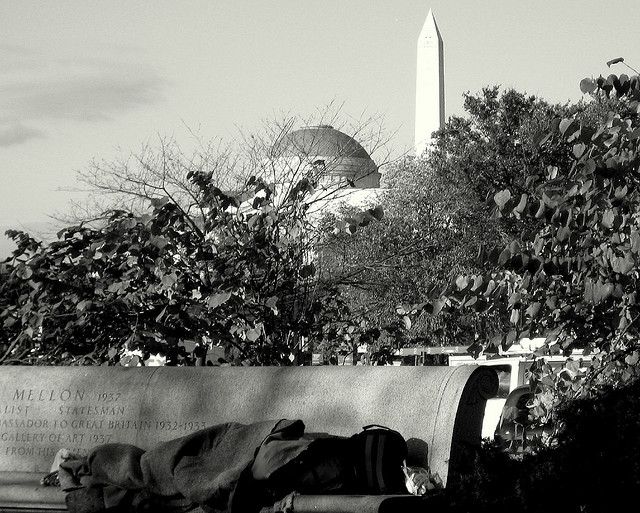
 Photo by rjs1322.
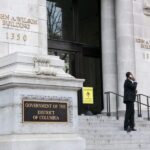
The D.C. Council voted to approve the fiscal year 2015 budget yesterday, with broad tax cuts for many residents and a major reduction in funding for the streetcar.
While a comprehensive plan created by advocates to get a handle on the family homelessness crisis was not fully funded, there were many victories. Kate Coventry from the D.C. Fiscal Policy Institute says the Council identified $2 million for a homelessness prevention program, $3 million for the tenant-based Local Rent Supplement Program, $600,000 for additional case managers at D.C. General, and $500,000 for Emergency Rental Assistance. For adults, $250,000 was identified for coordinated entry and $1.5 million for rapid re-housing.
Improving the entry system will allow the city to assess 750 single people in 100 day and house 275 through permanent supportive housing, rapid re-housing, and other means. There will also be money to hire a person to coordinate this effort and other people to assess clients.
It’s a similar effort to what Tom Murphy from Miriam’s Kitchen called the “historic” commitment Mayor Vince Gray put in motion toward ending veteran homelessness in D.C.
“It’s just about making sure that the resources that are available go to the people who need it the most,” Murphy said of coordinated entry. “It’s a way of making sure that people are evaluated based on their need and matched with what can most help them.”
“You can’t improve the system if you’re not measuring where the greatest need is,” he added, saying coordinated entry is a step forward in making servings more effective and more efficient in general.
Even with $2.3 million in additional funding for permanent supportive housing for families and veterans, advocates would like to see more for other homeless groups.
“The funding we’ve gotten is a good start,” Coventry said. “We’re hoping that we can get additional funding between the first vote and second vote if additional revenue is identified.”
Essentially, the Chief Financial Officer will identify additional revenue, and the Council will decide how to spend it. ‘We hope we can use it to tackle homelessness, as it’s clearly a community concern and we don’t a repeat of what happened last year,” she said.
“The targeted prevention program should help, but we really think the roadmap is needed.”
While Murphy, whose group is part of the Way Home Campaign — an effort to end chronic homelessness by 2017 — would also like to see more money go to PSH, he sees the additional funding as an endorsement of the housing model.
“We have to look at it as progress,” he said, later adding, “The challenge is knowing that there are still a number of clients [who could benefit from PSH that] it won’t necessarily be funded for this year.”
For youths, $250,000 was identified in the budget for street outreach, $25,000 for a youth census, $500,000 for coordinated entry, $190,000 for five emergency beds, $380,000 for 10 transitional beds and $200,000 for two positions to support the McKinney-Venter Coordinator at Office of the State Superintendent of Education, allowing for additional outreach and interventions for homeless youth in public schools. This is just $1.3 million of the $10 million needed, according to the D.C. Alliance for Youth Advocates, to end youth homelessness.
DCAYA executive director Maggie Riden said they will continue to lobby and advocate to get closer to the $10 million mark. “We have some great allies at the Council who will help with that,” she said.
But even if $5 million for the plan is eventually funded, Riden said they will still have to give up much of what is needed, including beds, nightly street outreach, a high level of re-engagement and family reunification — “a real travesty.”
“We’re going to have to get very creative as a community with how we use those dollars,” she said. This could include finding matching funds through donors and using a D.C. government facility with low overhead for a drop-in center.
Riden said a loss of funding to the Council’s Human Services committee made it impossible to come up with the money there. While she appreciated Councilmember Marion Barry’s idea to move $3 million from the Department of Youth Rehabilitation Services for the plan, “we would have been hurting the same kids.”
Other committees had available funding, she said, but that money was allocated to other priorities.
“For whatever reason, the issue of young kids and parents on the street wasn’t at the top of their wish list,” she said. “I’m a little shocked by that given the crisis.”
Riden said there are Councilmembers and committees that are actively looking for funding and would make the plan a priority if supplemental funding is found.
“Perhaps we need to do a better job of explaining how that $10 million [will save money] over time,” she said. “There’s still a disconnect.”