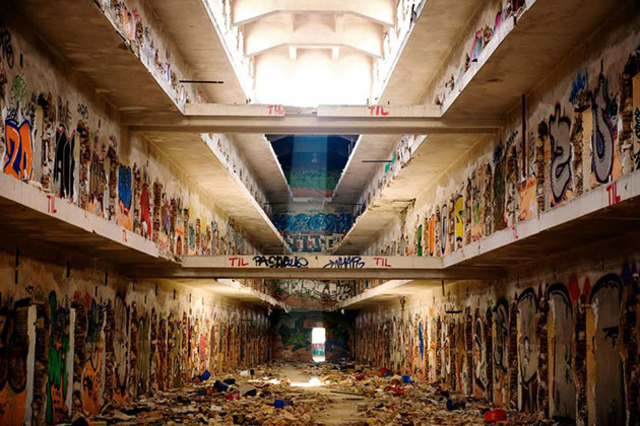
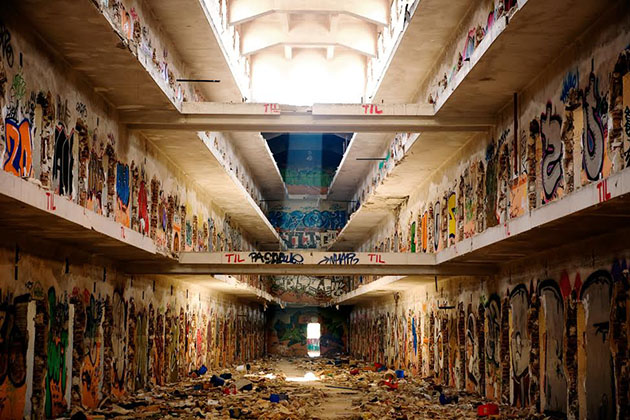
 From Carabanchel (Mark Parascandola)
Photographer Mark Parascandola is based in Washington, D.C. and Almeria, Spain, where he has family ties. Parascandola’s work has previously documented former movie sets in Almeria, while his self-published book, Carabanchel, takes a different kind of look at human architecture.
The area where the Carabanchel Prison once stood was in the 18th and 19th centuries a kind of bacchanalian idyll where the rich spent their leisure time and lorded over grand country estates. The area saw a lot of damage during the Spanish Civil War, so much so that by 1939 the one luxurious resort area seemed as good a place as any for a massive prison. Based on the Panopticon, the same design that inspired Eastern State Penn in Philadelphia, the prison closed in 1998 and quickly fell into a graffitied ruin. Parascandola photographed the prison before it was demolished in 2008. The massive institution that once housed and dehumanized thousands of prisoners had shed its institutional uniformity for the chaos of local graffiti artists. Parascandola’s new book documents this decay and the colorful tags, which suggest a change in the pattern of human behavior from one in which freedoms are taken away, to one in which freedom becomes an institution’s destruction.
DCist recently asked Mark about his work and training.
How does your study of epidemiology inform your photography? Does your photography come into play in your work in epidemiology?
Professionally, I was trained and work as an epidemiologist. This has come to inform my artistic work over time. Epidemiologists study patterns of health and disease in human populations. That is, instead of focusing on the individual, they study groups of people and their surrounding environment. Epidemiologists ultimately seek to understand the causes — social, economic, and environmental, as well as biological — that are behind the patterns we observe in health and disease.
My approach to photography also involves looking for patterns and visual clues to a hidden story. Rather than reflecting the stories of individuals, as photography often does, my work focuses on a community or population over time, such as the half-century story of Carabanchel seen through the architectural remains. Also, in photographing Carabanchel, I was struck by the repetition and symmetry in the structure that lies behind the chaotic graffiti and debris.
Your projects “explore the impact of movements in human populations on the surrounding environment” in Almeria. Do you have any plans to use this methodology on the Washington, D.C. area?
So far most of my photographic work has been in Spain or elsewhere outside Washington. But living in Washington, and watching streetscapes and neighborhoods change dramatically over the past twenty years, I think it would be fascinating to explore this (if I’m not too late!).
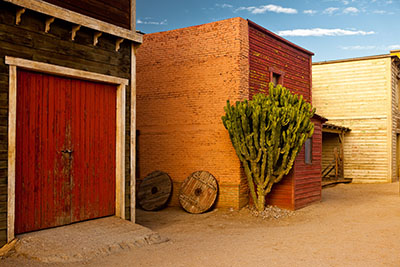 From the series, “Once Upon a Time in Almeria” (Mark Parascandola)
Tell me about your project, “Once Upon a Time in Almeria.”
During the 1960s and 1970s, the region of Almeria, Spain, attracted dozens of international filmmakers because of its combination of unique desert landscapes and cheap labor. Cleopatra, Lawrence of Arabia, Patton, and Sergio Leone’s spaghetti westerns starring Clint Eastwood were all shot here. Four decades later, remnants of the old movie sets remain in the desert. This series of photographs focuses on the architecture and locations used in classic films over the years. Some of the buildings shown were constructed solely as temporary sets, while others are pre-existing structures with their own history, discovered and reused by foreign movie directors.
My mother’s family is from Almeria, so I have a personal connection to the landscape and history of the region. But I also found these film sets especially intriguing as a different kind of relic or “ghost town”. Of course, these buildings were never really inhabited. They are a fiction, constructed solely for the movies. They are not meant to be accurate representations of the American West. Instead, they were constructed to meet a European filmmaker’s vision of what the American West was like. The films also created a fiction about Spain. Franco brought the international film industry to Spain in this period as part of his effort to change Spain’s image for the rest of the world, to promote tourism and show Spain as a modern country that could compete with the rest of Europe. But the version of Spain that tourists saw, either in the movies or at the resort beaches, was a fiction, freed of harsh realities.
The artist Federico Castellón was your great uncle. Can you tell me something about your relationship with him as an artist?
Unfortunately I never knew Federico as he died in 1971. But I grew up with his distinctive artwork always on the walls in our house. The desert-like landscapes that appear in his paintings and prints remind me very much of Almeria, even though he left Spain as a child to come to the U.S. He was an American artist but retained a connection to Spain in his work. Much of my work has focused on locations in Spain, though I see it largely as an outsider. I’ve also been drawn to the way Federico’s dreamlike images suggest rather than tell a story directly.
Is there anything else you’d like to add?
Carabanchel is available for order through my website. I have a solo exhibit coming up at Studio 1469 in D.C. opening October 10 titled “La Chanca: Living on the Margin,” showcasing a series of photographs from a gypsy community built into a hillside in southern Spain. I was awarded an Individual Artist Fellowship from the DC Council on Arts and Humanities last year, which has helped support the upcoming exhibit.