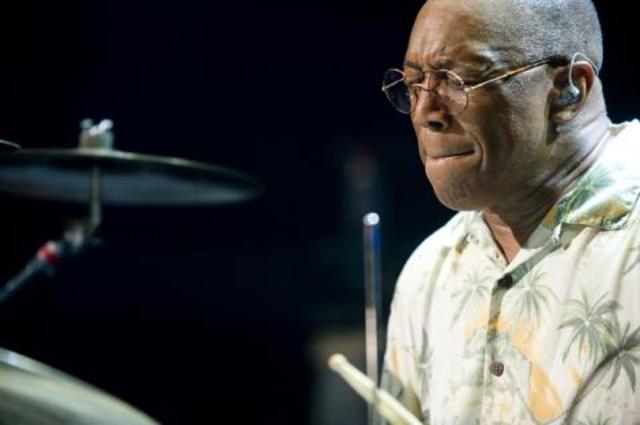
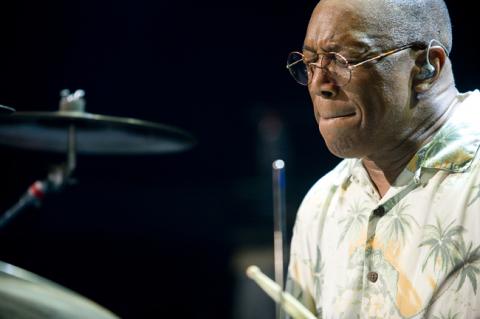
 Billy Cobham leads his quartet, Spectrum 40, tomorrow night at The Howard Theatre. Photo by Anton Antonov.
 In any field, there are times when one individual comes along and turns everything on its ear. A new bar is set and everyone who comes afterwards owes a debt to the accomplishments of that one person. That’s what Billy Cobham did for drumming in the 1970s. He was on the ground floor of the jazz fusion movement and became one of its most influential figures.
“We were a batch of people that put a lot of stuff forward to the generations that came after us,” Cobham said of that period. “Now, many are gone and not around to talk about what we accomplished. I feel like a lot of us were misguided and misinformed on how to take care of ourselves.”
Cobham’s professional career began in the late ’60s, where he first cut his teeth with the legendary pianist, Horace Silver. The now 70-year-old musician got a major boost when he recorded with Miles Davis on 1971’s A Tribute to Jack Johnson. That same year, trailblazing guitarist John McLaughlin invited Cobham to be a founding member of the Mahavishnu Orchestra, an ensemble that is considered among the fusion era’s definitive groups.
“It was a real, real special time. We had a personality that just seemed to connect the dots. If there was a cause, it was really a cause,” Cobham said. “Whereas now, speaking as a ‘young senior citizen,’ yes, there’s a lot of anger in the position of the music, and rightly so, but it’s a lot of bluster.”
In 1973, Cobham released his first solo album, Spectrum, now considered a classic recording. He formed a band last year to celebrate the 40th anniversary of its release, and the chemistry among the group was such that the project continued into 2014. The quartet — comprised of Cobham, keyboardist Gary Husband, guitarist Dean Brown and bassist Ric Fierabracci — is not simply re-creating the material on Spectrum, as Cobham was not interested in pure nostalgia. Instead, Cobham invited the members to have partial ownership by contributing their own tunes. Cobham said that this type of band dynamic is what he’s interested in these days, going so far as to state that the Mahavishnu Orchestra might even still be playing together if it was more democratic.
“Yes, there’s got to be a dictator, and I’m it, because where we find the work and all, that’s me,” Cobham explained. “Where I think that we can share is in the music. It’s all about having a rapport on and off stage.”
Cobham has also evolved as an artist. He has appeared on hundreds of recordings, both as a sideman and as a bandleader. In his early days, much of his effort was devoted to technical mastery of the instrument, to the point where he may have even felt a sense of competition with his contemporaries. Now, Cobham thinks as an all-around musician, not just as a drummer.
“The areas of growth are in the better understanding of the musician who plays the drumset,” he said. “What do the components of the drumset represent? How do they represent you as a player? Most musicians have a tendency to just forget about all that. They look at the color of the drumset and think how it’ll look under the lights.”
Billy Cobham’s Spectrum 40 performs on Thursday, September 11 at The Howard Theatre. 7 p.m. Tickets $30-$50.