 Via Martin Prosperity Institute.
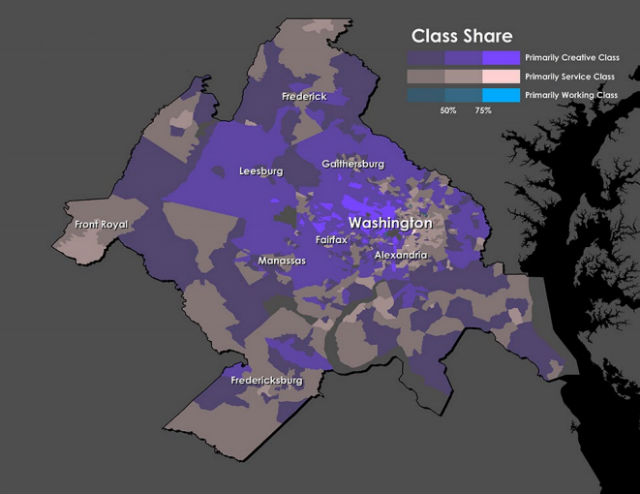
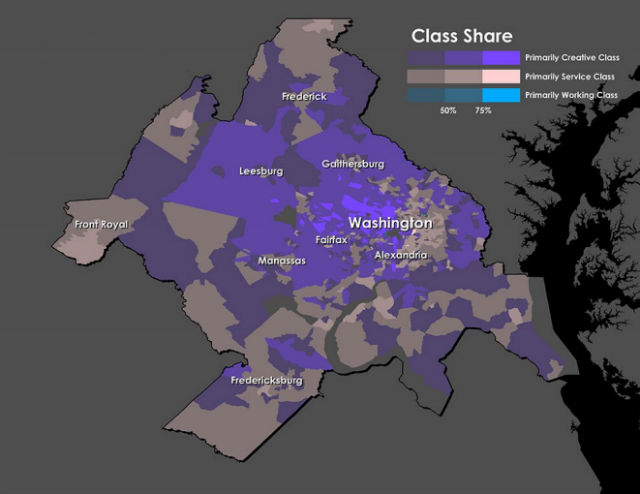
Nearly half of the D.C. area’s workforce is part of the “knowledge-based” creative class, a term coined by economist Richard Florida. A new report from the Martin Prosperity Institute, which Florida heads, maps just how separated that class is from the service and working classes in major U.S. metropolitan areas.
As the report shows, the D.C. area’s creative class is concentrated “in and around Northwest D.C., Arlington, and Alexandria and out to Fairfax, Manassas, and Leesburg in Northern Virginia, and Bethesda, Gaithersburg, and Frederick in Maryland.” The service class, which includes retail, food service and administrative work, “is pushed to the metro’s far corners and the in-between spaces separating creative class concentrations.”
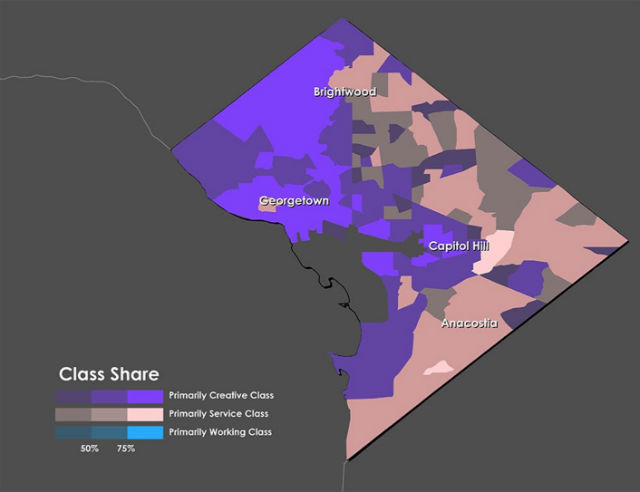
Seven of the ten top service class tracts are located in historically black neighborhoods within D.C. city limits. Two are in Maryland’s Prince George’s County, which wraps around the southern border of the District. One tract includes Georgetown University dorms, where 97 percent of residents are between the ages of 18 and 24, and thus likely to be temporarily employed in service jobs. This is an isolated island in a neighborhood that is predominantly creative class.
The divide is even “sharper” in D.C. proper, the report states.
The classes are also heavily divided by yearly wage. The creative class, which makes up 46.8 percent of the workforce, averages $90,442 in wages and salaries. The service class (40.3 percent) averages $34,337 and the working class (12.8 percent) averages $41,951.
 Via Martin Prosperity Institute.