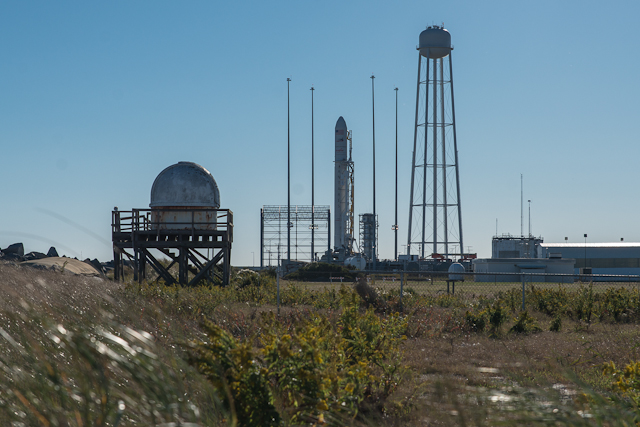
Wallops Flight Facility is a quaint place.
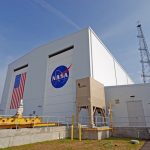
That’s not to say that it’s small; the facility, on Virginia’s Eastern Shore, is expansive, spread out over 6,200 acres of land. It’s to say that it feels distinctly homely. If Cape Canaveral is a touristy resort, Wallops is a cozy bed and breakfast. Satellite dishes dot the rolling terrain the facility sits on, while a small but welcoming visitor’s center serves as its public face.
I went there on Sunday and Monday, with the intention of witnessing the launch of an Orbital Sciences Antares rocket, bound for the International Space Station. I never ended up seeing the launch: Monday’s departure was scrubbed, and what followed on Tuesday, was, well:
The visitor’s center is sparse. Various displays tell the story of the place. It is among NASA’s oldest facilities — it actually predates the organization by some 13 years — and over 16,000 rockets have been launched from it. A wooden cutout of a shuttle astronaut performing a spacewalk sits in a corner, and wide-eyed children and child-like adults line up to be photographed, their faces protruding through a hole cut in the astronaut’s visor.
There’s nothing fancy here. Some of the displays work, others are broken. Employees have taken it upon themselves to affix pieces of printer paper to the inoperative exhibits that share various space facts. “Did you know that the crust on the dark side of the moon is thicker than the side that faces earth?” I did not.
Nestled between the permanent displays at the museum are temporary ones from groups of students who’d been selected as participants in this latest mission to the ISS. Each group was given a test tube with three separate compartments and was tasked with designing an experiment for the astronauts aboard the ISS to carry out. Their plans are laid out on large, trifold pieces of foam board. It’s just like the science fairs of yesteryear, only these students seem less focused on making volcanoes out of baking soda and vinegar and more focused on whether E. Coli will affix itself to lettuce in orbit, whether lead solder will grow “whiskers” when exposed to zero gravity. It is inspiring.
I wander into the auditorium for a pre-mission science briefing. It’s like every other one I’ve seen on TV. The audience is a motley crue: corduroy-clad correspondents from various science journals, NASA employees who’ve clearly upped their fashion game for the event. I feel underdressed in jeans and a t-shirt until I see a space enthusiast in the rear of the room who looks like they haven’t slept in weeks. “Planetary formation is my jam,” the woman tells me.
The briefing is fascinating. Representatives from NASA and Orbital Sciences — the private company that NASA has contracted to deliver the goods — fill the audience in on the payload. It includes the aforementioned student experiments, but more important are the food and supplies headed up to the ISS. There’s equipment headed up that will be used to better analyze meteorites, as well as experiments focused on better treating Alzheimer’s and Cystic Fibrosis.
But the highlight of the briefing comes when Jeff Goldstein, director of the National Center for Earth and Space Science Education, lambasts Sen. Tom Coburn’s (R-Okla) latest “wastebook” report, one which was highly critical of student space programs.
“These are thousands of students being immersed in real research to see it for themselves. These are the next generation of scientists. They are in the pipeline to ensure that the space program can continue for generations to come. To diminish what these students are doing is not right.”
Goldstein goes on to mock Coburn’s assertion that “billions” of dollars are being spent on these programs. The last student space research program, Goldstein asserted, cost $622,000, with $572,000 covered by private partners. Only $50,000 of federal funding was used.
Along with several other media members, I load into a school bus and depart for the launch pad. Fifteen minutes or so later, we arrive. I am in awe. A few hundred yards from me, the 13-story tall Antares rocket seems eager to break free of it’s moorings. I shoot a few pictures of it, but mostly I just stare. When I take a moment to look around me, I see others who’ve come to visit have taken a different approach, snapping “selfies” with the thing. One woman gets a fellow visitor to take a picture of her with the rocket. She poses with her hand extended, the perspective of the picture creating the optical illusion that her outstretched palm is the launch pad the rocket sits on. It’s kind of gross.
I return the next day for the launch. The photographer to my right is an old cat; he used to shoot for a photo agency but has since retired and now just does it for fun. I start picking his brain about how I should set my shot up. I can tell he’s a bit irritated by my advances, but he eventually warms up. “I shot every single one of the Apollo launches,” he shares. “They stationed us three miles away from the thing. When those rockets took off, you could feel the ground shake from 10 miles out.”
There is a small crowd gathered where we are. VIPs, I suspect. This is nothing like the Apollo missions my new friend is talking about. This isn’t Cape Canaveral. There aren’t millions of spectators lining nearby beaches and roadways. There are maybe a few hundred people here. A picnic of sorts. Bereft of any massive amount of public interest, the Antares launch seems to have become a private performance.
Twenty minutes or so before launch, we get word that the “range is red.” Some idiot in a sailboat — yes, one idiot in a sailboat — is holding things up. Engineers have determined that this guy, who is 40 miles out to sea and has apparently turned his radio off, is in the “danger zone,” at risk should the rocket experience some sort of catastrophic failure. There is only a 10-minute window for launch. Sailboats are slow. I fear the worst. A few minutes later, my fears are confirmed: the launch is scrubbed.
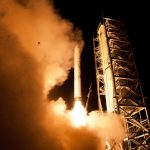
I’m gutted. I know I can’t come back on Tuesday. Twenty-four hours later, I tune into a stream of the launch, standing in a parking lot of a friend’s apartment complex. My eyes are fixed on the sky, hoping to catch a long-distance glimpse of the rocket’s ascent. Then, the unthinkable: the Antares lifts off, climbs majestically for several seconds, plummets back towards the launch pad and explodes.
On television, CNN has decided to take a quick break from their wall-to-wall Ebola scare-a-thon to cover the aftermath of the accident. “They had apparently tried to launch this rocket yesterday but weren’t able to,” Wolf Blitzer barks from the left side of the screen, clearly unaware that there was ever to be a launch in the first place. On the right, a 15-second or so loop of the accident plays over and over again, the basest form of disaster porn.
It is probably the first time CNN has mentioned our space program in ages. Later that evening, a Soyuz rocket will depart from Russia, bound for the ISS. They won’t mention that, either, unless it bursts into flames. For fuck’s sake, are we that desensitized to wonder? In the past several decades, we’ve sent multiple vehicles to Mars and contributed greatly to the construction of a space station that’s been continuously inhabited for 14 years. In July, a NASA probe will give us our first up-close look of Pluto. Probes we launched in the ’70s have gone interstellar, and they are still transmitting data back to earth. In December, the next-generation of U.S. manned space flight will begin with the first unmanned test flight of the Orion crew module.
And yet it seems nobody cares, which is a shame. I came away from my couple of days at Wallops newly inspired. In a way, our greatest triumph in space is that we’ve made getting there seem routine. Occasionally, we get a wake-up call. Tuesday’s explosion was a reminder of how difficult this stuff really is. Please, I implore you, take an interest in our space program. I chuckled when I saw those pieces of printer paper in the visitor’s center. But the fact that we even know these things — that the crust of the moon’s dark side is thicker than the one we can see, that Mars has the tallest mountain in the solar system, that Neptune orbits the sun once every 165 years or so — is astounding.
Perhaps Goldstein, towards the end of his anti-Coburn Rant, said it best: “We are born curious. We are born to explore. It’s wired in us. That’s what it means to be human. We as a species are curious about our place in outer space. We are born to go forth and explore that curiosity, we are meant to do these things.”
And also don’t take a selfie with a rocket. That’s just stupid.