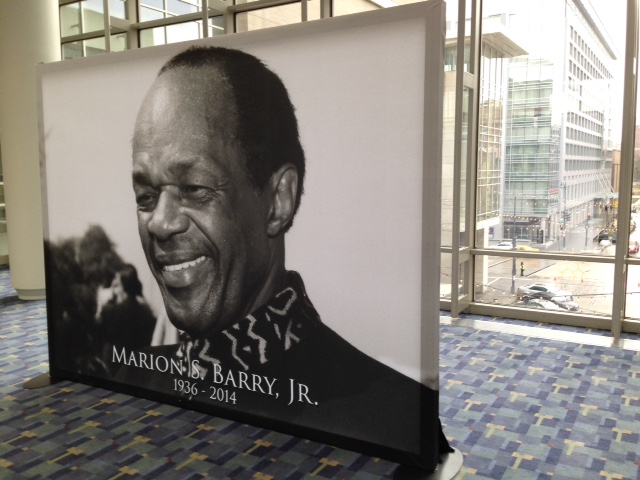
 Photo by Matt Cohen.
When Mayor Vince Gray announced plans late last months for how D.C. will mourn the passing of the “mayor-for-life,” he joked that it would be a “larger than life” celebration, the way Marion Barry would want it.
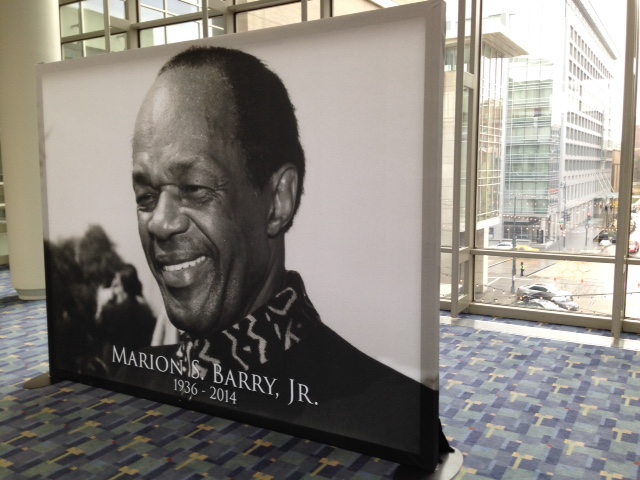
And he wasn’t kidding. The District of Columbia mourned the loss and celebrated the life of Barry over three days last week that culminated in a memorial service at the Walter E. Washington Convention Center. Thousands gathered to the Convention Center where so many people wanted to speak about Barry that the event, which was already scheduled to be a whopping four hours, went well over its time limit. People were so eager to speak at length about Barry that Rev. Willie Wilson, who was tasked as being the emcee of the event, joked about installing a “bungee chord ejector” for people who spoke over their allotted time.
But despite the lengthiness of Saturday’s service, it was an event worthy of the “mayor-for-life:” lively, praiseful, and never dull.
Among the dozens of people scheduled to speak—including reverends, rabbis, politicians, and some of Barry’s family—there was no shortage of thoughtful, rousing, and honest words about Barry and his life and career. “Marion Barry was an icon,” Wilson said to open the day’s festivities.
While the event was certainly a celebration of his life—after every two or three songs, a choir would break into gospel song, sending the crowd to their feet in dance—no one was coy about speaking about Barry’s misgivings. From his addiction with crack-cocaine to his infidelities, most speakers were blunt about discussing all aspects of Barry’s life.
Minister Louis Farrakhan of the Nation of Islam recalled a story in which a reporter confronted him after the Vista Hotel incident and asked how he, an upstanding man of God, could support Barry after his “use of drugs and many infidelities” came out.
“Who are you talking about?” Farrakhan recalled. “John Fitzgerald Kennedy?”
While Barry’s troubles were well documented in the public’s eye—for better and worse—Wilson quite beautifully summed up that struggle early in the service. “Barry understood that our lives are marked by sins as well as virtues,” he said.
In addition to a slew of speeches from local politicians who worked closely with Barry in his last decade of political life—including Gray, mayor-elect Muriel Bowser, Del. Eleanor Holmes Norton, and Council Chairman Phil Mendelson, who livened things up with a particularly funny story about a time when he was an ANC and Barry tried to get him arrested—the ones that struck a particularly strong chord with the audience were the ones delivered by his family.
Though they separated more than a decade ago, Barry’s wife, Cora Masters, said that they still spoke every day and very much loved each other. She described his passionate demeanor and love for the city and its people. “He was a person who felt passion every day of his life,” she said. “He was a person who loved his people.”
Christopher Barry, Marion’s son, painted a portrait of the “mayor-for-life” that not many people have seen: Marion Barry, the father, the teacher, and the chemist.
“He was the chemist in the formula he used for his leadership,” Christopher remarked. Prior to joining the civil rights movement full-time in the ’60s, Barry was working to get his doctorate in chemistry at the University of Tennessee, as the only African-American student in the program.
Christopher discussed how he applied his chemistry background to his political career, developing formulas for how to accomplish his political ambitions. He also spoke of Barry as a “gardener” for the city.
“He planted seeds in people’s lives, and planted hope in the lives of people and the city,” Christopher said. “There isn’t a corner of the city Marion Barry hasn’t touched…and because of that, he’ll never die.”