 Photo by Andrew Lapin.
By DCist Contributor Andrew Lapin
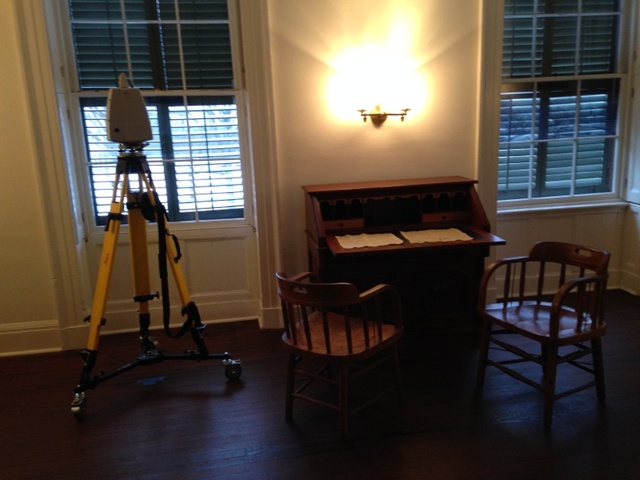
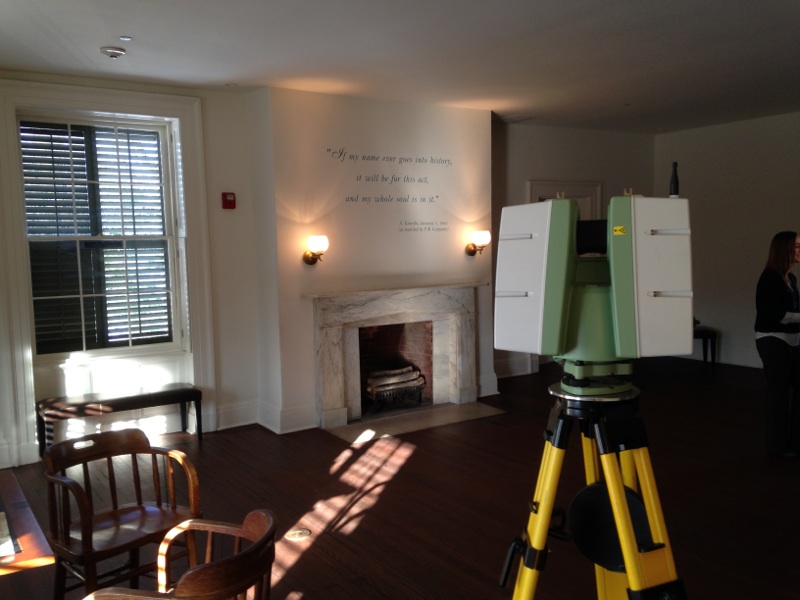
On the second floor of President Lincoln’s Cottage, next to a replica of the desk where Abraham Lincoln drafted the Emancipation Proclamation, a $95,000 laser contraption sits on a tall yellow tripod.
“You guys want to see the scanner?” Dr. Michael Rogers, a physics professor at Ithaca College, asks the small media crowd. Ithaca junior Kevin Coldren turns on the device, a Leica C-10. It makes a low whirring sound and projects a thin green laser beam onto the wall, floor, and ceiling in a full 360-degree circle, pulsing 50,000 times per second to look like a solid line.
The research team had also set up a flatscreen monitor where they rotated and zoomed through a 3D model of the cottage’s downstairs drawing room, which they had scanned the previous day, like it was a stage in Minecraft. A patch of virtual light shines through the window where the scanner had picked up some of the outdoors.
All this was just for show—the school wasn’t gathering data, only displaying the technology to the media. But over the next several days, Ithaca College plans to scan Lincoln’s cottage—the historic landmark in Petworth, where the Great Emancipator summered during his presidency.
It’s the latest step forward in Lincoln’s legacy: lasers in his summer home.
The scanning’s primary goal is preservation. A digital copy of the structure will carry potential uses including a 3D virtual tour of the landmark, which the cottage could provide online to, say, would-be visitors who didn’t book their tour far enough in advance.
The scanner creates its model by measuring the relative distance to walls, ceilings and any other objects present in the room. It’s accurate down to one millimeter. “You have to be very, very precise in all of your measurements,” Coldren said.
The partnership is a win-win for the cottage, as the registered nonprofit will gain a model of the grounds and their architectural features while letting Ithaca College front the costs and labor. The cottage’s preservation team had previously done their own measurements of the building’s infrastructure during an eight-year restoration project from 2000-’08, including the use of borescopes, but the scanner is a far less invasive method.
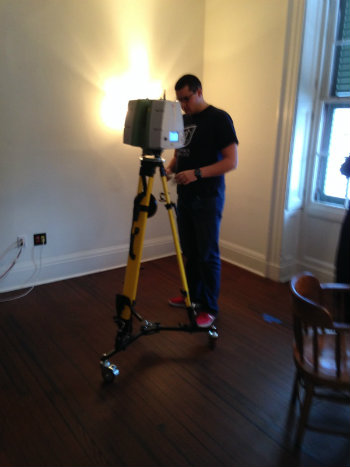 Ithaca undergrad Kevin Coldren takes notes on the scanning. Photo by Andrew Lapin.
“We’re trying to minimize our disturbance of the original fabric” of the cottage’s construction, said Erin Carlson Mast, Executive Director of the cottage. The model would be good to have on hand in the event of a catastrophe that damages the building enough to require reconstruction. Mast cited the 2011 earthquake, which caused some minor structural damage, as an example of an event where the cottage would benefit from having a virtual model in place, so that they can reference millimeter-specific details of the building’s restored condition.
Rogers and his team, which also includes fellow professor Scott Stull and undergraduate assistant Evan van de Wall, were drawn to the cottage because of its “interesting” Gothic revival architecture. “It has a lot of doors,” Rogers said. Those and other features like archways and pocket windows—frames that fold out of compartments in the walls—pose unique challenges for the scanner.
Each scan takes about 30 minutes, and every room of the cottage will be scanned twice. The research team will take until Jan. 14, a total of seven days, to scan the outside and inside of the building. But their plans could be hindered by this week’s cold snap. The scanner doesn’t do well in below-freezing weather, so it won’t be able to take measurements outside if current temperatures keep up.
But Rogers isn’t worried. “The nice thing is that this building isn’t going anywhere.”
Laser scanning isn’t the only activity Lincoln’s cottage has cooked up this year. In April, the preservation team will organize a trek from the cottage to the White House to mark the 150th anniversary of Lincoln’s final stay at the house—one day before the 150th anniversary of his assassination.