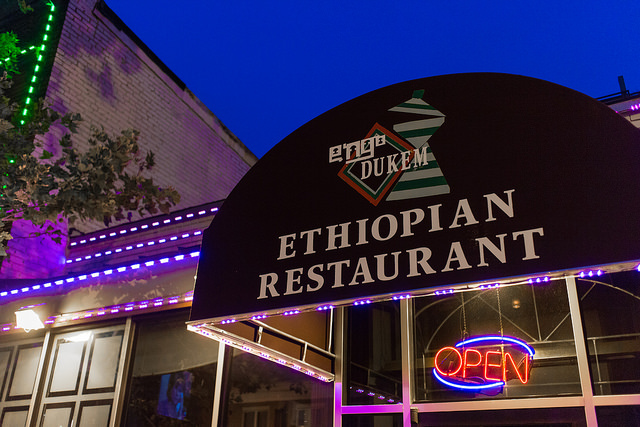
 Photo by Clif Burns.
By DCist Contributor Johanna Mendelson Forman
It is not hard to see that Washington, D.C. is a haven for ethnic restaurants. But did you ever consider how many of these culinary arrivals came here because they were fleeing a war? Once upon a time it was common knowledge that you could always tell where the latest global conflict was taking place by looking at the list of new restaurant openings in Washington.
When I first moved to Washington many years ago, the city was a restaurant backwater. So much so that in the mid-1980s, former U.S. Senator Wyche Fowler (D-GA) publicly lamented that he wished the Russians would send tanks down the Champs-Élysées so that Washington would finally get a good French restaurant.
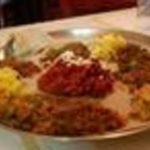
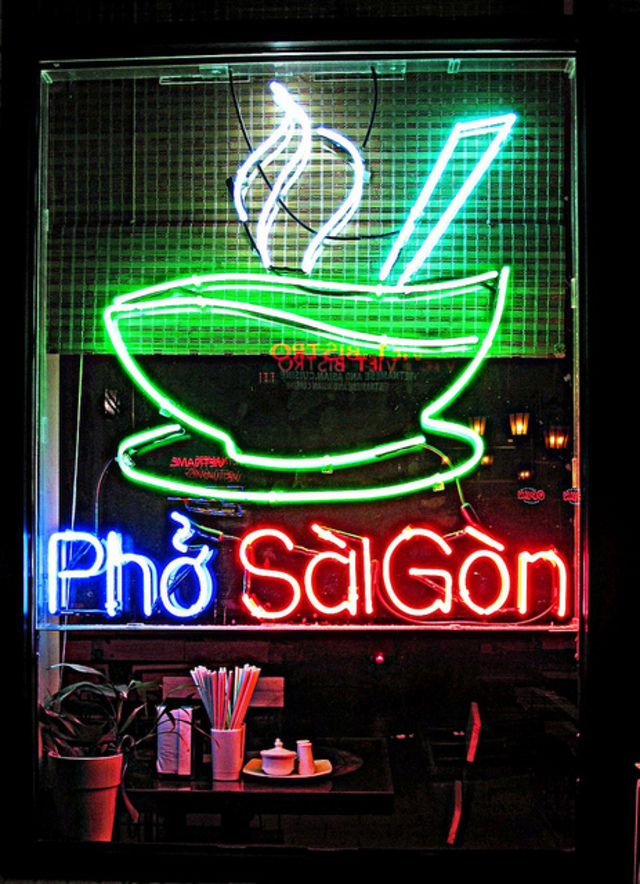
It’s no coincidence that places like the Eden Center in Falls Church, Virginia, or Little Ethiopia on 9th Street NW and 18th Street NW in Adams Morgan were destinations of diaspora who sought a new life in the United States. The restaurants new immigrants opened not only provided a livelihood but also helped integrate new foods into the American culinary experience. Today, if you crave pho, doro wat, or pupusas, you may not realize that the proliferation of Vietnamese, Ethiopian, and El Salvadoran restaurants represent the hopes and dreams of people who fled their homelands with little more than the memories of food they ate.
Starting with the large influx of Vietnamese to the Washington area in the mid-’70s, followed by Afghans who took refuge here after the Soviet’s invaded their country in 1979, the Ethiopians who came here as things fell apart in the mid-’80s, to the large number of immigrants from Central America, but especially El Salvador and Guatemala, Washington has been the home to what I call conflict cuisines. These polyglot cuisines arose from the recipes of immigrants who used their cooking skills to make and living. Not as obvious is that they also used these culinary traditions to communicate about their culture, even when many could not yet speak English.
Often the roots of these foods are overlooked, even though food is a powerful tool to communicate with others, to share memories about a place where one cannot return, and to keep traditional foods alive in the face of great pressure to succumb to the fast food culture.
Conflict cuisine is a unique part of Washington’s culinary scene, even if many food writers overlook our city as the home to so many ethnic restaurants that are often safe havens from wars. Hungry Washingtonians in search of unusual cuisines will scope the listings on Yelp or DCist. Whether they realize they’re practicing gastrodiplomacy, a people-to-people form of diplomacy, is probably lost on many of us.
I teach a course on conflict cuisines at American University because war and peace are intimately connected to food and eating. While I focus on those ethnic groups that have come here in search of freedom from the effects of war, I also realize that food can build peace by coming around the table. But it can also provoke a war if governments restrict food supplies or bomb bakeries where innocent civilians are targeted as they wait in line for their daily loaf. Just look up “bakery bombing” in Syria to read how the war has boiled down to access to food. Last year a Facebook page was set up on how to cook insects and vermin in the city of Homs to help those being starved the by Syrian regime.
Each new war still brings restaurants to Washington. During the Balkans conflict, Bosnians brought their comfort food to Alexandria. Iraqi’s featured their kebabs in storefronts in Springfield. Sierra Leone, a tiny African country, now more famous as the center of Ebola, was also a war-torn society. Some of their refugees opened a café in Washington.
In a city where politics and diplomacy are the lifeblood of our being, it may be worth a moment to consider that the arrival of new ethnic restaurants often mirrors of the state of play in any given hot-spot around the globe. Food is borderless and a tangible sign of just how globalized we are.
Johanna Mendelson Forman is a Scholar-in-Residence at American University and a Senior Advisor at the Stimson Center.