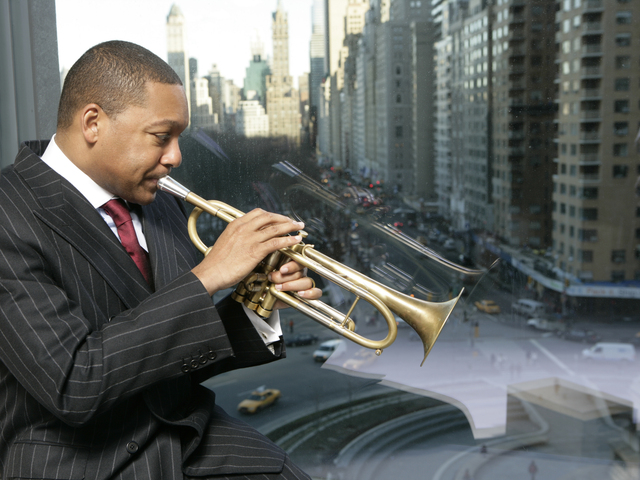
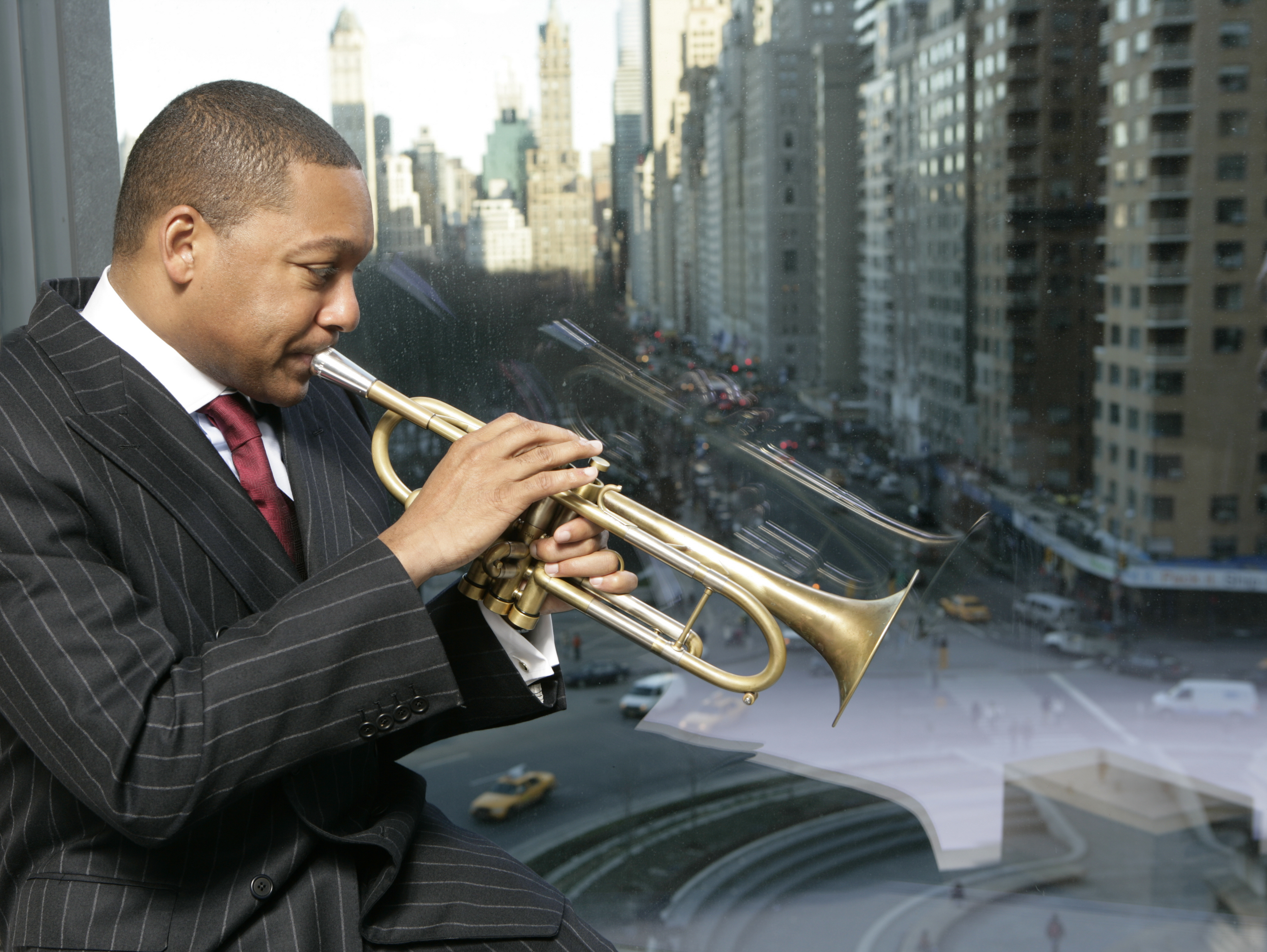
 Wynton Marsalis. Photo courtesy of Jazz at Lincoln Center
By DCist Contributor Caroline Baxter
What: World Premiere: “Blues Symphony,” Wynton Marsalis. Performed by the Shenandoah Conservatory Orchestra
Where: The Music Center at Strathmore
When: February 4, 2015, 8 p.m.
Tickets: $35-$75
The symphony as a musical art form has been around for about as long as the United States has been a country. What better form to use, then, to knit together the quilt of American sound? Incorporating Latin rhythms, folk songs, and spirituals, Wynton Marsalis orchestrates the story of America over a six-movement symphony, the foundation of which is the quintessential American musical style: The blues.
Marsalis, a true musical scholar, wrote the symphony in 2009 after wondering, as he puts it, “What would the blues sound like applied to symphonic sound? What would it sound like if the orchestra members played like we play? And what would it sound like to use the strings as a rhythm section?” Marsalis grounded each movement in a historic period.
As Murray Horwitz, the Director of Special Programs at Washington Performing Arts, said in an interview with DCist, “that’s why the Blues Symphony has such poignant passages. There are parts of the symphony that deal with Middle Passage. You will hear what W.E.B. DuBois called ‘the sorrow songs.’ But somehow, Wynton, as a composer, lets you know that yes, that was there, and yes, there was such a thing as Middle Passage, but somehow, it was transformed by slaves and later by other Americans into something beautiful.”
For the musicians, eschewing their classical training in favor of ignoring the bar lines and swing the music instead has been a challenge. Horwitz explained, “classical musicians are trained to hear in a different way and to attack in a different way.” To help the musicians stop thinking about the notes and start to feel the music they were playing, said Horwitz, Marsalis would often play recordings of Jelly Roll Morton, Max Roach, Thelonius Monk, and John Coltrane. “He’d ask them, ‘Listen to how he phrases…listen to how he’s hearing the time.’ It’s about getting them to listen, and to see if they themselves hear a way to play differently.”
The orchestra has certainly been getting in a lot of time to rehearse. Though the piece was written and performed in 2009 with the Atlanta Symphony Orchestra, it has never been performed in its entirety—and it’s never been recorded. Orchestras often have precious little time to learn brand new pieces, which prevents them from being able to fully understand and execute the composer’s vision. With something as innovative as Blues Symphony, in which Marsalis has integrated modern music with an old format, it’s taken a full semester of rehearsals to transform a precision-oriented classical orchestra into a loose blues and jazz group.
Washington, D.C. has played an important role in the history of blues and jazz. The self-styled inventor of jazz, Jelly Roll Morton, became a D.C. fixture after moving here from New Orleans, and Duke Ellington, a D.C. native, named his first group The Washingtonians. D.C. has been—and still is—home to some of most important blues and jazz venues in the country, like Bohemian Caverns, where Ramsey Lewis recorded the album The In Crowd, and Blues Alley. It’s appropriate, then, that the world premiere of Marsalis’s entire symphony take place here. This is a rare chance to hear American history played—and made.
Correction: The article initially read that Horwitz is the Director of Special Projects at the Strathmore. He is the Director of Special Projects at Washington Performing Arts