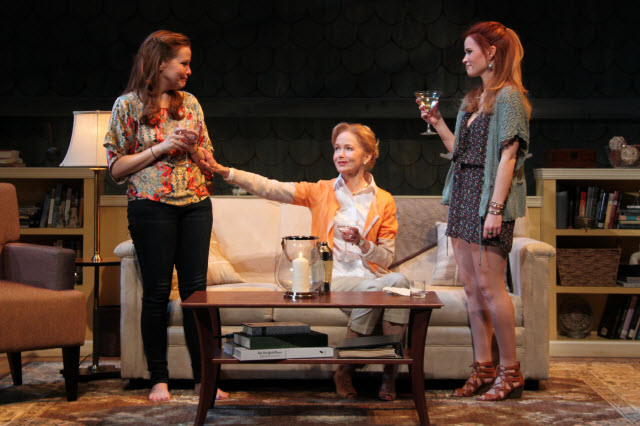
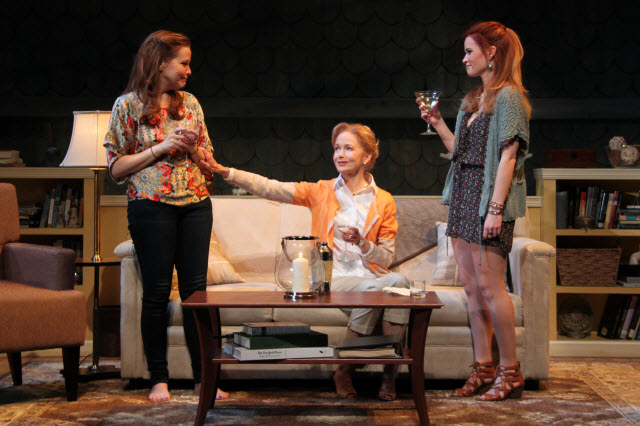
 Michelle Six, Helen Hedman, and Maggie Erwin in Rapture, Blister, Burn. Photo: Danisha Crosby
By DCist Contributor Jonelle Walker
It seems only fair that, in response to a play so concerned with social ideologies, one should begin with an identification of bias: Rapture, Blister, Burn, a play ostensibly about feminism, was not written for young women. Not that there’s anything wrong with that.
Roundhouse Theatre’s production of Gina Gionfriddo’s Pulitzer Prize finalist is good. It has solid performances from every member of the five-person cast, smartly designed scenery, and a whole mess of well-delivered jokes (including one about Internet porn and Google Maps, which should be remembered for use at a future social gathering). However, it would be disingenuous to ignore that, while this play uses feminism as a vehicle to dissect the limits of politics in practice, it occasionally undermines itself by discounting the valuable perspective of arguably its most appealing character.
Rapture, Blister, Burn focuses on career academic Catherine Croll (Michelle Six) who returns home to care for her mother, who’s had a heart attack. Back in her hometown (not so coincidentally), Catherine’s ex-boyfriend Don (Tim Getman) and his wife Gwen (Beth Hylton) have made a life together after Gwen snatched Don out from under Catherine during a fellowship abroad in graduate school. Meanwhile, Catherine is busy teaching a summer seminar for the local college on feminist theory, wherein her only students are frenemy Gwen and her former babysitter, Avery (Maggie Erwin). Arriving at another crossroad in her life, Catherine is offered a second chance at choosing between her successful career and a successful family life, with the steady hum of feminist analysis ringing in her ears.
The frank onstage discussion—not just of gender politics, but also of the history of the feminist movement—is refreshing; how often does the memetic “women can’t have it all” get presented to a theatrical audience for thorough consideration? And not between a heterosexual couple? Not often. Gionfriddo and Director Shirey Serotsky play tag team here, balancing scenes of academic discussion and genuine human pathos with relative ease. The piece itself is another smart choice for Roundhouse in a season of bold selections, filled to the brim, it might be noted, with female theater practitioners.
All of the women in the majority-female cast turn in strong performances, but it’s the two actresses representing ideological and generational extremes who are most memorable. Maggie Erwin brings the house down as Avery, a burned-out, former pre-med babysitting for Gwen and taking Catherine’s summer seminar. The character is written more or less in the “wise fool” archetype, but Erwin gives her drive, fire, and, of course, formidable humor. It seems that nearly every line she utters gets a laugh, but Erwin’s fully realized connection to each member of the ensemble lends the role enough gravity to stay grounded in reality. Helen Hedman, playing Catherine’s ailing mother Alice, glides across the stage with grace and tenderness without sacrificing any humor. She plays Alice’s traditional values without judgment, making her a strong foil against Erwin’s morally dubious (more on that in a moment) college student, without making the two diametrically opposed.
The lone male on stage, Tim Getman as Don, presents a nice break from the representation of female archetypes among the rest of the cast. Getman manages to play Don as both charming and despicable, eschewing so many of the qualities of the classic provider. He has little-to-no ambition, more akin to a Seth Rogen’s character than a Mr. Cleaver. Getman nicely turns up the play’s nod to the fluidity of male identity in modern relationships, as well.
The clever scene design by Daniel Conway nicely conveys the suburban homestead with breezy colors and appropriately nested set dressings. The slick conception of the scene changes is a delightful surprise that keeps this domestic play from becoming too fussy in its pursuit of reality.
So what makes this generally enjoyable performance come across as tone-deaf to a portion, presumably, of its intended audience? Simply put, the play undermines its own message with its questionable treatment of Avery’s character.
Avery, a 21-year-old student, is consistently undermined—intellectually and morally. She freely admits to being in an open relationship (“hooking-up exclusively” she clarifies as other characters mock her) and to working as a stripper for a few weeks while filming a reality television pilot with her exclusive hook-up.
Punchlines at Avery’s expense amount to “she’s in a steady, non-committed sexual relationship” or “she has, at one time, dabbled in sex work;” zingers that may not exactly tickle the funny bones of the social justice generation. While one might expect the play to accept this young woman’s fresh perspective on what it could mean to be a woman, her redemption never comes. Instead, she has her knuckles metaphorically rapped as her steady hook-up leaves her for a — presumably— chaste Mormon girl. Though the constant send-ups of Avery can be quite funny, they don’t do much to bolster the play’s spectrum of acceptable female experiences.
But, this play isn’t about millennials. This play was written for people who have already faced the decision, if they had to, between family and career. For them, Gionfriddo explores the difficulty of making the political personal and vice versa. Rapture, Blister, Burn is an opportunity for those people to use Catherine as an avatar and experience the soft grass on the other side of the fence. For a young person, it is a helpful glimpse into the decision to come. For the older set, it is a wistful contemplation of what could have been.
Ultimately, Rapture, Blister, Burn provides a chewy night of quality contemporary theater. You may not like what it has to say, but it will certainly have you leaving the theater with several talking points and counterpoints for discussion.
Rapture, Blister, Burn plays at Roundhouse Theatre in Bethesda through February 22. Tickets start at $30, and are available here.