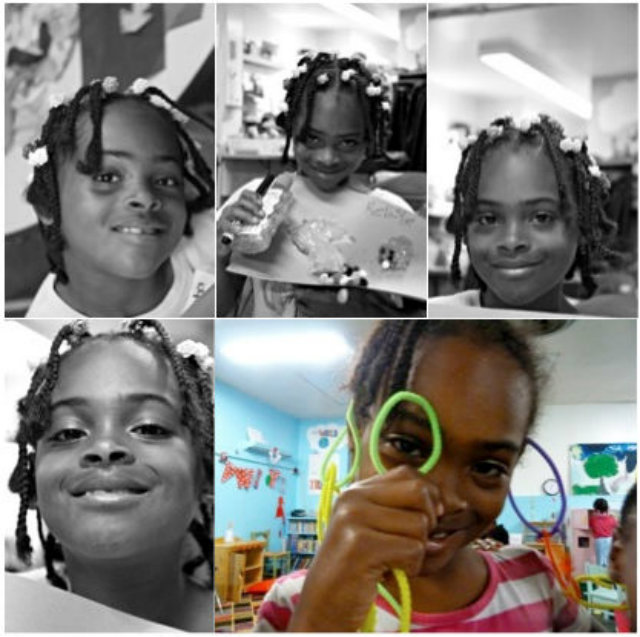
 Via MPD.
“The Metropolitan Police Department is seeking the public’s assistance in locating 8-year-old Relisha Tenau Rudd, and two vehicles that are pictured below that she may be traveling in. She was last seen in the 1900 block of Massachusetts Avenue, SE. Relisha is described as a black female, 4’0” tall, weighs approximately 70 to 80 pounds, black hair, brown eyes, and has a medium complexion. She may be in need of medication.”
The above is from the first release the MPD sent out about eight-year-old Relisha Rudd, who was last seen by her family at the D.C. General homeless shelter a year ago yesterday and reported missing on March 1 of 2014. Of course, that release didn’t come until March 20, nearly a month after Relisha went missing.
Why did it take so long for Relisha’s disappearance to be reported? It’s one of many questions in the heartbreaking saga of Relisha and her family. She lived with her family at D.C. General—a shelter notorious for its poor living conditions and corrupt oversight—but at the time of her disappearance, her mother said that she’d been living under the care of Kahil Tatum, one of the shelter’s janitors, who had prior felony convictions on his record. Tatum’s body was discovered in Kenilworth Park nearly two weeks after Relisha’s disappearance, making the case all the more puzzling and disturbing (one that would be a good fit for the popular podcast Serial to focus on in their second season, I suggested a few months ago).
Relisha is still missing, but her disappearance proved to be a catalyst for city officials to take a close look at D.C. General and how poorly it’s run. The Community Partnership for the Prevention of Homelessness, the contractor that runs the shelter, has been under close scrutiny since Relisha’s disappearance. Reports and inspections have highlighted the poor living conditions at the shelter—families residing there often complain of no heat or hot water, bed bug and rodent infestations, and corrupt employees taking advantage of them.
During election season, numerous candidates talked about finding a new contractor to take over the shelter, but as this week’s Housing Complex column in the Washington City Paper tackles, that has yet to happen.
“We’ve lost any confidence in The Community Partnership,” Rev. Mike Wilker, senior pastor of the Lutheran Church of the Reformation on Capitol Hill told WCP’s Aaron Wiener in his column. “It’s our judgment that The Community Partnership is broken, and that the problems at The Community Partnership are so fundamental, we don’t think they can be fixed,” he says.
It’s clear that things need to change for D.C. General and Mayor Muriel Bowser’s administration knows that. When I spoke with Mayor Bowser in the lead up to November’s election, she said that the biggest issue with fixing oversight of D.C. General is that it’s not the most attractive task for contractors.
“I know a lot of people want to say ‘let’s end that contract and let’s do it right now!'” Bowser told me. “But then the question is, who’s going to provide the services? As I understand it, there’s not a lot of people waiting in line to run D.C. General. And there haven’t been. And that’s our fault, that we haven’t generated the kind of interest in D.C. General to operate it.”
And therein lies one of the many problems.
But this isn’t is an article about those problems. It’s not about the system that failed Relisha, and it’s not meant to be an article advising how city officials can fix D.C. General. This is just a remembrance of an eight-year-old girl who vanished without a trace one year ago, and all the pain and suffering it’s caused her family. I hope to never have to write about something so troubling ever again.