DCist loves it when a great, locally based record label makes waves (and on the flipside, we hate it when a great local label goes under) so congratulations is clearly in order for Carpark Records, who celebrate their Sweet Sixteen this year. Considering that ten years for many labels (including at least one of the Carpark subsidiaries) is often an unreachable and unsustainable achievement, sixteen years is no small feat.
Carpark Records—the home (or former home) of beloved artists like Toro y Moi, Speedy Ortiz, Beach House, Dan Deacon, and more—is holding two Sixteenth Anniversary shows this weekend and the local edition will be at DC9 this Saturday. Lexie Mountain Boys, Jimmy Whispers (of Light Pollution), Ear Pwr, Greg Davis, Greys, Chandos, Adventure, and Safety Scissors will provide a full night of music and there will be intermittent DJ sets from Montag and Young Magic. In advance of this celebration, we talked to the label’s founder, Todd Hyman, about his love of college basketball, Carpark’s experimental roots and why we still haven’t seen any D.C. bands on their label.
DCist: I appreciate the basketball imagery with Sweet Sixteen. I don’t think everyone would have gone in that direction.
Todd Hyman: I’ve always been a college basketball fan. I grew up in Louisville, Ky. I grew up going to U of L basketball games. So, it seemed like a fun thing to do since it seems like most people—most labels that have anniversaries—when it’s 10 or 15 or 20, they have a big party. I figured that might be a way to have a little more fun with it.
DCist: Did you go to U of L?
TH: No, I didn’t. I went to Northwestern in Chicago. They have a crappy basketball team, so I just stuck with U of L. My dad had season tickets and starting at 10 or 11, they allowed me to start going to the games at night. I went to the 1980 Final Four in Annapolis. I sat on my dad’s lap. I went to the 1986 Final Four when Louisville won. We won in 1982 and I went to the 2013 tournament which we won. Good times.
DCist: Yeah! Well, now you’re here. How did you end up in D.C.?
TH: I was in New York before and my wife got a job at NIH. So, we moved here [in 2005]. I was kind of tired of living in New York, too. It seems like we’ve been happier since we moved here. It’s quieter.
DCist: Is it an accident that the anniversary shows coincide with March Madness or did you do that on purpose? Did you coincidentally start your label in March sixteen years ago?
TH: No, the label didn’t start in March but we definitely wanted the parties to happen in March. That was intentional. The first release on Carpark, I believe, came out in November 1999. Technically, we’re not quite at sixteen, but this is the year we have our sixteenth anniversary.
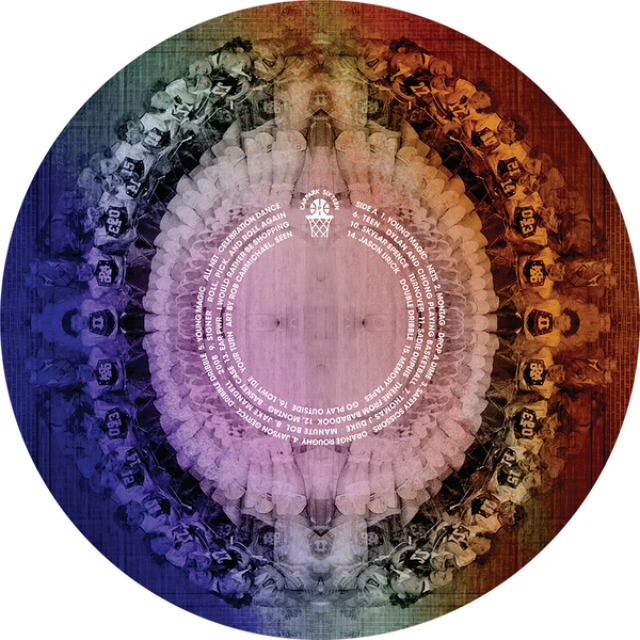
DCist: Who designed the picture disc (shown above) and where did that idea even come from?
TH: I can’t remember all the details. I think one of our employees gave our designer a couple of photos of some old basketball teams. And then our designer, Rob Carmichael, he turned into a psychedelic kind of epic piece of picture disc-ness.
DCist: When did [the label] become a full time pursuit for you?
TH: I started to do it full time I think around 2003 or so. I just did it by myself for a long time until 2011 and that was when I hired my first employee. Now, I’ve got a couple more.
DCist: How many people are on staff there now?
TH: We’ve got two other people here in D.C. and we have one person in Brooklyn and a whole cast of helpers who are on our payroll but aren’t full time. We have promoters and a couple of interns.
DCist: What were you doing before starting the label?
TH: I was working at a record shop for a few years while I was starting the label in New York. Before that, I was in grad school for a year. Before that, I was a PA on commercials for a few months in Chicago. I worked at another record store around Chicago and New York before that.
DCist: It sounds like you always knew that you wanted to work around music.
TH: I do have a passion for it. When I got to college, I immediately started working in college radio. This was before the Internet and music was not really accessible, then. So, this was the first time that I had this music library where I could listen to all the stuff instead of reading an article in a magazine and having to go to a record store and trying to find it. So, I listened to a lot of music there and did a bunch of radio shows and ended up as the rock music director for a couple of years. That was early-to-mid ‘90s.
I was a film major as well, so I had music and film as my main interests. I did a little bit of film as well, but I guess it just seemed a little more complicated and more difficult to film as opposed to music. Music just seemed more hands on. Unless you’re a director of a film, it seems like you’re being stuck in kind of menial jobs that didn’t excite me too much. When I was a PA, you’re just driving a guy back and forth to something. Right then music seemed like it was more immediate and it was easier to get started doing something. Anyone could start a record label if they wanted.
It’s easier now, but twenty years ago, it was a lot more difficult to make a movie or something. So, I guess the music stuff was easier for me to get involved with. I worked in a few record stores. I was a music buyer in Kim’s West in New York for about a year and came back to Chicago and did some PA work and then went to graduate school and studied popular music and then I came back to New York and a friend of mine had a record store and I was lucky enough to get a job there. We did a DJ night in the late ‘90s in the East Village at Brownies—it was called Invisible Cities and it was kind of like weird electronic stuff. There wasn’t much of that going on at the time. It was kind of a new thing. We were doing that every week and we had live musicians every week as well and met all these people that I thought were making really interesting music on their laptops and I thought this was the next thing so I decided to start a label.
DCist: It’s funny, because I associate weird electronic music with Paw Tracks now. How hands-on are you with Acute and Paw Tracks?
TH: Well, Paw Tracks is kind of not really doing anything anymore, so nothing really going on there. Then, Acute—you know, I work with Dan Selzer, who lives in New York, and basically it’s his label. I helped him get things going. I’ll do the kind of business-y stuff. He’s the one who picks the projects and gets it all ready to go. He’s a graphic designer and lays out the art and everything. And that label has slowed down over the years as well. He’s older and he’s started up a printing press and he’s trying to get a business going and he doesn’t have as much time to dedicate to post-punk reissues. So maybe one every year or so will come out with Acute. But we did start up a new label with Chaz from Toro y Moi. So, Company Records is our newest label partner.
DCist: Can you tell me a little bit about Company Records and what sort of music we can expect to see?
TH: I don’t know what kind of music will come out on Chaz’s label, to be honest. You’d have to ask Chaz. He likes all types. It could be weird dance music, lo-fi hip hop, psychedelic new age music. Who knows?
DCist: When did the Carpark focus shift from experimental electronic to its current hybrid?
TH: I think the main shift in what we released happened after i moved to D.C. I became friendly with a lot of folks in Baltimore and subsequently put out a lot of music from there (Dan Deacon, Beach House, Ecstatic Sunshine, Lexie Mountain Boys, Adventure, Lesser Gonzalez Alvarez). When i started the label I very consciously was starting an experimental electronic label. By the time I was in D.C., I figured no one really cared about what kind of music Carpark released. People just want to hear interesting music. So it was then that I decided I was just going to put out whatever I liked.
DCist: Did you foresee remaining a record label after 16 years?
TH: I can’t say I foresaw anything, really. I will just keep doing it as long as it works and I’m enjoying it.
DCist: When did it become clear that this could remain sustainable?
TH: I’ve been through a few periods of feeling directionless or confused label-wise. It was only after moving down to D.C. in 2005 and finding success with folks like Beach House, Dan Deacon, and Panda Bear (through Paw Tracks) that I realized the potential of what we could do and found new focus.
DCist: What is the biggest challenge you currently face running the label? Is it a similar/different challenge from when you started?
TH: I suppose the biggest challenge is to keep finding music that resonates with people and also finding music that will generate revenue to keep the business going. It’s pretty much the same challenge that’s I’ve always had, except I have more expenses now than when I started the label.
DCist: How tapped into local music are you? Is there anyone in D.C. that has interested you recently?
TH: I’m not sure if I’m “tapped in” but I’d like to think I know a few of the more popular bands in the area. I have been to most of the legit and DIY venues in town. I never consciously ignored the D.C. area in terms of our label, I just never found any music from here that interested me. I wish it wasn’t so. Ironically, there is a band from the area that we are going to work with later this year, but they are planning on moving to LA in a couple weeks, so I guess we are cursed or something to never work with a D.C. band.