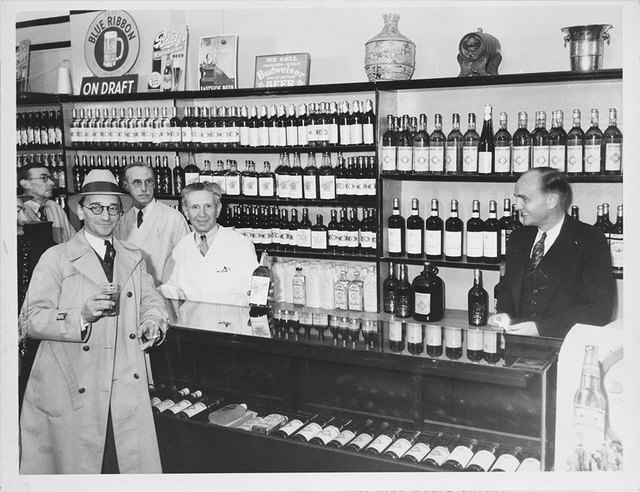
 Photo courtesy of the National Archives.
By DCist Contributor Juana Summers
America has had a long, complicated history with alcohol, and a new exhibit at the National Archives seeks to capture that ebb and flow. “Spirited Republic: Alcohol in American History” examines the production, consumption, and regulation of alcohol throughout U.S. history. Using National Archives documents and artifacts, the collection explores the wide variety of views Americans have held about alcohol.
“The big idea behind the show is that America has had a love-hate relationship with alcohol,” Bruce Brustard, senior curator for the National Archives, recently told DCist. “Those two forces have sometimes been at war, and sometimes been at kind of an uneasy peace.”
Immediately upon entering the exhibit, guests are greeted with what Brustard described on a recent tour as a “tower of jugs.” Visitors are immediately propelled back to 1830 where it is estimated that people of legal drinking age drank 7.1 gallons of alcohol per person. That’s more than two times today’s average consumption.
Each section of the exhibit is cleverly named. One, “Good Creature of God” embodies the attitude that alcohol is “simply a part of American life and is integrated very easily,” Brustard explained.
The walls are packed with artifacts that speak to the rise and fall of drinking and the shifting culture. One wall includes a collection of beer and liquor labels from the years immediately following prohibition. There are more familiar names like Rolling Rock, Southern Comfort, and Bacardi alongside more obscure ones like North Pole Beer, Picnic Beer, and Night Cap Whiskey.
The exhibit features information on Daisy Simpson, one of the few women who worked as a federal agent during Prohibition. Her nickname was “the lady hooch hunter,” and she was famous for her ability to work undercover to unearth the illegal production and sales of alcohol in San Francisco.
Another section includes a more novel artifact: a prescription for whiskey. During prohibition, doctors were authorized by the Treasury Department to prescribe medicinal alcohol for patient’s ailments. It was one of a few legal exceptions to prohibition.
“Spirited Republic” also touches on some of the societal costs associated with alcohol, including abuse and alcoholism. The collection includes an early “drunkometer,” the grandfather to the modern breathalyzer; a first-edition of “Alcoholics Anonymous,” the text at the center of the well-known 12-step program and a letter to former First Lady Betty Ford from musician Johnny Cash who struggled with addiction.
The exhibit’s final section is devoted to the modern American presidency and drink. It includes the glasses former President Gerald Ford and Soviet leader Leonid Brezhnev used to toast after the 1975 signing of the Helsinki Accords. The section also includes former President Franklin D. Roosevelt’s cocktail shaker.
“Spirited Republic” is on display at the Lawrence F. O’Brien Gallery of the National Archives Museum (700 Pennsylvania Ave. NW). Museum hours are 10 a.m. to 5:30 p.m. daily, except Thanksgiving and Christmas. The collection will be on display until Jan. 10, 2016.