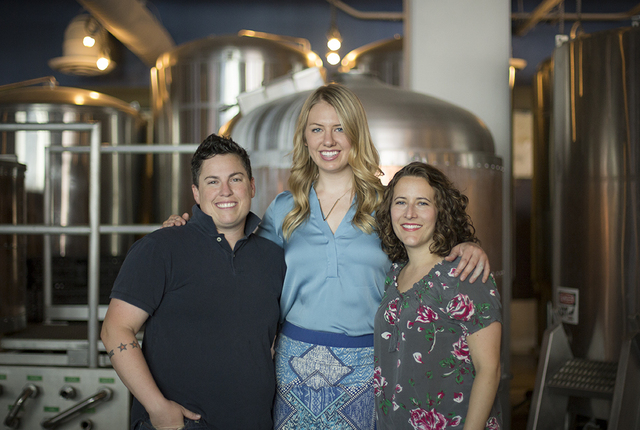
 Julie Verratti, Taylor Barnes, and Emily Bruno (L to R) are among the four founders of Denizens Brewing Co. (Photo courtesy of Denizens Brewing Co.)
By DCist Contributor Juana Summers
When I walked in the door of Denizens Brewing Company in Silver Spring, Md. every employee I encountered—the person who greets me at the door, the person who pours my beer and the person who helpfully points me in the direction of the restroom—was a woman. That’s no coincidence: Denizens’ founders—three of four owners are women—have worked intentionally to carve out a space that is welcoming to all beer drinkers, no matter their gender.
“One of the things that we’ve tried to do is market to women more and make our brand more accessible to a broader range of people,” said Emily Bruno, one of the brewery’s owners. “It feels like the white men who are running most of these breweries are not thinking about what non-white men who don’t listen to heavy metal might be interested in. So what we try to do is really market the way we would want to market, but we do have men on our team so we’re always engaging with them too.”
Denizens opened its doors in July 2014, and since then Bruno and co-owners Julie Verratti and Taylor Barnes said they’ve been something of a magnet for other women hoping to launch their own breweries.
“I think the fact that we are the only woman-owned brewery in this immediate vicinity, people sort of gravitate to us. People who are women in the industry have said ‘oh hey I’m a woman in the industry too,’ since we’re sort of out there as that,” Verratti told DCist.
The past few years have seen an uptick of women brewing and otherwise working in craft beer in the D.C. area. Besides Denizens, women are leading the charge at breweries including D.C. Brau, Port City Brewing Company, and Capitol City Brewing. They’re involved in every aspect of the beer business, from marketing to bottling to tasting room operations to brewing the beer itself.
Alexandria, Va.-based Port City Brewing Company’s staff is roughly 33 percent women, according Tammy Portnoy, Beer Admiral, marketing and events (her real title) at the brewery. One of them is Allison Lange, a brewer/beer scientist.
“I actually was a biochemist in my previous life. I got my Ph.D, and I happened to study yeast for all of my dissertation research so it was a pretty natural leap to want to do what’s obviously the most fun thing you can do with yeast, which is to make beer,” she said.
Lange jumped into the beer world after she moved to the D.C. area with her husband.
“I basically cold-called breweries and said ‘I want to be your microbiologist,’” she said. “A lot of people aren’t ready for that. Port City basically said we’d love to have you come set up our lab, and in the meantime, you can come bottle.”
More women like Lange aren’t just working in beer, they’re drinking more of it, too. According to the Brewers Association, a national trade group that represents craft brewers, women consume almost 32 percent of the craft beer market. Almost half of that, according to the Boulder, Colo.-based group, comes from women ages 21-34.
Kristi Griner, the director of brewing operations at Capitol City Brewing Company, said one reason for that is because craft beer markets to women, rather than marketing in a way that objectifies them. The only time women are seen in macro-beer advertising, she observed, is if a woman is serving beer to a man.
“Macro beer is not sold to us,” she said. “We’ve only been used to sell it.”
Griner, a veteran of the restaurant industry has been heading up Capitol City Brewing’s brewing operations since 2013. “You can make anything,” she said. “I have an idea and I can make it come to fruition and someone can drink that. It’s a very happy thing, giving someone a glass of beer. It’s one of the things that we’ve been doing since we’ve been civilized. I think it’s very gratifying on a very deep level.”
While Griner knew her way around the kitchen, she’d never been a home brewer. Instead, she firmed up her brewing knowledge at the Siebel Institute of Technology in Chicago. Since then, she said she’s found herself feeling at home, despite the fact that the industry remains both locally and nationally male-dominated.
“I felt more pushback when I was cooking professionally and was the only woman in the kitchen. People in the brewing industry are usually very welcoming and very friendly,” she said. “It’s all about the beer anyway. If the beer’s good, it speaks for itself.”
But sometimes it isn’t all about the beer. Bruno, who also heads up Denizens’ business operations, said that while the craft beer industry writ large is very supportive, there are people who aren’t totally comfortable with women brewing their beer.
“At the end of the day if a group of guys from another brewery come in, they talk to [director of brewing operations] Jeff [Ramirez]. They don’t talk to me,” she said.
This topic also came up at last month’s International Women’s Day Beer Brunch hosted by Port City and the local chapter of Girls Pint Out, a national craft beer organization for women.
“We spent most of the time talking about frustrations we’ve had being women in beer,” Portnoy said.
“The more the brunch went on, the more people were actually sharing,” added Chrystalle Ball, the founder of D.C. Metro Girls Pint Out. “People were saying, ‘We love this place, but there’s this one person that always looks at my husband or boyfriend instead of me when I’m trying to order.’ The more the conversation got going, the better we felt about it.”
Griner said she hopes that soon women will no longer be seen as novelty presences in the beer industry.
“I think in about another five years these kinds of women in beer articles are going to be completely defunct,” she said, noting the surge of younger women into the beer industry nationally. “I think by the time those women who are coming in now are my age, we’re not going to be a novelty anymore,” Griner said.
“It’s going to be just as natural to walk into a brewery and see a woman as it is to walk in and see a white guy with a bald head and a beard.”