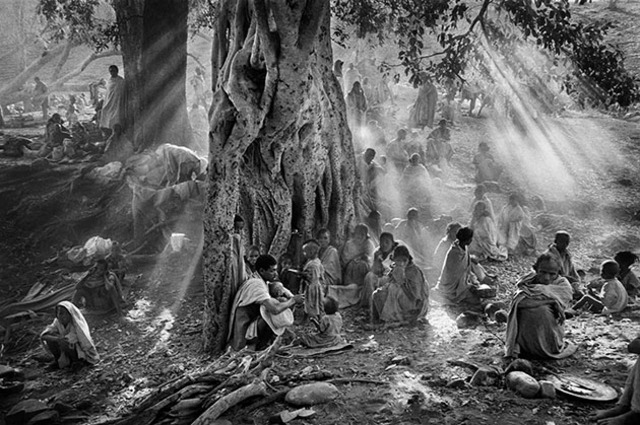
 Ethiopia, 1985, Photo by Sebastião Salgado, Courtesy of © Sebastião Salgado/Amazonas Images/Sony Pictures Classics
I am a little conflicted about the work of photographer Sebastião Salgado. He’s made powerful images of human tragedy, but his aesthetic can be so stylized that it ends up overshadowing the humanity it depicts. I’m even more conflicted about The Salt of the Earth, director Wim Wenders’ documentary about Salgado. When the director overplays his cinematic hand with atmospheric imagery and music, the movie is as much about Wenders as his subject. It also elevates Salgado into a bald, ominously-lit god. But when the director steps back and turns the focus away from art to the world, the film is thoroughly affecting.
The film opens with banalities and excesses that make me wince. Wenders narrates a breathless monologue, telling the viewer that “a photographer is someone literally drawing with light.” It’s true, if a truism, but the platitudes are bolstered by a dramatic orchestral score and delivered in a hushed, sleepy voice—and it gets worse. “He really cared about people. That meant a lot in my book. After all, people are the salt of the earth.”
What is this, an inspirational poster?
Wenders used to be one of the more entertaining directors of the German New Wave, wearing his love of American culture on his sleeve by casting Nicholas Ray and Dennis Hopper in The American Friend, Patricia Highsmith’s adaptation of Ripley’s Game. He got more sentimental—imagining the life of angels— in the crowd-pleasing Wings of Desire, but Wenders was still an artist who took risks. Though he had a long dry spell, his last film Pina (read my DCist review here) was a technical tour de force, his use of 3D some of the best I’ve seen. That an artist like Wenders, who once filmed a man taking a dump in the desert (in Kings of the Road), now resorts to inspirational poster cheese is discouraging.
Wenders eventually drops that hushed tone and gets to a more straightforward profile of his subject. Brazilian-born Salgado was trained as an economist, but on trips to Africa for The World Bank, he discovered his true calling, which he began pursuing full-time in 1973. The film’s best sequences simply let the photographer tell stories about the photos we see. Some of them are heartbreaking. Salgado is known as a social photographer, covering famine in the Sahel (see the above picture) and genocide in Rwanda. “Everybody should see these images,” he says as we see a bulldozer move piles of corpses in the Congo, “to see how terrible our species is.”
This is important journalistic work, but it came at a price, paid with the despair felt at the atrocities he saw and the time spent away from his growing family. Salgado’s oldest son Juliano talks of growing up with an absent father, but the documentary is a father-son collaboration of sorts: Juliano Ribero Salgado co-directed, and I wonder if his involvement reined Wenders in and helped point the film away from the artist to the world. (Read a long interview with the younger Salgado here.) There’s a story in that arrested relationship, and Wenders just touches on it, though that’s probably for the best.
Wenders occasionally notes Salgado’s habit of taking photos of the film crew photographing him, but when the artists stop looking at each other and start looking at the world around them, The Salt of the Earth finally becomes as dedicated to humanity as its title suggests. The human species is terrible but also resilient, and it can even overcome aesthetic overreach.
—
The Salt of the Earth
Directed by Wim Wenders and Juliano Ribeiro Salgado
Written by Wim Wenders, Juliano Ribeiro Salgado, David Rosier and Camille Delafon
With Sebastião Salgado, Wim Wenders, Juliano Ribeiro Salgado
Rated PG-13 for thematic material involving disturbing images of violence and human suffering, and for nudity
Running time 109 minutes
Opens today at Landmark E Street Cinema, AMC Shirlington and Landmark Bethesda Row