
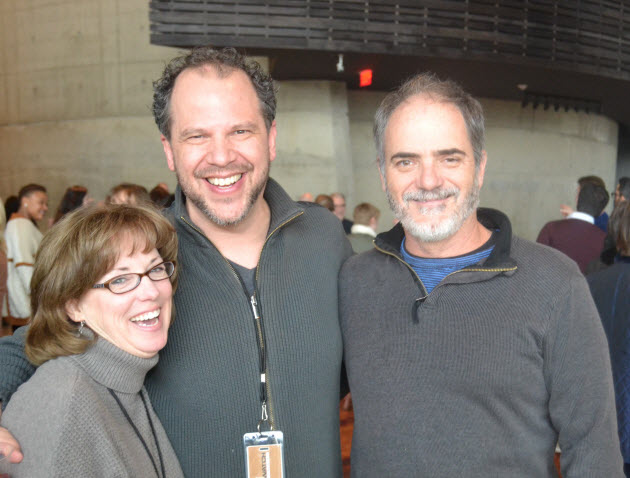
 Sherri Edelen (Sonia), Aaron Posner, and Eric Hissom (Vanya) on the first day of rehearsal. Photo courtesy Arena Stage.
In the Western canon, nothing is better known or more produced than Shakespeare, except possibly adaptations or remixes or modernizations of Shakespeare (looking at you, The Lion King). But trailing closely behind— especially recently, and especially around D.C.—are the works of a brilliant (if often dour) 19th century Russian playwright and professional grump, Anton Chekhov.
This month, D.C. is in the middle of a localized Chekhov storm. Within a few days, three Chekhov-related plays will be running simultaneously: Uncle Vanya will be playing at Round House Theatre while its boozy brother Drunkle Vanya plays at The Pinch by way of LiveArtDC (as we said, Chekhov often immediately follows Shakespeare. This vodka-soaked production is a spiritual sequel to last year’s similarly tipsy R+J Starcross’d Deathmatch). And tonight, Christopher Durang’s Broadway-pedigreed Chekhov remix Vanya and Sonia and Masha and Spike opens at Arena Stage.
This last production is being directed by Aaron Posner, a D.C.-based playwright and director who might be the epicenter of Hurricane Anton. Within the past few years, Posner has written and directed two Chekhov remixes that proved to be critical darlings: Stupid Fucking Bird (a take on The Seagull) at Woolly Mammoth in 2013 and Life Sucks (A take on Uncle Vanya) at Theater J earlier this year.
Feeling like you’d need a master’s degree in depressed Russian playwrights just to know where to start? Fret not. “If you know some things about Chekhov— some nuances of his plays or his style— you’ll find some small references and gifts [in VSMS],” says Posner, “but exactly zero amount of Chekhov knowledge is required to enjoy the hell out of the show.”
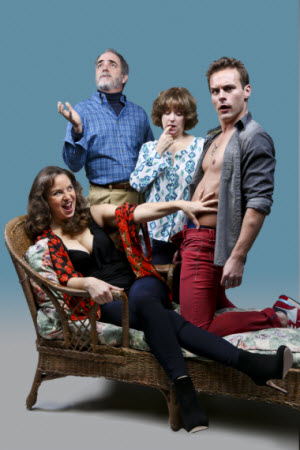 Eric Hissom (Vanya) and Sherri Edelen (Sonia) and Grace Gonglewski (Masha) and Jefferson Farber (Spike). Photo: Tony Powell.
Indeed, Vanya and Sonia and Masha and Spike contains Chekhovian allusions to cherry orchards and birds and suffering playwrights. But its also references Greek oracles, voodoo curses, and a good deal of Snow White. Durang’s plot is original, though it’s built from familiar elements: aging actress Masha (Grace Gonglewski) comes home with boy-toy Spike (Jefferson Farber) who revels in taking his clothes off, much to the consternation of Vanya (Eric Hissom) and his sister Sonia (Sherri Edelen).
If you’ve never seen Chekhov but have caught Bird or Life Sucks, those names and themes will be familiar. “These are all very different plays, but the impulse behind them is very similar,” says Posner, “Chris [Durang] and I are splashing around very differently in Chekhov’s pool. Ultimately, none of our plays have anything to do with Chekhov! My plays have to do with me, and Chris’ plays have to do with Chris… His plays are based on his own ideas of life and love and relationships and connections, and mine are based on mine.”
As much fun as Chekhov-land can be, it often proves to be an angsty place: “it’s a tremendous playground of real life and real things that real people think about every day: ‘Why am I so disappointed? Why is life harder than I thought it would be? What does real love look like?’ These are hard questions, posed in quotidian, everyday ways,” says Posner, who notes that it “is fertile ground for a playwright.”
This, by the way, is how Posner gets when he’s excited (which he often is, when talking about Chekhov). He talks in multiples, and lists. Posner rarely utters a single adjective not chained to two others. The D.C. theater scene isn’t just thriving, it’s “exciting, diverse, powerful.”
And you can hear it when he talks about how Vanya and Sonia and Masha and Spike subverts Chekhov’s reputation for gloom: “I’m a big fan of melancholy and death and destruction and tragedy— and there’s a place for all of those in things in the theater. But then you have a play [like this] that is delightful, that brings people together, that points towards hope— and I think that’s something that Arena does well, and this play does well, and I think that’s why it’s one of the most produced plays in America this year.”
That may seem to be a surprising sentiment from a man who once penned an angst-ridden Chekhovian playwright that dismisses feel-good productions as being “like the hand-job of the theater.”
But what matters isn’t whether the play is a comedy or a tragedy— it’s whether it was worthwhile in the first place. “I think that the world would like to pass us by,” Posner says, when pressed on the state of modern theater. “The world would like to digitize everything. So if we’re going to make a case that sitting in a room with other people, and listening to stories with them, is a worthwhile past-time, or a worthwhile and engaging way to spend our time and money… sometimes we succeed, and sometimes we fail.”
And the best way, according to Posner, to make theater worthwhile is “to make the experience of us all being together, in the same room sharing a story, as enlightening, as engaging, as visceral, as rich as possible. And when that doesn’t happen we’re left thinking ‘yeah, I should have just Netflixed that.'”
Posner believes that Vanya and Sonia and Masha and Spike won’t leave viewers pining for their Netflix account— and not just because of his love for all things Chekhov. “Chris is writing in a fairly broad comedic style,” and what sets it apart from other plays is “the same thing that sets apart a truly great sitcom from a truly bland sitcom.” They’re both shooting for the same wide comedic base, but the greats do so “with humanity, and integrity, and complexity— while also making it very funny. And I think that’s what Chris has achieved here.”
All that remains is for the play to open tonight, and see if the audience agrees.
Vanya and Sonia and Masha and Spike runs from tonight through May 3 at Arena Stage. Tickets are available here.