 Rachel Sadon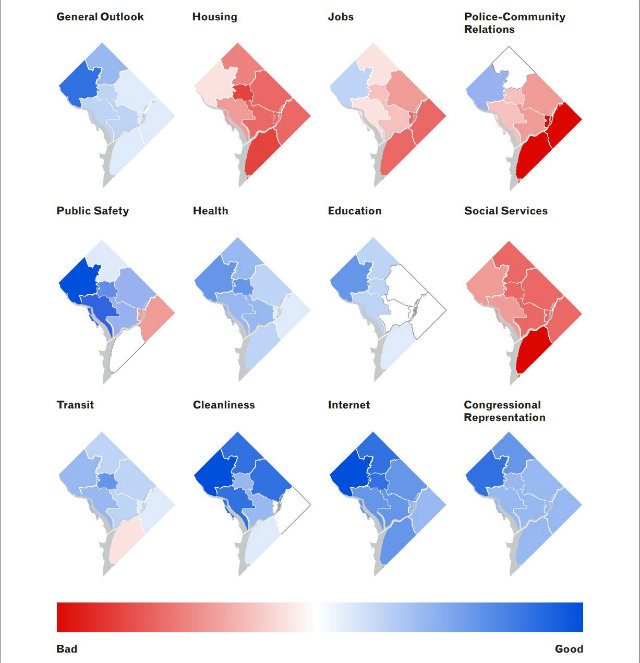
 Courtesy Talking Transition DC.
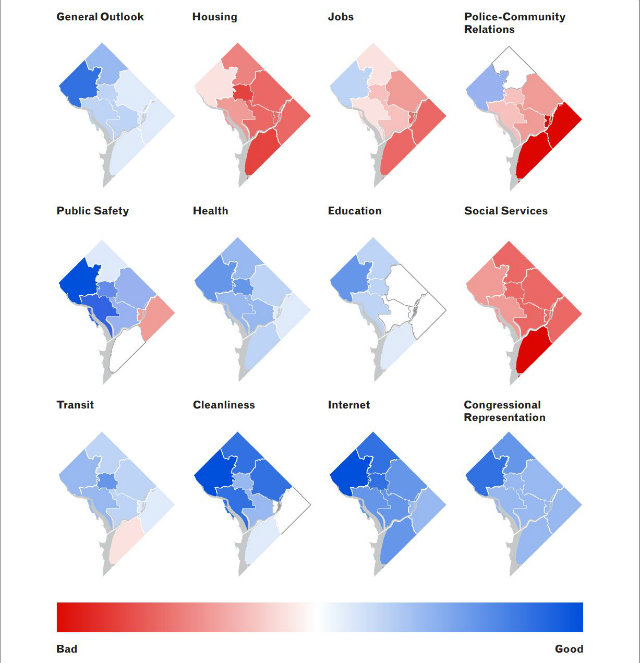
Across all eight wards, most D.C. residents seem to agree: our city’s housing is unaffordable, access to healthcare is decent, and Internet access is pretty good.
But opinions about police-community relations, public safety, and job availability resulted in a stark divide—with Wards 7 and 8 responding far more negatively than other parts of the city, according to a newly released survey by the Talking Transition DC initiative.
The project replicates an effort undertaken in New York City to advise Mayor Bill de Blasio when he took office last year. The Open Society Foundations enlisted several local groups—DC Vote, DC Working Families, National Institute for Civil Discourse, the Urban Institute with technical support from HR&A Advisors—to do the same for D.C. and help inform Mayor Muriel Bowser’s transition.
To that end, the groups queried 8,552 Washingtonians, using street canvassers as well as an online survey, with the goal of taking a representative sample of the city’s residents. In their attempt, residents between the ages 0-14 and over 65 were undersampled and those between the ages of 25-34 and 35-44 were over-sampled. Geographically, Ward 3 were under-sampled, while those in Wards 1 and 2 were over-sampled.
Over half of the people they spoke to have lived in D.C. for more than 15 years, and nearly a third reported they’ve been residents for between four and 15 years. So these are hardly just the opinions of newcomers. And importantly, 45 percent of the respondents said they hadn’t voted—giving voice and representation to people who are sometimes left out of opinion polls (which often only query “intended voters.”)
“Some of the biggest takeaways are that people are really interested in being involved in their local government but have few opportunities to do so,” said Nathan Mckee, a program associate at Open Society who helped coordinate the initiatives.
In D.C., the results also showed a particularly severe disparity between how residents of different neighborhoods view police relations within their communities. Black communities have long witnessed a disproportionate number of arrests, according to a study by the Washington Lawyers’ Committee, and residents have charged MPD with overzealous policing through tactics like stop-and-frisk and jump-outs.
 Courtesy Talking Transition DC.
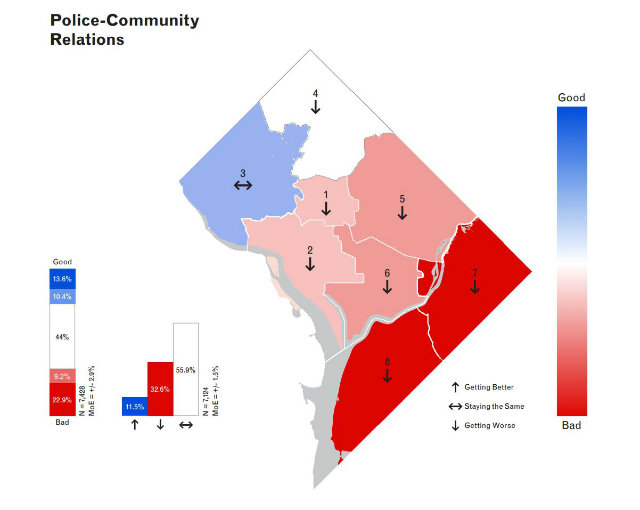
The poll confirms that residents of Wards 7 and 8 are deeply unhappy about police interactions in their neighborhoods. In Ward 8, a mere 14 percent of people described police-community relations as “good” or “slightly good,” 35 percent said they were just “okay,” and 51 percent reported they are “slightly bad” or “bad.”
Compare that to the majority white Ward 3, where residents paint a far rosier picture: 37 percent of people described police-community relations as “good” or “slightly good,” 48 percent said they were just “okay,” and only 15 percent reported they are “slightly bad” or “bad.”
The majority of people in every ward said that police-community relations are getting worse, except for Ward 3, where three-quarters of people felt that things are staying the same.
Those patterns persist in a question about employment, which asked residents “My ability to find a job that pays enough for me to stay in D.C. is…”
In Ward 3, 35 percent of people answered “slightly good” or “good.” In both Ward 7 and 8, that figure was almost half that at 18 percent.
And again, the majority of residents of every ward said that it is getting harder and harder to find a job that allows them to afford to live in D.C., with the exception of Ward 3, where most people said things are the same.
 Courtesy Talking Transition DC.
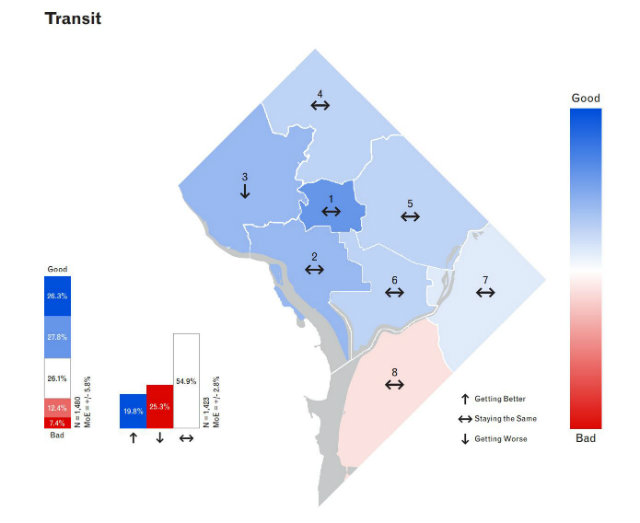
Considering that one of this city’s favorite pastimes is griping about Metro, one surprising place where most people came together is transit: More than 50 percent of respondents across the city said they had a favorable view of the system. Although a caveat here is that Ward 8, where transit options aren’t as plentiful, had more people responding negatively to questions about bus and Metro service.
Citywide, about 20 percent of people think that the transit system is improving, 25 percent say it is getting worse and the remaining 55 percent believe things are staying the same.
As part of the initiative, the coalition also sought feedback at a town-hall style meeting that around 400 residents attended in mid January. A report based on that meeting was also released today. The participants most often cited the following policy priorities:
1. Target District programs to neighborhoods that most need it, and particularly Wards 7 and 8.
2. Invest in youth, particular regarding jobs, public education, and public safety.
3. Focus on vulnerable groups, notably seniors, the homeless, and ex-offenders.
4. Lift the voices of residents, by bringing them into all important decisions, and, particularly, by putting them on an equal footing with developers.
The groups presented their findings last month to Bowser, who has shown an affinity for data-driven analysis. She has since launched her own fact-finding mission called R.E.S.U.L.T.S in an effort to connect with 83,000 residents.