 Rachel Sadon
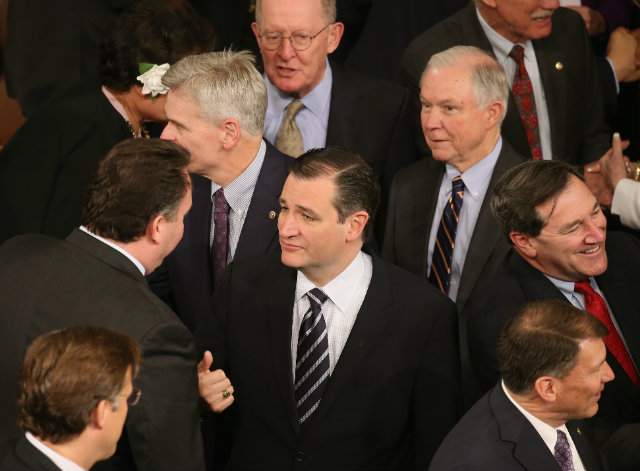 Republican presidential candidate Sen. Ted Cruz talks with other members during a joint meeting of Congress on April 29, 2015. (Photo by Mark Wilson/Getty Images)
Over the vehement objections of Del. Eleanor Holmes Norton and other House Democrats, Republicans voted last night to strike down a D.C. law that bans discrimination based on reproductive health decisions—like having an abortion or taking birth control.
Ted Cruz introduced the measure to block the law—as well as another that extends the city’s gay nondiscrimination laws to religiously affiliated educational institutions—last month.
“While this particular law only applies to the District of Columbia, it sets a dangerous precedent for future legislation that could further weaken our long-held tradition of respecting Americans’ conscience rights,” said Congressman Diane Black, who co-authored the resolution with Cruz.
The final vote of 228 to 192 was mostly along party lines; three Democrats backed the measure, and 13 Republicans opposed it.
Religious and anti-abortion groups hailed the decision.
The U.S. House just PASSED #HJRes43 by a vote of 228-192 to defend the conscience & religious liberty rights of pro-life & religious orgs
— Susan B Anthony List (@SBAList) May 1, 2015
Meanwhile Democrats, local leaders, and a coalition of 50 national and local organizations expressed indignation over the attempt to meddle in city law.
“It is outrageous that House Republicans would seek to overturn a duly-enacted D.C. law so that businesses can fire employees for their private health choices,” House Minority Leader Nancy Pelosi said in a statement that called the attempt an “unconscionable intrusion into workers’ personal lives.”
Holmes Norton made the requisite commentary on the absurdity of the fact that D.C.’s elected representative had no say in the decision. “This resolution is wildly undemocratic, is in violation of the nation’s founding principle of local control of local affairs, and is profoundly offensive to D.C. residents. This resolution uniquely targets my district, but every Member will get to vote on it except for me, D.C.’s elected representative.”
The vote to repeal the law still would need to pass the Senate and earn the signature of President Barack Obama, who has vowed to veto it. But Republicans may well take the issue up through the next federal spending bill, in which they could seek to block D.C. from spending money on enforcement of the law.