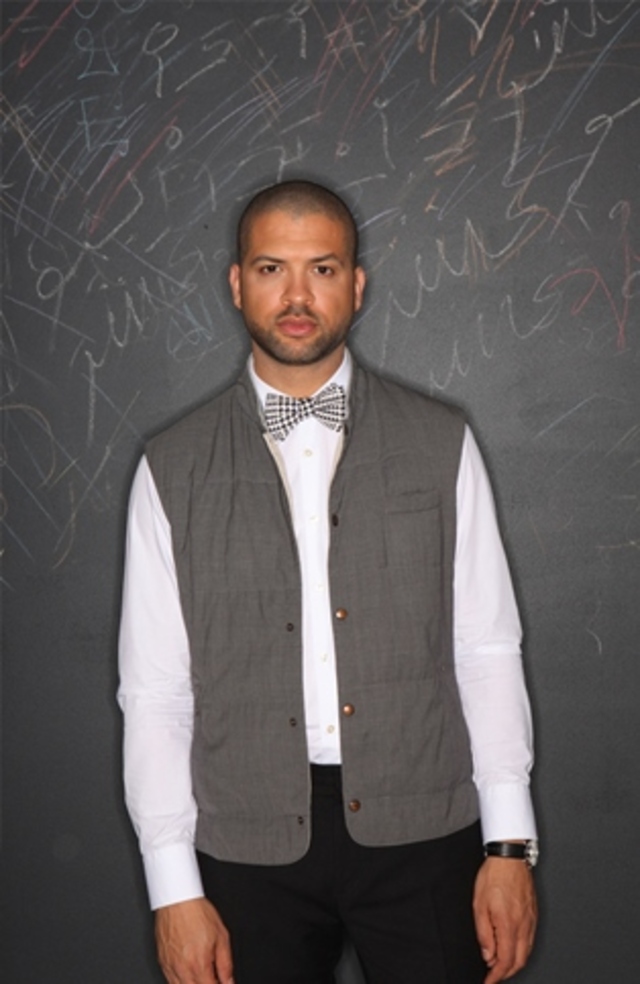
 Pianist Jason Moran, a Harlem resident and the Kennedy Center’s Artistic Advisor for Jazz, curated Harlem Lights/U Street Nights, a collaboration between the Kennedy Center and the Apollo Theater.
 New York has long been recognized as the world’s jazz capital, and rightfully so. This genre was born in New Orleans and had its adolescence along the Mississippi River in places like Kansas City and St. Louis, but New York is the place where the cutting edge has been for most of jazz history. The cliché holds true: the jazz artist that makes it in New York can make it anywhere.
The District’s jazz scene does not have the same notoriety, but those who truly follow this music recognize that this city boasts a cohort of musicians that can hold their own with any other in the world. Even less appreciated than that is the artistic cross-pollination that has been occurring between New York and D.C. jazz musicians for nearly a century.
“I moved from Houston to New York in 1993 and I’ve spent my years in Harlem ever since then,” said Jason Moran, the MacArthur “genius” grant-winning pianist who currently serves as the Kennedy Center‘s Artistic Advisor for Jazz. “When I was in the city, I learned about Harlem’s piano history and it reflected greatly with D.C.’s piano history.”
Last year, Moran and his Kennedy Center colleagues met in Harlem and that’s when the idea arose to explore the relationship between the historic centers of jazz in D.C. and New York. The result is Harlem Lights/U Street Nights, a collaboration between the Kennedy Center and Harlem’s venerable Apollo Theater.
Two pianists lie at the center of this program, as well as the broader association between D.C. and New York: Duke Ellington and Billy Taylor. Ellington, the jazz icon, spent his early years in the District before going to New York and gaining international fame. Taylor, less well-known but highly regarded and influential, was Moran’s predecessor at the Kennedy Center before his passing in 2010. Dr. Taylor made it his mission to bring jazz to the masses through programs like JazzMobile and his popular segments on CBS News Sunday Morning.
“Both Duke and Billy in their being were major spokesman for the music and showed what it means to be African-American, that’s a really important thing,” Moran said. “America doesn’t realize how much it needs to credit them.”
Harlem Lights/U Street Nights begins on Saturday with performances at the Apollo featuring the hip-hop artist and D.C. native, Christylez, followed by a marquis concert that will be repeated on Sunday night at the Kennedy Center. Sunday’s programming begins with a free Millennium Stage performance, and the festival concludes with a panel discussion on Monday at THEARC that will feature a number of performers.
Sunday’s main event is sure to be something special. The concert will be divided into three segments, the first of which will focus on the piano with Moran, Bertha Hope and Gerald Clayton playing in varying configurations. Jazz vocals will be highlighted next with performances from Howard University’s Afro Blue, Queen Esther and Brianna Thomas. The final segment will illustrate the relationship between jazz and go-go. The late Chuck Brown incorporated many jazz standards into his repertoire, and players like Marc Cary and Federico Gonzalez Peña, both skilled jazzers who started in the local go-go community, will be among those taking the stage.
As with almost any musical genre, go-go also falls under the great Miles Davis’s shadow. The set is, in part, a tribute to the late Ricky “Sugarfoot” Wellman, who played with Miles in the ’80s and who many consider to be finest drummer to come out of go-go. Jimmy Cobb, the D.C. native and jazz elder who played on Davis’s Kind of Blue (1959), the best-selling jazz recording of all time, will also be on hand.
The most surprising and gratifying element of Harlem Lights/U Street Nights is that it does not depend solely on big names. Those are necessary to bring people out yes, but many of the musicians on stage are respected locally and regionally, but don’t necessarily have a draw outside of that. For example, local musicians Brian Settles and Donvonte McCoy will be performing on Sunday alongside Cobb and Moran. This is intentional on Moran’s part, as curator, because that is one of jazz’s strengths.
“D.C. people know this, but there is a real sound and a real feel that is apparent in the music there,” he said. “The musicians that do it weekly, the places that a community can rely on, that’s what keeps a scene healthy. It’s as important as the musicians who travel the globe.”
Harlem Lights/U Street Nights takes place at the Kennedy Center on Sunday, May 10, at 8 p.m. Tickets $23. The RSVP period has ended for Monday’s panel discussion.