 Rachel Sadon
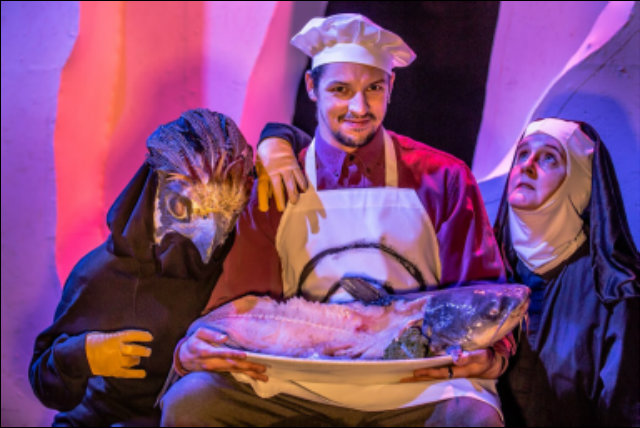 Photo by K-Town Studios, courtesy of Spooky Action Theater.
By DCist contributor Anya van Wagtendonk.
You don’t need to be familiar with the works of French avant-gardist Alfred Jarry to enjoy the earnest and resourceful Jarry Inside Out, an original exploration of his life and works playing at the Spooky Action Theater through June 21. Midway through this weird and experimental play, I suddenly remembered that I had, in fact, studied Jarry in college—but my experiences of this play before and after that realization were identical. Indeed, one of this play’s great pleasures is the chance it offers to turn off your thinking brain for two and a half hours.
If you paid more attention in Introduction to Theater Studies than I apparently did, you may recall Jarry as the absinthe-guzzling writer behind Ubu Roi (1896), a play whose central character—a fat, long john-wearing, toilet brush-wielding king—and literal, uh, merde-talk sparked a riot on opening (and, subsequently, closing) night. A decade later, Jarry died, aged 34 and riddled with tuberculosis; it was another decade before the Dada and Absurdist theater movements of the early 20th century took hold.
Perhaps Jarry’s historical import might have carried further if he’d been a more entrenched part of, and not precursor to, these famous modern movements. But this leaves room to approach his brief body of works and bizarre biography—supposedly, his last words were a request for a toothpick; he carried a revolver that Picasso later purchased; oh, and he was 5 feet tall—with fresh eyes, as playwright Richard Henrich, who is also the founder of Spooky Action Theater, has done here.
Something between biography and fever dream, Jarry Inside Out mixes passages from Jarry’s works with historical scenes from his life and less-historical scenes from his rotting brain, in a sort of hazy, illogical pastiche. Despite the biographical details, there’s no clear linearity to grasp onto for very long. The ordering logic is more like something from your dreams; it doesn’t not make sense, until you pause to figure out why not.
The set, a sort of demented Seuss-ian landscape of amorphous gray mounds designed by Giorgos Tsappas, is perfectly suited to this style. Phantom limbs pop out of hidden holes to dole out and rescind props; a talking owl magically appears and disappears; and Ryan Sellers, as a mean-eyed, deft Jarry, has free range to fly and flop and hurl himself about in time to his wild whims. (Augmenting the surreal set is the setting: Spooky Action Theater lives in the basement of the Universalist National Memorial Church on 16th Street. You have to pass through a kitchen to get to the stage, which seems oddly fitting.)
Sellers’ performance is skilled, but more importantly, he commits to every strange scene or nonsensical line. The rest of the cast is equally sincere, and that matters in a work this unusual, and in a production held up by—it must be noted—a shoestring budget. Everyone plays several characters, and there are only so many costumes, so the burden of clarity is almost entirely on the actors. Even in a play not overly concerned with clarity, some scene transitions seem to rely rather lazily on confusion-as-trope to excuse what is simply poor staging, for example.
Still, nearly all the actors turn in great performances that make partners of the audience along this curious journey. In particular, Ian LeValley is wonderful as the sycophantic Dr. Saltas, a would-be creative collaborator with his idol, Jarry, and as a grotesque character out of Ubu.
In his life, Alfred Jarry delighted in lampooning the institutions that bounded up his society. Science, art, language itself were all tools of the bourgeoisie, and he aimed to smash these structures from within. It’s a concept that may have been more fearsome in the 19th century (when is the last time you saw riots at a theater?), but that same goal has, in one way or another, motivated countless counterculture movements since. Jarry Inside Out reminds us how jarring it can be to lose those foundations—and how freeing.
Jarry Inside Out runs through June 21. Tickets are available here.