The Pennsylvania Turnpike — “America’s First Superhighway,” they once called it — slices through the lower half of the Keystone State, winding gracefully through state forests and mountain ranges, and at times slowing to snail’s pace through the misery of construction zones and fender benders.
Hundreds of thousands of cars travel the turnpike’s 360 miles every day, and many pass through Breezewood, a traveler’s oasis at the intersection of the Turnpike, Interstate 70 and PA Route 30. As weary road warriors fill up on coffee and junk food, they’re likely unaware that they’re very nearly on top of a unique piece of the Pike’s history.
Just up the road is the entrance to what’s come to be known as the “Abandoned Pennsylvania Turnpike,” a 13-mile stretch of highway — with two long, disused tunnels — that the state of Pennsylvania shut down in the late 60’s. And here’s the best part: unlike most of this country’s ruins, this one is publicly accessible and perfectly legal to visit.

Photographs by Pablo Iglesias Maurer & Arthur Rothstein
The turnpike was conceived in the 1930’s as a way to help travelers over— or rather through—the Appalachian Mountains in central Pennsylvania. Seven tunnels, previously constructed for the then-abandoned South Pennsylvania Railroad, were re-used for the Pike. After the first stretch, between Irwin and Carlisle opened in the fall of 1940, the Turnpike was extended east to Valley Forge (1950), west to Ohio (1951), and finally to New Jersey in 1954.
It was a smash hit from the get-go. Photos and advertisements from the first decade of the turnpike’s existence take us back to an era where Americans got excited about infrastructure. A quick search for turnpike-related ephemera on eBay turns up an array of vintage memorabilia—mugs, t-shirts, pennants! Today, Congress sits grudgingly on transportation dollars. Back then, people were out there waving pennants … for a highway!
The road became so popular, that by the early 50’s, massive bottlenecks would form at the entrances to the tunnels, where the four-lane highway slimmed down to two. The turnpike commission began studying ways to alleviate the congestion, and decided the best course of action was to “twin” four of the tunnels by adding another bore, and bypass three of them entirely at Ray’s Hill, Sideling Hill, and Laurel.
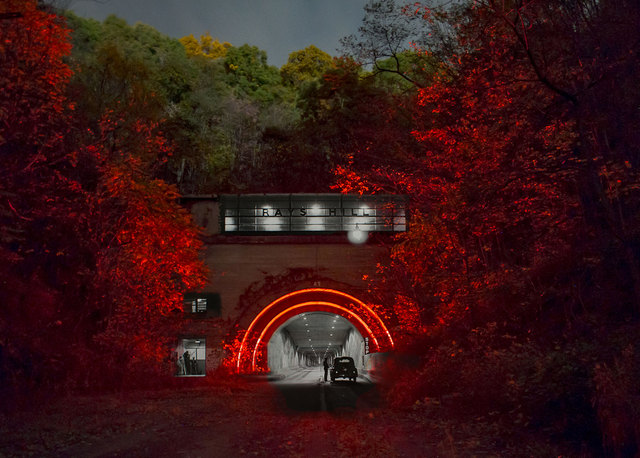
In 1968, the bypasses opened, and the 13-mile stretch of highway passing through the Ray’s Hill and Sideling Hill tunnels was abandoned. The state maintained the tunnels and roadway for several years, occasionally using it to test new equipment, but they began to fall to ruin. In 2001, the Turnpike Commission turned over most of the roadway to the Southern Alleghenies Conservancy, who opened it to the public.

Photographs by Pablo Maurer, historical imagery via Goodyear, Inc.
Today, hikers, bikers, and curiosity-seekers use the turnpike, which some say is the longest stretch of abandoned turnpike in the world. Portions of the film adaptation of Cormac McCarthy’s “The Road” were filmed there some years back. The highway itself has largely been reclaimed by nature, with trees sprouting through the concrete and the forests reclaiming what was once theirs.
On a weekday, the trail is nearly empty; you can park your car in Breezewood (GPS: 39.999881, -78.228380), or alternatively leave it a few miles down the pike at another parking area (40.048683, -78.095839), and set out towards either of the tunnels.
The Ray’s Hill Tunnel is heavily trafficked: every inch of its interior is covered with graffiti, but it retains much of its former glory. Sideling Hill tunnel is a bit more remote, less visited, and much longer than Ray’s Hill: it’s nearly a mile in length, and there’s no light at the other end… If you listen closely while you’re in it, you can hear the constant hum of cars traveling on the bypass above it.
At ground level, the doors to the upper levels of the tunnels were long ago welded shut. A quick scramble up the mountainside gives you access to the massive fans that once pumped exhaust gases out of them. They’re worth seeing.
At night, the Turnpike is surreal. Go when the moon’s full, let your eyes adjust and wander down the roadway by moonlight. On a recent trip, I heard a certain unmistakable knocking on the pavement, looked over my shoulder and saw a doe and a pair of fawns surveying an empty patch of roadway—once the Cove Valley service plaza.
No coffee for me, but the weeds sprouting up through the pavement made a nice snack for my weary fellow travelers.

Photographs by Pablo Maurer & Arthur Rothstein