Rachel Kurzius
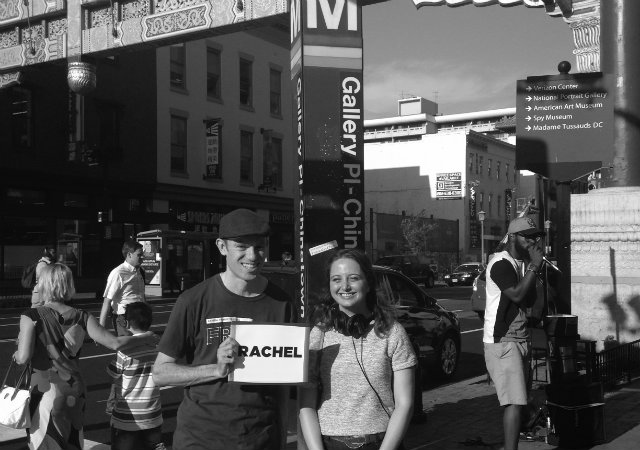 Brian Feldman with the author.
By DCist Contributor Rachel Kurzius
“Is there anything you won’t do?” I ask Brian Feldman at the beginning of our two hours as best friends.
“Well, I’m not going to moon anyone,” he says as we walk through Chinatown. That’s odd, I tell him, because I saw his derriere less than 24 hours before.
“That wasn’t me,” he insists. “That was txt.”
As an increasing number of Washingtonians have come to discover, the Deanwood-based Feldman specializes in the kind of conceptual art that blurs the line between performance and persona. That day, I was attending, or perhaps collaborating on, a show he calls #BFFDC.
We meet at 6 p.m. by the Chinatown Friendship Arch. He shows up in a Capital Fringe shirt with a sign bearing my name, as if he were a driver picking me up at the airport. For the $30 ticket price, Feldman would do nearly anything I wanted—go to a museum, ride bikes, eat, visit sentimental locations, or go to a movie. But he won’t show me his butt.
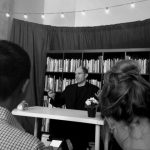
I don’t press the issue, having already gotten my fill the previous night when I attended txt. In that show, now the longest-running independent show in D.C. theater history, Feldman wears a blazer and sits on a small stage with a phone in front of him, at the American Poetry Museum in Brookland. Audience members each receive an anonymous Twitter account so they can send 140-character missives that he reads verbatim on the stage. If no one is tweeting, Feldman will wait.
Feldman had generously offered me two extra invitations to the show, and I felt nervous that the three of us would be the only ones there, meaning we’d be responsible for choosing between creating an hour’s-worth of tweets or sitting in silence. (As a Siri-like voice reminds you when the show begins, “If you do not like the show it will be obviously 50 percent your fault.”) My fears never came to fruition—the 17 seats were nearly all filled.
No matter what people tweet, Feldman reads it out loud with the kind of gravitas generally reserved for the famous “Once more unto the breach” speech from Shakespeare’s Henry V (I should know—I tweeted part of it during the show and Feldman read it as expected). “I can’t believe you took me to this thing on our first date,” one person types in, and Feldman recites it with equal bravado.
Someone in the audience is trying to get Feldman to do things rather than say them. “Take off your jacket,” he reads from his phone, but the jacket stays on. We’ve already seen him do a dance resembling the Macarena, presumably because someone compelled him to via Twitter. Some audience members have figured out how to command him. In effect, they’ve leveled up and opened a new frontier in the show. Using this secret format, an audience member gets Feldman to bear his booty.
After, he reads a series of texts responding to it:
“#butt”
“#hairytushalert“
“I don’t feel safe looking up at the stage”
It’s like a livestream at a conference, with everyone responding in real time to whatever is happening. With all of the thematic links between the tweets, it’s sometimes tough to believe that Feldman isn’t reading them out of order to emphasize the relatedness of some of the topics. He swears that he reads them as he receives them.
During #BFFDC, my new best friend thinks that I’m the one who got him to moon the audience. “I never want to know if it was you,” he tells me unprompted.
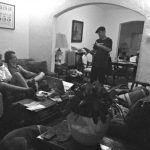
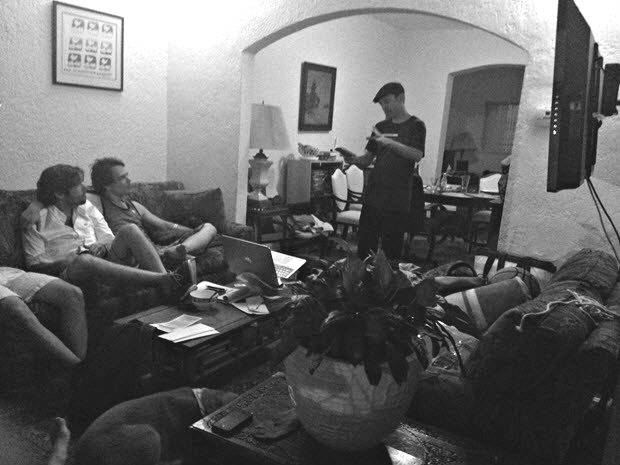 Feldman performs his final Dishwasher performance of the run at a group house in Petworth. (Photo by Rachel Kurzius)
When Feldman and I first meet for #BFFDC, I am open to his suggestions about how we should spend our time together. What is friendship if not flexible? He wants to go to Bed Bath and Beyond and weigh himself, because he said a friend told him he was looking too skinny.
We find the most expensive scale in the shop and Feldman hops on it. He weighs 128.5 pounds, meaning he has lost seven pounds in a month. For an already slim guy like Feldman, that’s a lot of weight. His loose pants are practically hanging off of him. He attributes it to all the hustling he’s been doing.
July was a particularly busy month. In addition to #BFFDC on a daily basis and continuing txt on Sundays, he also participated in Capital Fringe with a show called Dishwasher. It was a play in two acts, performed in the audience’s house. Unlike #BFFDC, the audience can be larger than one person.
For the first act, Feldman washes your dishes. You can watch him or you can spend that time catching up on emails, clipping your toenails, or doing whatever else your heart desires. He says the longest he spent washing was for the people at The Washington Post, where he stayed at the sink for an hour and a half as his audience members piled more and more dishes on top.
Once he dispenses with the dishes, he performs a monologue of your choosing. That’s Act Two. At the end, he asks the audience whether he’s a better dishwasher or actor.
The show proved extremely popular, and earned an extended run. I go with Feldman to the last of these performances (“extra innings,” as he calls them) at a group house in Petworth as our #BFF time is drawing to a close. In the cab, he asks me to put on my seatbelt just like a friend would.
There are five men in their twenties waiting for Feldman. “This is like the coolest thing ever,” one of them says. They’re finishing up dinner and their plates are still at the table.
They want to skip the whole dishwashing part and go straight to the monologue, but Feldman insists on following the planned structure. He gathers the plates from the table and gets to washing.
While he’s at the sink, the audience is doing a variety of things—engaging in small talk with me, leafing through a portfolio Feldman brought along, interacting with one of three dogs, calling up a girlfriend on Skype from St. Thomas so she can hear the monologue. While they’re hesitant at first to have Feldman doing their dishes, they quickly become comfortable with it.
“Can you get the French press while you’re at it?” one of them asks, as the dishes make their way to the dryer. Feldman abides.
“Act One is done,” Feldman announces, to much applause. For Act Two, the residents give him The Map of the System of Human Knowledge, by James Tadd Adcox, a small book of prose poetry they describe as “absurdist” and “obscure.”
Feldman stands in front of the living room to read the entry as the five men, three dogs, and Skyped-in woman watch. Their downstairs temporarily becomes a poetry salon of sorts. He’s gesturing, he’s articulating, and his audience looks impressed.
When Feldman finishes the reading, he asks the crew to compare his acting to his dishwashing. Their conclusion? “A satisfactory job with dishwashing, but top-notch acting.”
They give him his own copy of The Map of the System of Human Knowledge.
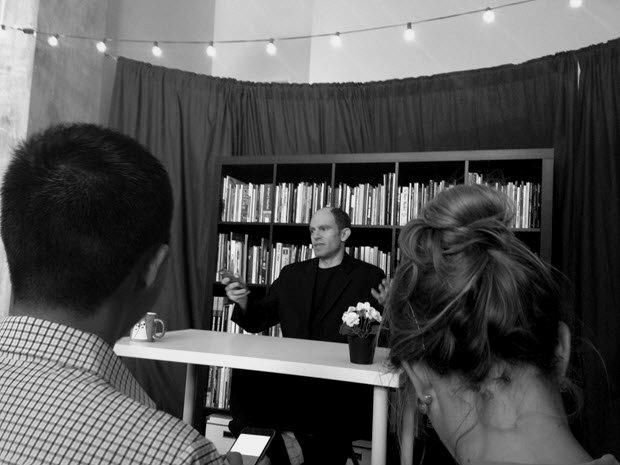 Feldman reads tweets on stage in txt. (Photo by Rachel Kurzius)
At Whole Foods, I ask Feldman whether he sees Dishwasher as part of the sharing economy, like Uber, but for dishwashing and reading dramatic monologues. He doesn’t.
He wants to motivate people to see theater, even if that means going to their houses and performing chores for them or otherwise challenging what it means to “see theater.”
“Netflix is my competition,” he tells me. He claims that he only sees movies at the cinema and does not watch any television.
His leaning toward time-based art began out of what he describes as a frustration over traditional performance. “Doing the same thing night after night gets rote,” Feldman says. “It’s a little terrifying and fear is a driving force. Fear of the unknown is exciting.”
His parents, and frequent collaborators, say that Feldman has always loved performing.
“Back in elementary school, it appeared that he enjoyed being on the stage,” his mother Marilyn Wattnan-Feldman tells me over the phone. “As a result of being introduced to Shakespeare, he learned that [the Orlando Shakespeare Festival] was doing auditions. I drove him down and he nailed it. He was around ten years old.”
His father, Edward Feldman, says it started even earlier. “From the minute Brian popped out, right from the start it was, ‘Here’s my little performer.’” The elder Feldman also works with his son on poster design.
The Feldmans have performed with their son in a number of performances, including The Feldman Dynamic, where the entire Feldman family (Brian, his parents, and sister) all eat dinner together on-stage in front of a paying audience, which Brian describes as, “anti-reality TV.”
“Brian pitched the idea to us for for years and I ignored him,” Wattnan-Feldman says. “I was terrified by the idea of going onstage. I overcame some of that fear in college, but it took a diagnosis of cancer for me to have something else to fear.”
Wattnan-Feldman and her son also worked together on 24 Minute Embrace, performed on Mother’s Day of this year. The two of them embraced for 24 minutes in three cities—Orlando, Washington, D.C. and Philadelphia—all on the same day.
This followed a 2011 hugging project between father and son called 24 Hour Embrace, where they hugged all of Father’s Day in a boxing ring. “That was really fun, actually,” Edward Feldman says.
When #BFFDC debuted at the Capital Fringe Festival back in 2012, the show had a problem-shooting raison d’être. Feldman had just moved from Orlando (for a relationship, which has since ended) and was looking for friends.
All three of the performances— txt, #BFFDC, and Dishwasher—depend entirely upon his interaction with the audience. Ultimately they reveal more about the people seeing the show than they do Feldman.
He admitted to me that he has had funnier, more engaging audiences during txt than mine, which focused a lot on song lyrics and pick-up lines. One particular fascination during the performance I saw? A man with “luxurious curls” sitting in the front row.
One person tweeted about his hair, and it snowballed from there. Feldman read aloud ridicule of the curly-haired man’s necklace and flip flops, and speculation about his sex life, as well as vigorous defenses of his fashion choices and conspiracy theories that he was the one tweeting about himself.
Feldman says that someone gets picked on just about every show, though they could be sitting just about anywhere. It’s odd for the mob mentality of cyber bullying to meet with the knowledge that someone sitting within ten feet of you is the culprit. Audience members were eying one another in a way I’ve never seen in a theater setting.
The one-on-one of #BFFDC leaves room for no such interaction. In many ways, that show is like going on a platonic Tinder date. It’s low-key, though the knowledge that this is performance, this is art, hangs over the proceedings. I am also aware that he knows I am observing him to write about the experience (I wonder, for instance, if he weighed himself in front of me to create the kind of anecdote that would fit well in a profile piece).
Ultimately, is the performance that Feldman and I are putting on any different from the roles we play when we interact with anyone?
Feldman tells me that I’m the first journalist to see the show who identified myself beforehand. In describing reading one such surprise review, he says, “I had no idea she felt that way…she must have been acting.” He seems to sense no irony in feeling hurt that, during a performance, someone else was acting.
I followed up with him later about this, once we are no longer on the clock as #BFFs and thus (theoretically) not interacting as part of a performance.
“Honestly, I am trying to be as truthful as possible,” he tells me.
Right after that, I ask a question about his vague reference to a day job while he was shoveling food into his mouth at Whole Foods.
“I rarely talk about money jobs,” he says. He demurs as I pepper him with more questions. “I’m sorry to be so vague. I have friends who don’t need these kinds of jobs to support themselves and it makes me angry.”
Whatever Feldman does to pay the bills, it’s clear that he isn’t depending on his performances to supplement his income. Our cab ride up to Petworth cost nearly the full ticket price for Dishwasher, for instance. He also spends freely during #BFFDC. He tells me that in one formulation of Dishwasher, he wants to pay the audience to come to his house and perform a monologue of his choosing.
txt and #BFFDC will both continue their runs through the end of 2015, and Feldman is taking Dishwasher on the road to Fringe Festivals in Philadelphia and Baltimore. For the Philly show, he plans on taking the bus there and back for each performance.
How does he have time for all of this? Feldman says he saves a lot of time by not drinking alcohol, even if that makes it awkward when people present him with drinks during Dishwasher performances (we were both offered beer during the performance I saw—we both declined).
Staying sober doesn’t explain all of it, though. I know plenty of straight-edge people who don’t manage to fit in multiple performances a day. And it’s not just the shows themselves. Feldman needs to correspond with his audience to work out the times and locations for Dishwasher performances.
“I wish I could bottle his energy and inject it into me,” his mom Marilyn Wattnan-Feldman says.
Two days after our time as best friends, I get a small package in the mail at work. My name is printed neatly in all-caps. The return address lists Brian Feldman. I open it and at first it seems empty. Turning it upside-down, a small pin falls out. It says “BFF.”